



1573 products
Sort by:
1573 products


Product Type: Fluorite
Approx Weight (per piece): 12.46 Ct.
Size: 18.5x12 mm
Shape: Carved Cabochon
Color: Multi-Color Green, purple
Clarity: Opaque
Origin: Brazil
Fluorite comes in many colors. Deep purple (it's most famous), sky blue, sea green, sunny yellow, and crystal clear. There are rarer colors of pink, reddish orange (rose) and even black. Fluorite is very attractive and in demand. It is easy to see why fluorite earns the reputation as "The Most Colorful Mineral in the World".
Because Fluorite comes in a wide range of colours, it is often said that it contains something of all other gemstones in it. According to folklore, it is the home of rainbows.
Fluorite is said to increase concentration and foster mental balance. Nicknamed the "genius stone" fluorite is believed to be excellent for study and work areas. It helps the mind stay focused on the task at hand.


This is a beautiful cluster of intergrown pyrite and tetrahedrite. When these two minerals form in the same location, they create interesting clusters where the sharp, cubic crystals of pyrite contrast with the more blocky, tetrahedral crystals of tetrahedrite. The contrast in their appearance is striking.
Pyrite is known for its ability to shield against negativity, boost confidence, and attract prosperity, while tetrahedrite promotes emotional healing, spiritual connection, and inner balance. Together, this cluster is believed to help manifest success, encourage personal growth, and maintain focus and clarity.
This top specimen is in very good condition. Would be a beautiful addition to any new or existing collection.
Name: Cubic Pyrite and Tetrahedrite Crystal Cluster
Specimen Size: Cabinet-Sized
Dimensions: 66x51x22 mm / 2.6x2x.9 inches
Weight: 117 Grams / 4.1 oz
Origin: Mined in Peru


This beautiful cluster of tetrahedrite with calcite, small terminated quartz crystals and tiny flecks of pyrite.
Tetrahedrite crystals are fascinating minerals known for their distinctive tetrahedral shape and shiny, metallic luster. It typically forms in well-defined tetrahedral crystals, which can be grouped in clusters. The color range includes shades of metallic gray, black, and sometimes reddish hues due to the presence of copper and other trace elements. Tetrahedrite is commonly found in hydrothermal veins and is often associated with other minerals such as quartz, galena, and sphalerite.
Tetrahedrite is believed to promote emotional healing and provide a protective shield against negativity. It is thought to enhance creativity and clarity, helping individuals connect with their inner selves.
This top specimen is in very good condition. Would be a beautiful addition to any new or existing collection.
Name: Tetrahedrite, Calcite and Quartz Crystal Cluster
Specimen Size: Miniature-Sized
Dimensions: 56x47x23 mm / 2.2x1.9x0.9 inches
Weight: 59.20 Grams / 2.1 oz
Origin: Mined in Peru


Approx Weight (per piece): 49.54ct
Size: 24x22mm
Shape: Baguette Cabochon
Color: White with Silver Spots
Clarity: Transparent
Origin: Brazil
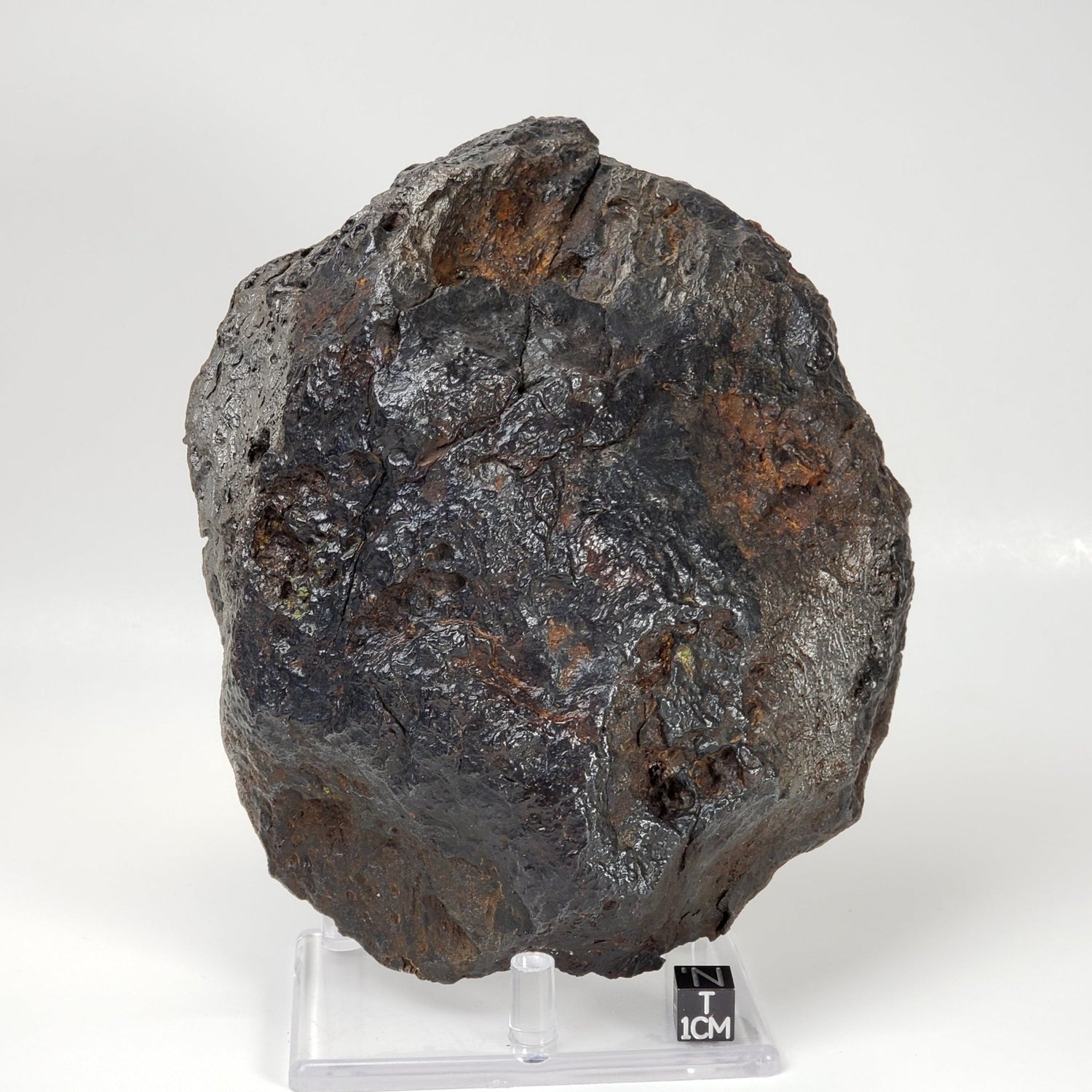
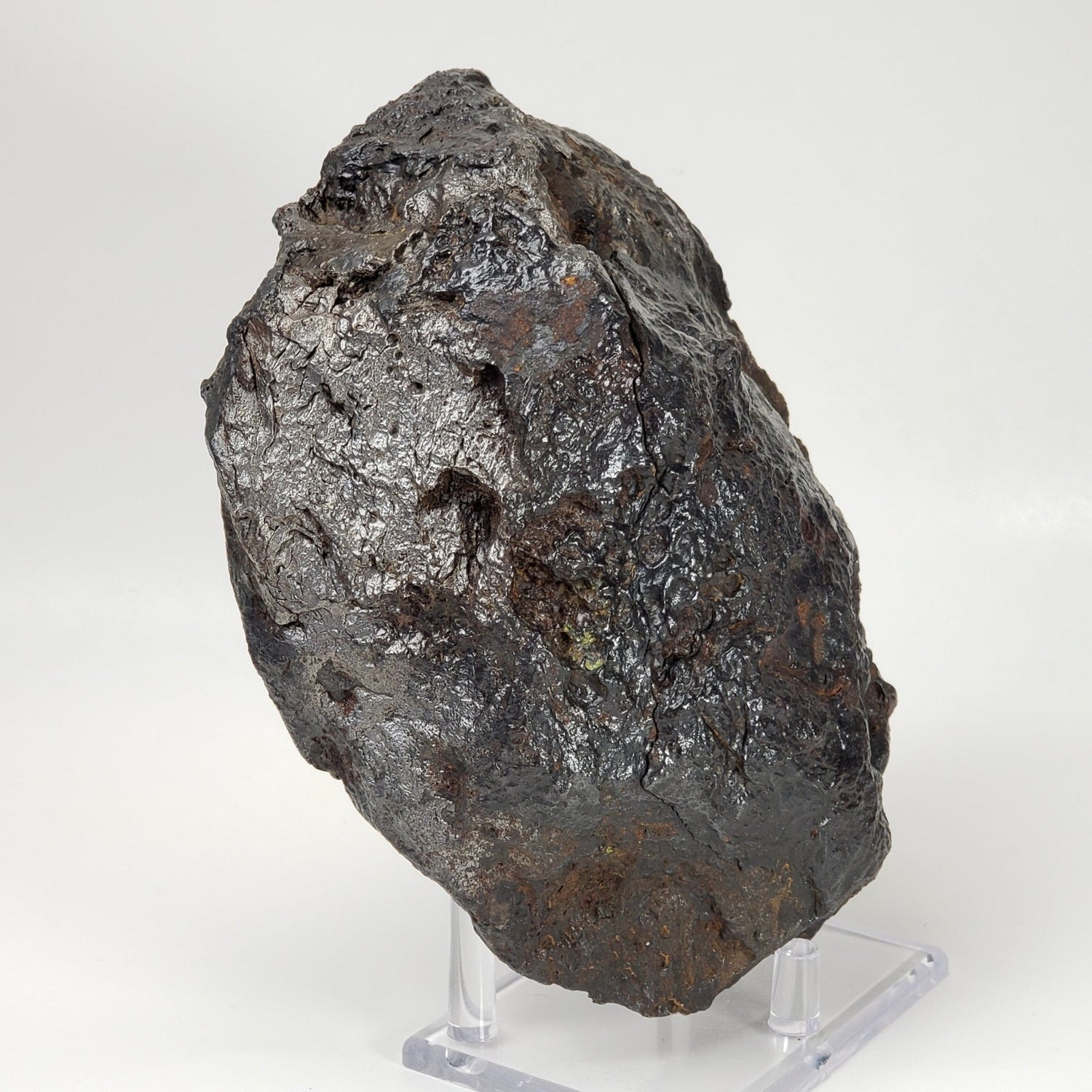
Nantan Meteorite | 4.2 KG | Rare Large Specimen | IAB-MG Iron | Guangxi China
This is a great looking 4.2 Kg (9.2 lbs) Nantan meteorite individual directly from Guangxi, China. Its dimensions are 17x15x7.5 cm (6.7x6x3 inches).
The Nantan meteorites are a must for all collectors, more so that it is now very difficult to find worthy specimen. They are a very interesting IAB-MG iron discovered in 1958 and there is an estimated 9.5 T of this material. This is 1 of 88 approved meteorites classified as Iron, IAB-MG.
Would be a beautiful addition to any new or existing collection. Comes with a Canagem Collection specimen card.


Gyrolite often forms nodular aggregates that can appear glassy, dull or even fibrous. The aggregate nodules often accompany many fine and rare minerals such as Apophyllite and Okenite plus many of the Zeolites.
Calcite is found throughout the world in sedimentary, metamorphic, and igneous rocks. Some geologists consider it to be a "ubiquitous mineral" - one that is found everywhere. Calcite is the principal constituent of limestone and marble.
Name: Gyrolite and Calcite on Quartz Matrix Cluster Crystal
Specimen Size: Cabinet-Sized
Dimensions: 95x57x57 mm / 3.75x2.25x2.25 inches
Weight: 240 Grams / 8.5 Ounces
Origin: Mined in Dindoshi, India


Product Type: Tourmaline
Approx Weight (per piece): 5.52ct
Size: 31.8x4.8x3.6mm
Shape: Baguette Cut
Color: Dark Sea Green
Clarity: Clean to the eye
Origin: Africa
Treatment: None


These beautiful Rose Quartz stones, from Madagascar, are polished on one side. Rose quartz has been revered by ancient civilizations for its symbolic connection to love and harmony. Often referred to as the "stone of love," rose quartz is believed to attract and nurture love in all its forms, from self-love and friendship to romantic relationships. Its gentle energy is also associated with the heart chakra, promoting emotional balance, forgiveness, and compassion.
The weight and dimensions of the pieces are as follows:
A - 53x46x23 mm / 2.1x1.8x0.9 in | 80.1 gr / 2.8 oz
B - 56x40x18 mm / 2.2x1.6x0.7 in | 59.1 gr / 2.1 oz
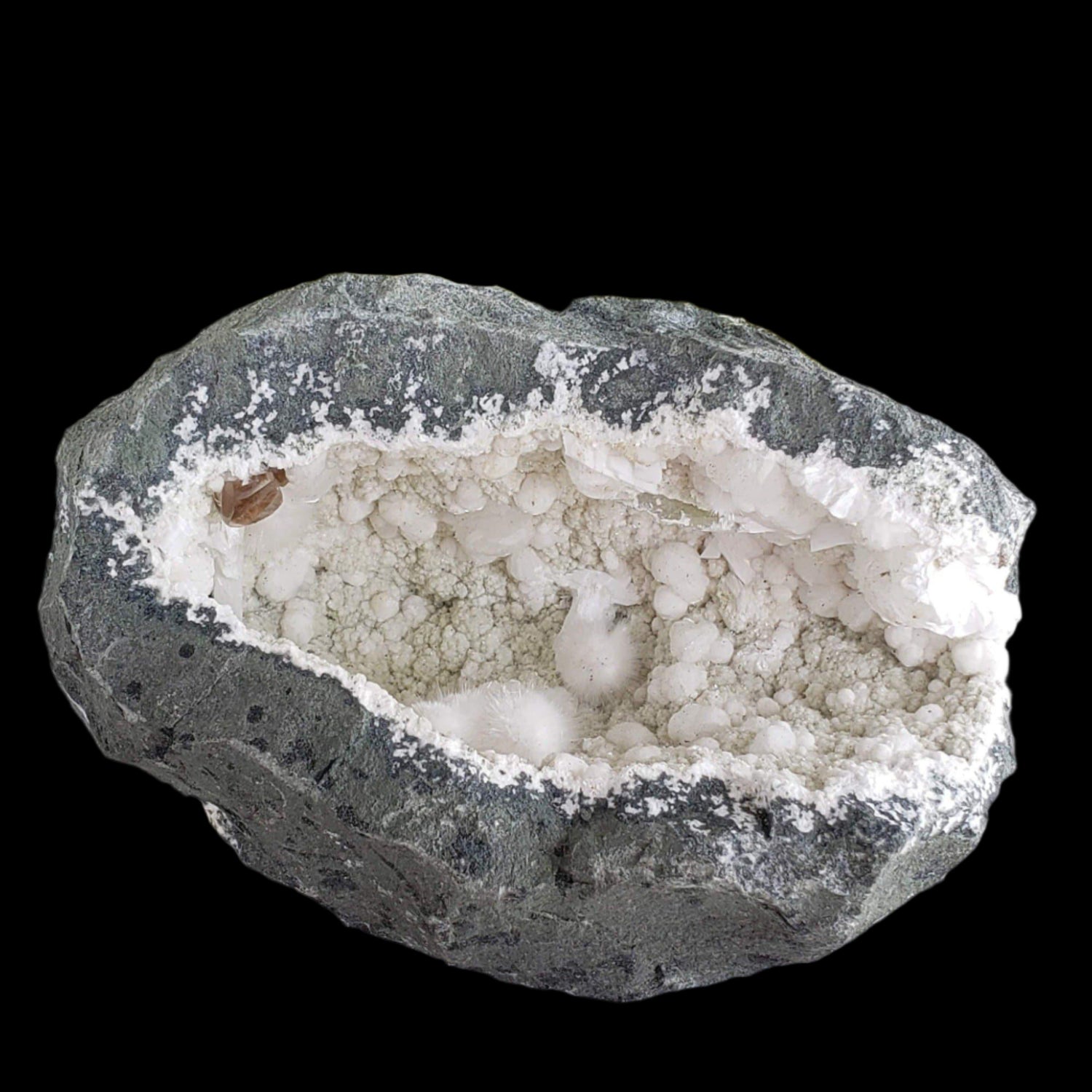
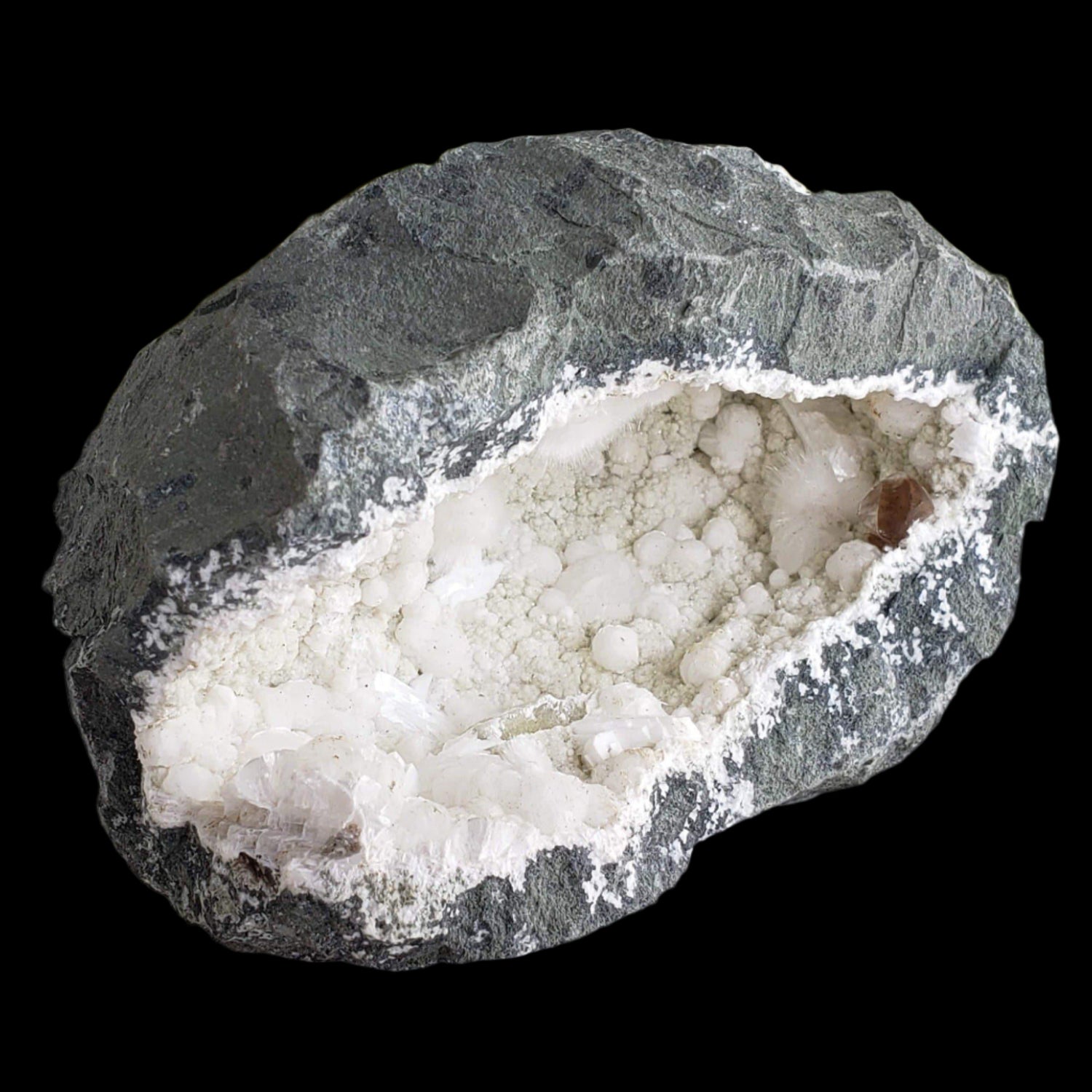
Okenite is a silicate mineral that is usually associated with zeolites. It most commonly is found as small white "cotton ball" formations within basalt geodes. These formations are clusters of straight, radiating, fibrous crystals that are both bendable and fragile.
Calcite is found throughout the world in sedimentary, metamorphic, and igneous rocks. Some geologists consider it to be a "ubiquitous mineral" - one that is found everywhere. Calcite is the principal constituent of limestone and marble.
Quartz crystals are among the most abundant and well-known minerals on Earth. It belongs to the hexagonal crystal system, and typically forms six-sided prismatic crystals with a pointed termination. Its crystals can be colorless or exhibit a wide range of colors. The color variations are often due to the presence of impurities or trace elements during the crystal's formation. Quartz is transparent to translucent.
Prehnite can form prismatic, tabular, or pyramidal crystals, but usually occurs in botryoidal, reniform, stalactitic, granular, or compact habits. It is usually green in colour, but may be white, colourless, yellow, or gray. It has a colourless streak. Prehnite is transparent to translucent, with a vitreous to pearly luster. Prehnite forms in cavities in basaltic lavas.
Name: Okenite, Calcite, Quartz and Prehnite Geode
Specimen Size: Large Cabinet-Sized
Dimensions: 120.7x88.9x76.2 mm / 4.75x3.5x3 inches
Weight: 796 Grams / 28.1 ounces
Origin: Mined in Dindoshi, India


Here we have for you a nice looking end cut of a Sahara Desert NWA unclassified meteorite weighing 147.64 grams. Its dimensions are 41x38x49mm. This never classified North West Africa stone was found in the Sahara desert around 2000.
It's a good quality cut NWA meteorite specimens showing interesting internal structure (L5?) and somewhat attractive with a mottled interior with chondrules and metallic flakes. Some weathering shows the meteorite's time spent aging in the desert. Displays nicely with a ground and rough polished without a mirror finish.
Would be a beautiful addition to any new or existing collection. Comes with a Canagem Collection specimen card.

Canagem is proud to be professional member of The International Gem Society(IGS) the world's top resource for gem professionals, enthusiasts, and industry content.