



1573 products
Sort by:
1573 products


This is a 6 piece lot of natural included quartz points. The combined weight of the lot is 39.3 grams and they measure between 24-30mm.
Quartz crystals are among the most abundant and well-known minerals on Earth. It belongs to the hexagonal crystal system, and typically forms six-sided prismatic crystals with a pointed termination. Its crystals can be colorless or exhibit a wide range of colors. The color variations are often due to the presence of impurities or trace elements during the crystal's formation. Quartz is transparent to translucent.
Quartz is considered a “master healer.” It's said to amplify energy by absorbing, storing, releasing, and regulating it. It's also said to aid concentration and memory. Physically, clear crystals are claimed to help stimulate the immune system and balance out your entire body.
Quartz is also said to be a power gemstone that harmonizes and balances; enhancing energy and thoughts as well as purifying the spiritual, mental and physical. Quartz is associated with the crown chakra.


You will receive one of the pictured selenite sticks. Selenite is thought to be a calming stone that instills deep peace and is excellent for meditation. It has an ethereal quality and is said to inhabit the place between light and matter. It is also believed that Selenite can be used to form a protective grid around a house, creating a safe and quiet space that does not allow outside influences in. Although an ancient stone, it is still one of the most powerful crystals.
Name: Selenite Satin Spar Stick
Specimen Size: Cabinet -Sized
Dimensions: 62x14x14 mm / 2.4x0.5x0.5 inches
Weight: 23 - 29 Grams / 0.8 - 1.0 oz


Here we have for you a large 56.6 gram superbly shaped Indochinite Tektite from Maoming City, Guangdong Province, China. It measures 60x29x28 mm. Although not a meteorite, tektite is directly linked to them or their impacts, just consider its age of around 780,000 years old.
Tektite can still be interesting because of the persistent mystery has that resisted clear explanations of their creation for generations of geologists.
This piece displays very well and is a very nice size showing multiple characteristics of its origin. It is a perfect elongated shape with a beautiful pitted body. Would be a beautiful addition to any new or existing collection. Comes with a Canagem Collection specimen card.
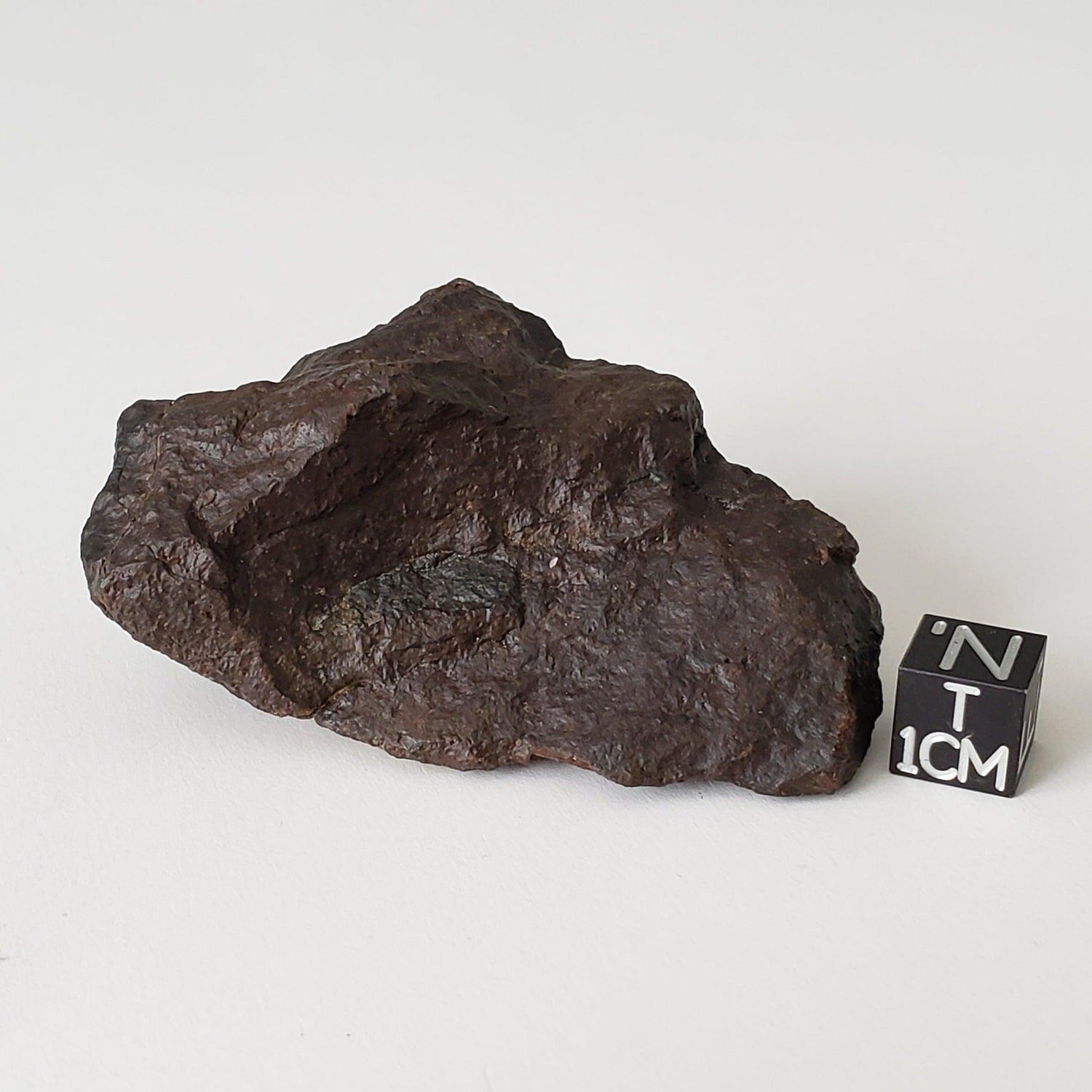
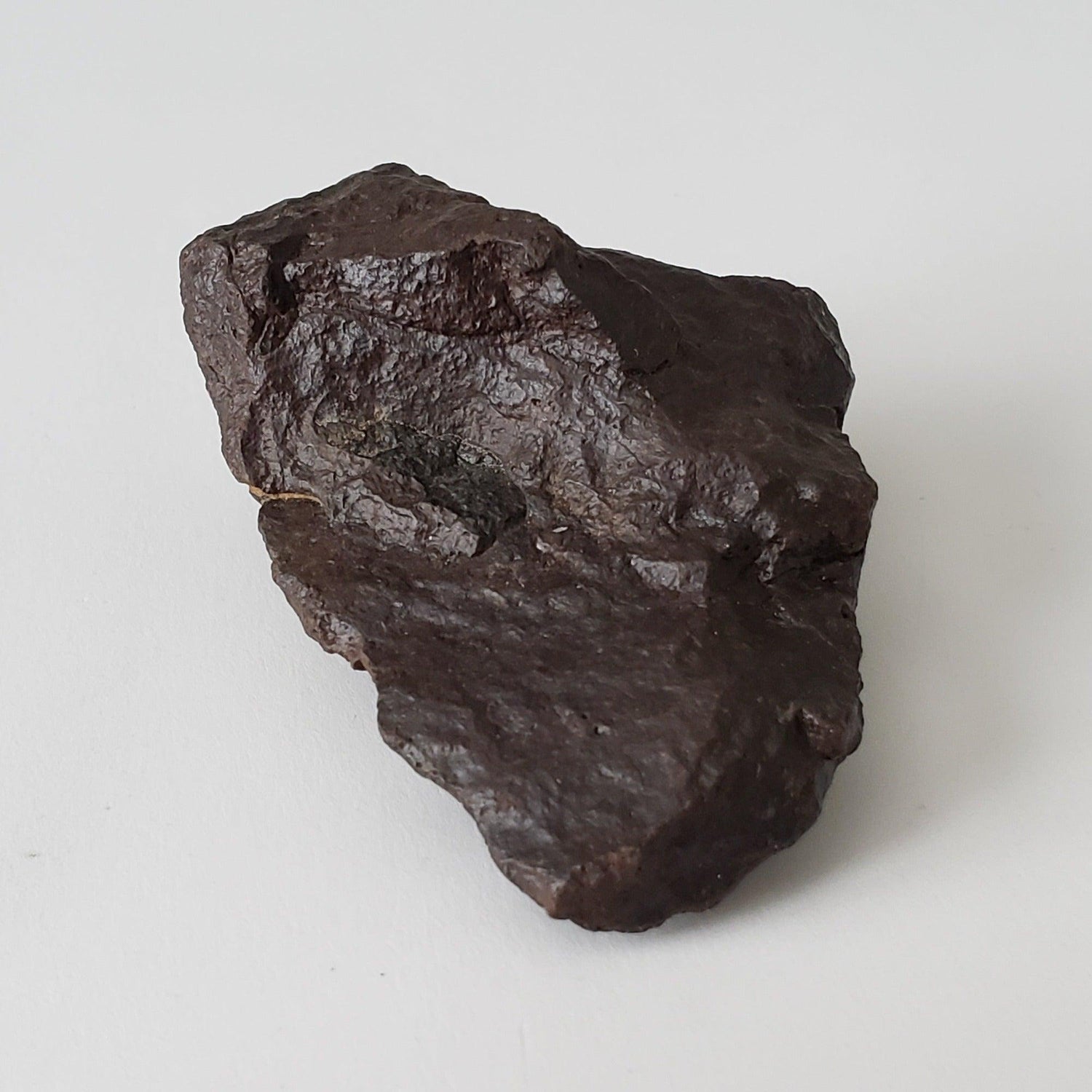
Here we have for you a superb looking Dhofar 020 classified meteorite weighing 103.75 grams. Its dimensions are 67x49x32 mm. Found 10 March 2000 in Dhofar, Oman, in the Arabian Peninsula this H4/5 classified chondrite has a TKW of 256 Kg with a shock stage of S4 and weathering grade of W3 by the Russian Academy of Sciences, USSR.
The following is an excerpt from Mark Bostick's review of this meteorite: "Dhofar 020 is a ordinary stone chondrite meteorite. The meteorite is high in free metal and therefore falls in the H class. S4 tells it is highly shocked. Slices of the meteorite, show veins of the cosmic impact created mineral Ringwoodite, although fractures in the stone tend to hide this some. It almost appears to me to have splinted upon impact. The meteorite falls in 4-5 petrology class, a reference to how metamorphed the meteorite is from its original state. This is judged by studying a thin section of the meteorite, most visually at the chondrules, a feature unique to stone meteorite. In a thin section under polarized light, pyroxene chondrules seem more common then their olivine pair. Still some regions in the meteorite show scattered patches of bright olivine inclusions. These are fairly rare, at least on my thin section, and most of the meteorite's olivine and pyroxene, some of the easier things to see in a thin section, appear to have went through a metamorphism, and have "melted" into the matrix and are at times undistinguishable."
This piece displays extremely well showing a beautiful crust, superb shape and good size. Would be a beautiful addition to any new or existing collection. Comes with a Canagem Collection specimen card.


This is a fabulous specimen of Black kyanite and quartz mined in Marilac, Safira pegmatite district, Eastern Brazilian pegmatite province, Minas Gerais, Brazil. The specimen will sit perfectly flat to allow easy display in a favorable position.
Kyanite is a silicate mineral and is known to be one of the most attractive natural minerals in the world, frequently found with lustrous bladed crystals, with the intensity of color varying by location of extraction. Kyanite regularly forms fibrous, radiating crystals, as well as flattened and tabular. Some crystals form with white striations, color bands, and even multi-colored crystals, though typically found with a deep blue streak running down the middle.
Name: Kyanite and Quartz Crystal
Specimen Size: Cabinet-Sized
Dimensions: 92x48x25 mm / 3.6x1.9x1inches
Weight: 104.36 grams / 3.7 Ounces
Origin: Safira pegmatite district, Eastern Brazilian pegmatite province, Minas Gerais, Brazil


The Lead–Zinc deposits of Madan Ore Field (Southwest Rhodopy Mountains) were operated by the Turks in the Middle Ages. Greek coins from Tassos island dating from 14th century AD, have been found in the ancient galleries. As well, the name of the Madan field, which in Turkish means Ore, originates from that time.
The Madan Ore Field is built up mainly of the highly crystalline rocks of the lower (Ar) and upper (Pt) metamorphic units which form the Madan dome structure. The Lead–Zinc deposits of the Madan Ore Field are represented by: 1. Ore veins of Quartz–Carbonate–Sulphide composition, and 2. Metasomatic scarn deposits of Johannsenite–Rhodonite or Quartz–Sulphide composition.
This top specimen is in very good condition. Would be a beautiful addition to any new or existing collection.
Name: Quartz Galena Crystal Cluster
Specimen Size: Cabinet-Sized
Dimensions: 62x36x24 mm / 2.4x1.4x0.9 inches
Weight: 59 Grams / 2.1 oz
Origin: Mined in Mogila, Madan, Bulgaria


Awesome variscite ball on quartz matrix with good luster. From a rare location Wiśniówka Wielka in Poland. Wisniowka is a village located near Kielce in Holly Cross Mountains. Cambrian quarzite sandstones occur there. Trace fossils of trilobite Olenus rarus Orlovskii as well as Diplocraterion and Bergaueria perata can be found in this area. Wiśniówka Wielka is also a well known locality of beautiful crystals of Variscite and Wavellite
This is a quality specimen and would be a beautiful addition to any new or existing rock collection.
Name: Variscite and Quartz
Specimen Size: Miniature-Sized
Dimensions: 47x42x21 mm / 1.8x1.6x0.8 inches
Weight: 38 grams / 1.3 oz
Origin: Wiśniówka Wielka, Kielce County, Świętokrzyskie Voivodeship, Poland


Microcline is one of the most common feldspar minerals. It can be colorless, white, cream to pale yellow, salmon pink to red, or bright green to blue-green. Microcline forms short prismatic or tabular crystals that are often of considerable size: single crystals can weigh several tons and reach yards in length. Crystals are often multiply twinned, with two sets of fine lines at right angles to each other. This gives a plaid effect that is unique to microcline among the feldspars. The nice patch of Quartz crystals makes this a spectacular piece.
This is a quality specimen that would be a beautiful addition to any new or existing rock collection.
Name: Microcline and Quartz
Specimen Size: Cabinet-Sized
Dimensions: 67x55x28 mm / 2.6x2.2x1.1 inches
Weight: 116 grams / 4.1 oz
Origin: Czarne - Poland


Cubic and crystallized pyrite matrix with calcite crystal cluster. This top Peruvian specimen is in very good condition. Would be a beautiful addition to any new or existing collection.
Name: Pyrite with Calcite Crystal Cluster
Specimen Size: Miniature-Sized
Dimensions: 51x40x19 mm / 2x1.6x0.7 inches
Weight: 60.2 Grams / 2.1 oz
Origin: Mined in Peru
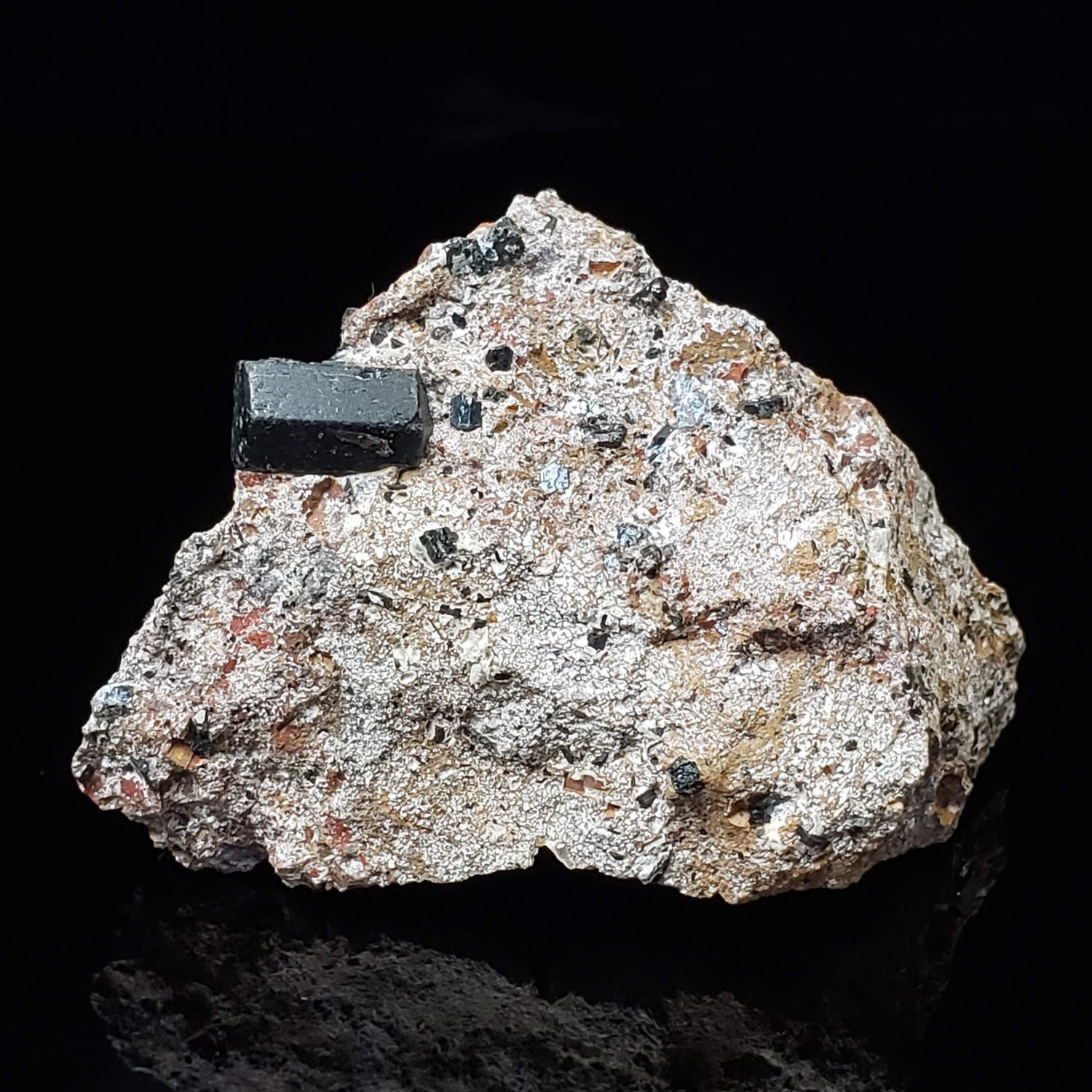
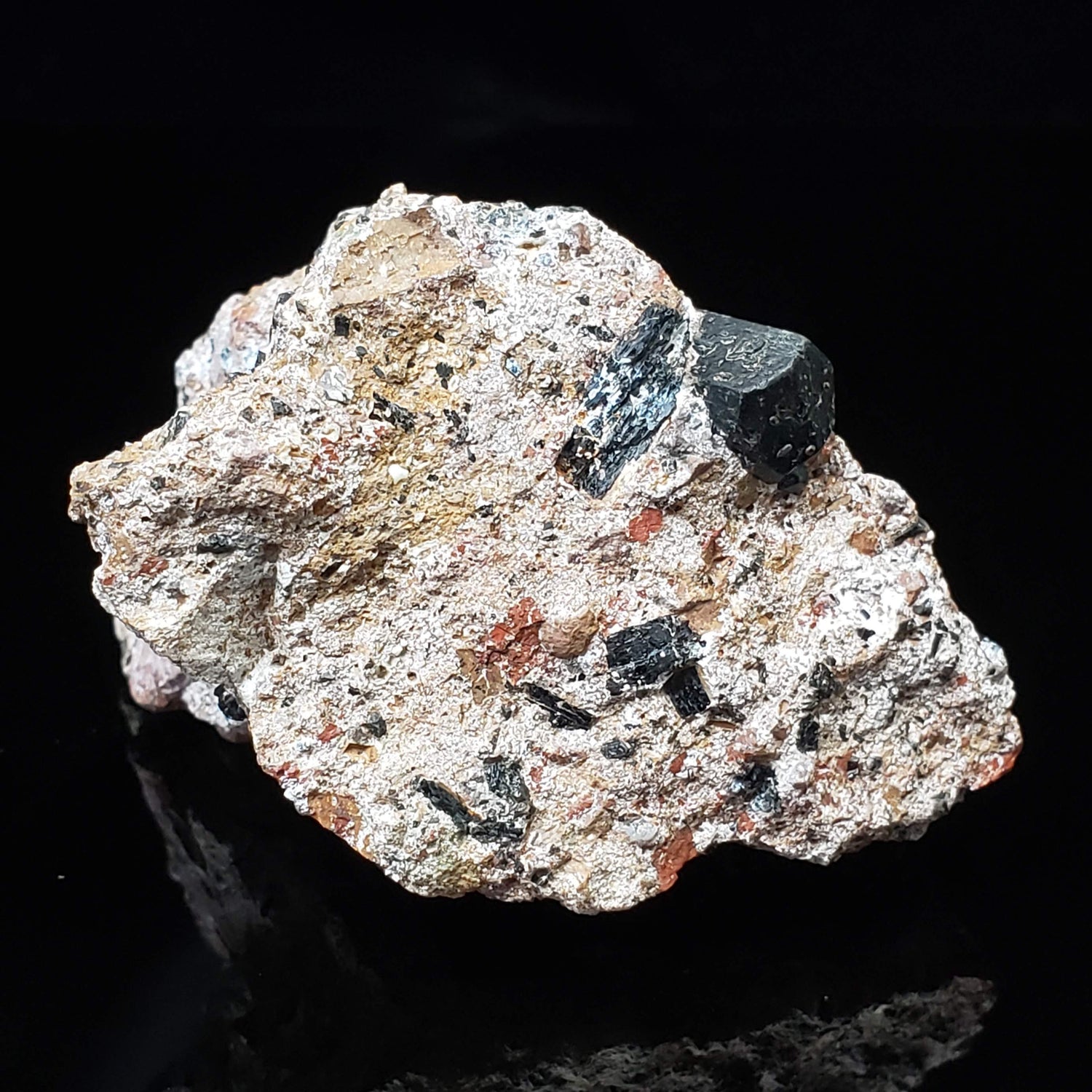
Amphibole is a group of dark-colored, complex silicate minerals that form in a variety of geological settings. The amphibole group includes several mineral species, such as hornblende, tremolite, actinolite, anthophyllite, and others. Each variety has its own unique chemical composition and physical properties.
Amphibole minerals can exhibit a range of colors, including dark green, black, brown, and even colorless. They often have a prismatic crystal habit, forming elongated crystals with distinct cleavage angles. They are commonly found in igneous and metamorphic rocks. They crystallize in magma and can also form during metamorphism when pre-existing rocks are subjected to high pressure and temperature.
This top specimen is in very good condition. Would be a beautiful addition to any new or existing collection.
Name: Amphibole on Matrix Crystal
Specimen Size: Miniature-Sized
Dimensions: 52x49x35 mm / 2x1.9x1.4 inches / Crystal is 11 mm
Weight: 63.44 Grams / 2.2 oz
Origin: Mined in Czech Republic

Canagem is proud to be professional member of The International Gem Society(IGS) the world's top resource for gem professionals, enthusiasts, and industry content.