

📢 Notice to ALL Customers 📢
48 products
Sort by:
48 products
48 products


This is a fantastic crusted 4.5 grams NWA (Northwest Africa) 869 L3-6 classified meteorite Individual found by Nomads in the Sahara Desert. The dimensions of the specimen are 18x13x12 mm.
NWA 869 classified meteorites can still be interesting and this one is for sure perfectly shaped to catch your attention. It displays a superb crust on most of its surface. Most samples are individual meteorites but some fragments (mostly >1 kg) also occur. In most cases the fusion crust has been polished or ablated by wind erosion. Many samples are more severely affected and show faces with deep wind erosion features. Fracture faces, formed by ground collision, show a typical gray-green color and sometimes visible brecciation (light and/or dark clasts).
Would be a beautiful addition to any new or existing collection. Comes with a Canagem Collection specimen card.


This is a micro of the Canyon Diablo classified meteorite. This Iron (IAB-MG) classified meteorite was found in Arizona in 1891. So far approximately 30 T of this material have been recovered.
The crater it formed is world famous and is known as Meteor Crater. It is an Arizona Meteorite and one that is a must have for any collection. The Canyon Diablo has been closed to hunting for many years so these pieces are becoming more difficult to acquire and this is a good time to get a fine specimen.
Would make a beautiful addition to any new or existing collection. Comes in a gem jar with a Canagem Collection specimen card.


This is a 0.95 gram grouping of micros of the Russian Sikhote-Alin classified meteorite. This Iron (IIAB) Coarsest Octahedrite classified meteorite was recovered in Russia after the fall of February 12, 1947.
So far approximately 23 tons of this material have been recovered. This piece displays extremely well and is a very desirable size. These specimens are known as shrapnel specimens, ripped and torn edges reminiscent of bomb shrapnel. They broke due to atmospheric pressure and/or mid-air collisions, and possibly explosive fragmentation upon impact. These pieces are a good example of the shrapnel type Sikhote-Alin.
Would be a beautiful addition to any new or existing collection. Comes with a Canagem Collection specimen card.


This is a 0.92 gram grouping of micros of the Russian Sikhote-Alin classified meteorite. This Iron (IIAB) Coarsest Octahedrite classified meteorite was recovered in Russia after the fall of February 12, 1947.
So far approximately 23 tons of this material have been recovered. This piece displays extremely well and is a very desirable size. These specimens are known as shrapnel specimens, ripped and torn edges reminiscent of bomb shrapnel. They broke due to atmospheric pressure and/or mid-air collisions, and possibly explosive fragmentation upon impact. These pieces are a good example of the shrapnel type Sikhote-Alin.
Would be a beautiful addition to any new or existing collection. Comes with a Canagem Collection specimen card.


Discover a piece of history with our Fossil Carcharhinus Gray Shark Teeth. These shark teeth are believed to be from the Carcharhinus species, dating back to the Miocene to Early Pliocene period, approximately ~23 to 5 million years ago. Sourced from the Peace River, Venice Beach Florida, these teeth are approximately .5 to 1 inch in size. Perfect for collectors or those interested in prehistoric relics.
The Carcharinus Genera - or the Gray Sharks are a genus of requiem sharks with over 30 extant species. They are very common and found virtually all over the globe. They feed on a variety of prey, from bony fish, other sharks and rays, and squid.
You will receive 1 of the shark teeth pictured.
Fossil Type: Gray Shark Teeth
Species: Carcharhinus
Age: Miocene to Early Pliocene (~23 - 5 million years)
Location: Peace River, Venice Beach, Florida USA
Size: Approximately .5 to 1 "


This is a Canyon Diablo classified meteorite shale specimen weighing 0.45 grams. Its dimensions are 12x6x2 mm. This Iron (IAB-MG) classified meteorite was found in Arizona in 1891. So far approximately 30 T of this material have been recovered.
The crater it formed is world famous and known as Meteor Crater (also known as "Barringer Meteor Crater"). It is an Arizona Meteorite and one that is a must have for any collection. The Canyon Diablo has been closed to hunting for many years so these pieces are becoming more difficult to acquire and this is a good time to get a fine specimen.
Would make a beautiful addition to any new or existing collection. Will come in a gem jar with a Canagem Collection specimen card.


Heulandite is one of the most common and well known members of the Zeolite Group. It has a nice pearly luster and lovely colored hues. It forms wonderfully complex and quite unique crystals and is often associated with other rare and beautiful minerals.
Green heulandite is a naturally occurring and is prized for its vibrant green color, glassy luster and well-formed tabular crystals. Found primarily in the basalt cavities of the Deccan Traps in Maharashtra, its distinctive green hue is typically caused by microscopic inclusions of the mineral celadonite rather than the heulandite itself. It commonly occurs alongside minerals such as apophyllite and stilbite.
Name: Heulandite cluster Crystal
Specimen Size: Miniature-Sized
Dimensions: 51x28x26 mm / 2.0x1.1x1.0 inches
Weight: 16.23 Grams / 0.5 Ounces
Details: Mined in Jalgaon, Maharashtra, India


Prehnite is a green to yellowish-green colored mineral that belongs to the phyllosilicate family. It is composed of calcium, aluminum, and silicate, with traces of iron, magnesium, and other elements. Prehnite crystals have a unique pearly luster and can form in a variety of shapes, including tabular, prismatic, and stalactitic formations.
Prehnite is believed to have a calming effect on the mind and emotions, promoting relaxation and inner peace. It is also said to be a stone of unconditional love, compassion, and healing.
Name: Prehnite and Graphite Crystal Cluster
Specimen Size: Thumbnail-Sized
Dimensions: 22x20x10 mm / 0.9x0.8x0.4 inches
Weight: 4.5 Grams / 0.16 Ounces
Origin: Mined in Merelani Hills, Arusha, Tanzania


This is a fantastic crusted 4.3 grams NWA (Northwest Africa) 869L3-6 classified meteorite Individual found by Nomads in the Sahara Desert. The dimensions of the specimen are 18x14x14 mm.
NWA 869 classified meteorites can still be interesting and this one is for sure perfectly shaped to catch your attention. It displays a superb crust on most of its surface. Most samples are individual meteorites but some fragments (mostly >1 kg) also occur. In most cases the fusion crust has been polished or ablated by wind erosion. Many samples are more severely affected and show faces with deep wind erosion features. Fracture faces, formed by ground collision, show a typical gray-green color and sometimes visible brecciation (light and/or dark clasts).
Would be a beautiful addition to any new or existing collection. Comes with a Canagem Collection specimen card.


These are Canyon Diablo classified meteorite micros. You will receive one of the specimens pictured, in a gem jar. This Iron (IAB-MG) classified meteorite was found in Arizona in 1891. So far approximately 30 T of this material have been recovered.
The crater it formed is world famous and is known as Meteor Crater. It is an Arizona Meteorite and one that is a must have for any collection. The Canyon Diablo has been closed to hunting for many years so these pieces are becoming more difficult to acquire and this is a good time to get a fine specimen.
Would make a beautiful addition to any new or existing collection. Comes in a gem jar with a Canagem Collection specimen card.


This is a fantastic crusted 3.81 grams NWA (Northwest Africa) 869L3-6 classified meteorite Individual found by Nomads in the Sahara Desert. The dimensions of the specimen are 19x11x14 mm.
NWA 869 classified meteorites can still be interesting and this one is for sure perfectly shaped to catch your attention. It displays a superb crust on most of its surface. Most samples are individual meteorites but some fragments (mostly >1 kg) also occur. In most cases the fusion crust has been polished or ablated by wind erosion. Many samples are more severely affected and show faces with deep wind erosion features. Fracture faces, formed by ground collision, show a typical gray-green color and sometimes visible brecciation (light and/or dark clasts).
Would be a beautiful addition to any new or existing collection. Comes with a Canagem Collection specimen card.


Stilbite is a zeolite mineral appreciated for its delicate crystal formations and pastel hues, ranging from colorless to white, yellow, pink, and peach. It forms distinctive tabular crystals with a bowtie or butterfly shape and exhibits a vitreous to pearly luster. Commonly found in cavities in volcanic rocks, stilbite is often associated with other zeolite minerals.
Stilbite is believed to have soothing and spiritually uplifting qualities, often associated with promoting emotional healing, inner peace, and mental clarity. Many consider it helpful for enhancing spiritual connection, deepening meditation, and supporting dream recall or lucid dreaming. Often linked to the heart chakra, it is thought to encourage love, compassion, and the release of emotional wounds. Stilbite may assist in navigating transitions, amplifying the energy of other crystals, and fostering a calming environment by shifting negative energy into positive vibrations.
Name: Stilbite Crystal
Specimen Size: Miniature-Sized
Dimensions: 45x34x31 mm / 1.8x1.3x1.2 inches
Weight: 18 Grams / 0.6 Ounces
Origin: Mined in India


This is a nice fossilized, highly polished natural Ammonite in brown marble from Morocco, it is perfect for gift giving to a new fossil collector. This Ammonite weighs 20 grams in weight and measures 48x39x7 mm. Ammonites are perhaps the most widely known fossil, possessing the typically ribbed spiral-form shell. These creatures lived in the seas between 240 - 65 million years ago, when they became extinct along with the dinosaurs. They belong to a group of predators known as cephalopods, which includes their living relatives the octopus, squid, cuttlefish and nautilus. This fossil would be excellent for jewelry making.

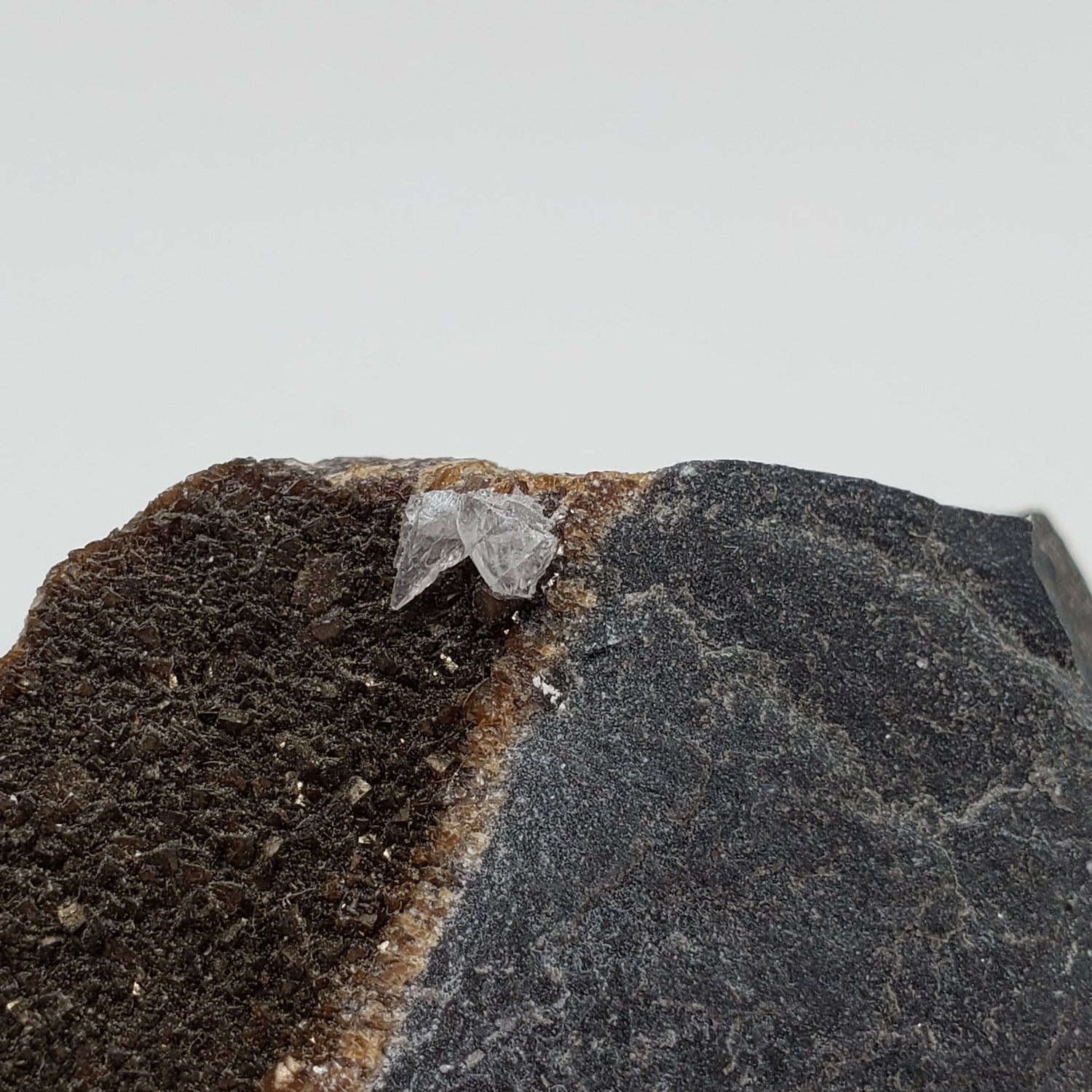
This is a natural cluster formation of calcite on calcite crystals or two variations of the mineral found in a cracked concretion in a coal mine in Oskaloosa, Mahaska County, Iowa, USA.
It is a specimen consisting of two types of calcite on matrix. The first type is a coating of iridescent, dark calcite on the matrix. The second type are white crystals of calcite. It is in good condition. Would be a nice addition to any new or existing collection.
Name: Calcite on Calcite Crystal Cluster
Specimen Size: Cabinet-Sized
Dimensions: 65x47x32 mm / 2.6x1.8x1.3 inches
Weight: 64 Grams / 2.2 oz
Origin: Mined in Oskaloosa, Mahaska County, Iowa, USA
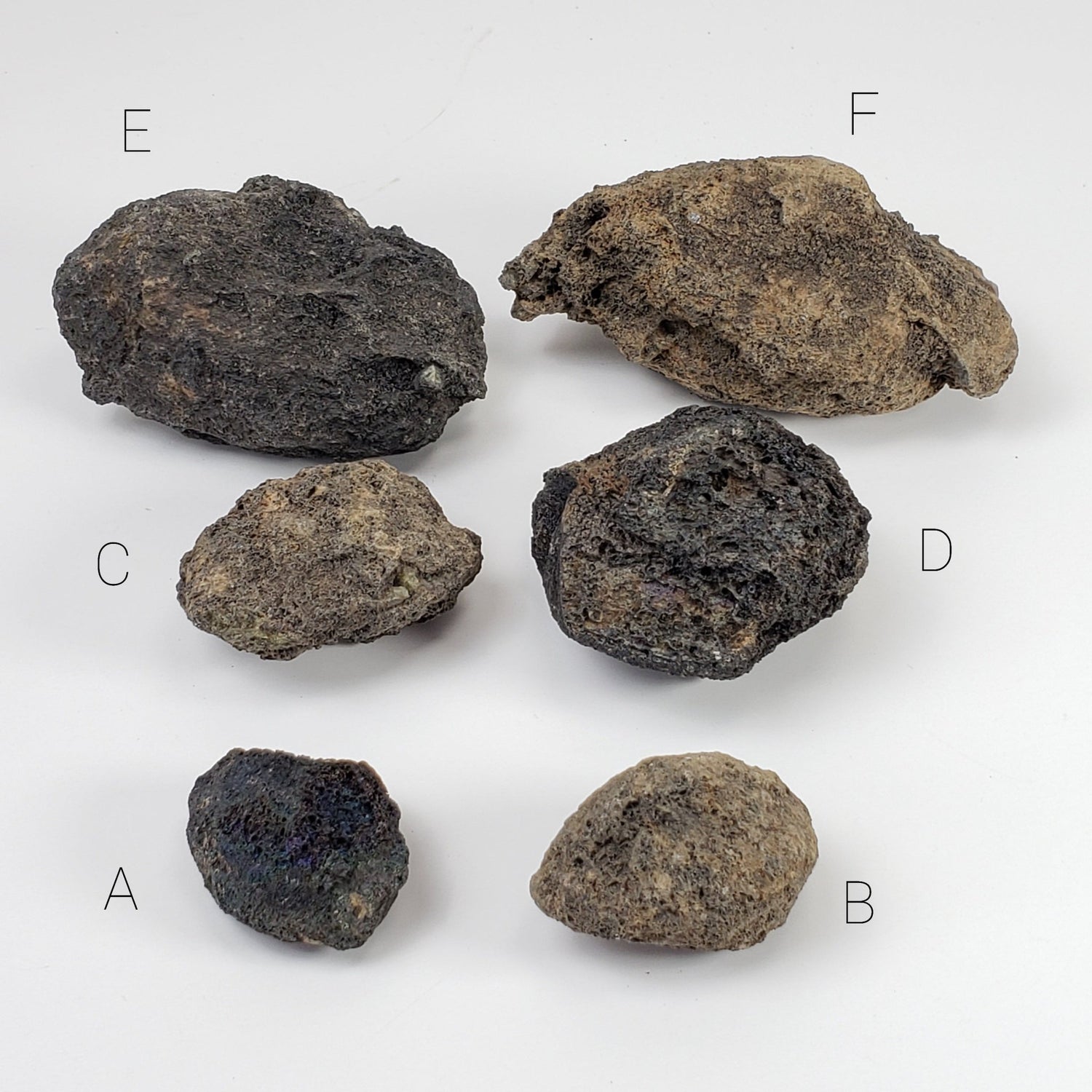
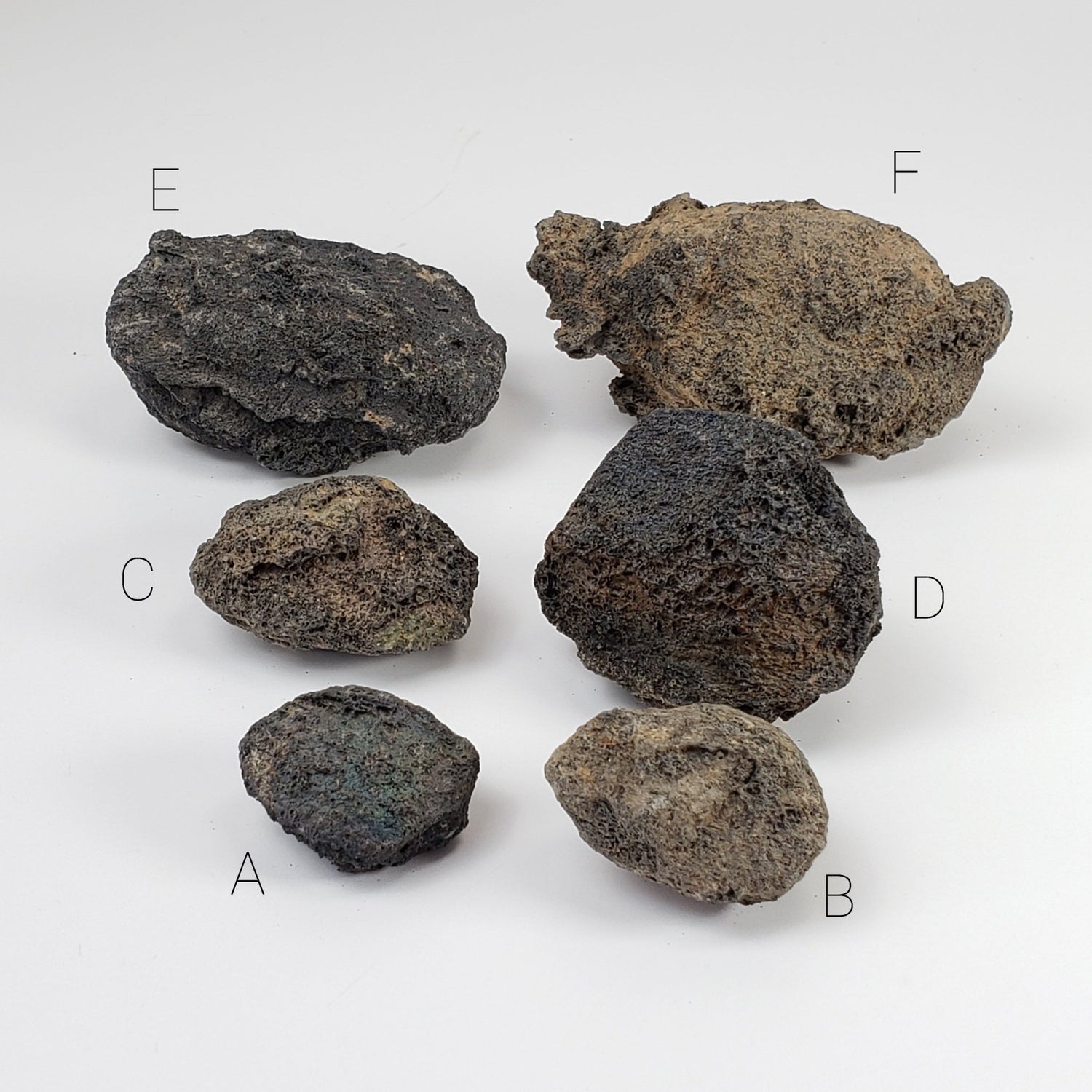
These are whole, uncut lava coated volcanic bombs from Mortlake, Victoria, Australia . The lava crust on these pieces is complete, they can be showcased as is or cut to show the interior. The lava is most likely covering green olivine crystals.
An olivine volcanic bomb is a type of volcanic rock that contains olivine crystals and has been ejected during a volcanic eruption. Olivine is a mineral that is commonly found in the Earth's mantle and is one of the first minerals to crystallize as magma cools.
Volcanic bombs are large clots of lava that are ejected from a volcano during an explosive eruption. They can vary in size, and their shapes are often streamlined due to their molten nature as they are thrown through the air. When these volcanic bombs contain olivine crystals, they are referred to as olivine volcanic bombs.
The dimensions and weight of each of these olivine bombs are as follows:
A. 32x25x17 mm / 1.3x1.0x0.7 in | 14.2 gr / 0.5 oz
B. 37x25x22 mm / 1.5x1.0x0.9 in | 23 gr / 0.8 oz
C. 43x34x21 mm / 1.7x1.3x0.8 in | 37 gr / 1.3 oz
D. 49x44x34 mm / 1.9x1.7x1.3 in | 63.6 gr / 2.2 oz
E. 66x44x33 mm / 2.6x1.7x1.3 in | 113.5 gr / 4.0 oz
F. 79x48x38 mm / 3.1x1.9x1.5 in | 145.4gr / 5.1 oz
Any of these Olivine Bombs would be a beautiful addition to any new or existing collection. Comes with a Canagem Collection specimen card.


You will receive 1 of these beautiful raw emerald pendants. Each pendant contains a raw 2ct emerald and includes a silver plated cage and 18" chain.
Emerald, the traditional birthstone for May, is believed to enhance love, compassion, and emotional healing, as well as promote mental clarity, intuition, and problem-solving abilities. Emerald is associated with balance, healing, prosperity, and abundance. It is also believed to aid in spiritual growth, connection, and protection against negative energies.

Canagem is proud to be professional member of The International Gem Society(IGS) the world's top resource for gem professionals, enthusiasts, and industry content.