



295 products
Sort by:
295 products

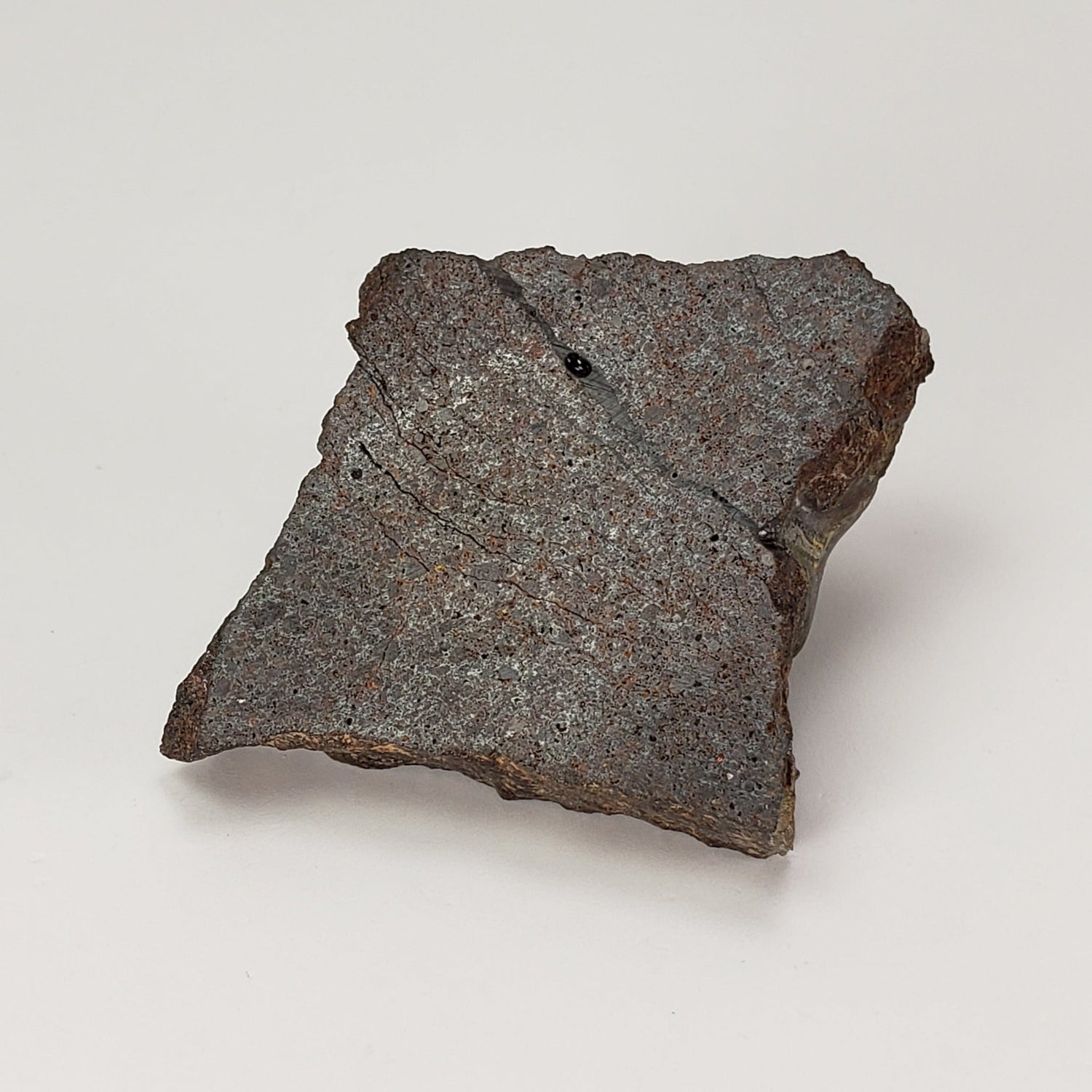
This is a superb looking slice of a Dhofar 224 classified meteorite weighing 23.2 grams. Its dimensions are 36x35x7 mm. This H4 classified meteorite was found in Zufar, Oman in 2001. The total weight of the pieces recovered is recorded as 14.97 kg and the meteorite has a shock stage of 1 and weathering grade of 3.
This piece displays extremely well because of its beautiful color and multiple chondrules. Would be a beautiful addition to any new or existing collection. Comes with a Canagem Collection specimen card.


This is a sharp, lustrous dark green epidote crystal specimen from V.A.G. Mine in Eden Mills, Vermont. Epidote is widely recognized for its distinctive green color, although it can also occur in shades of yellow, brown, or rarely, nearly black.
Name: Epidote
Specimen Size: Thumbnail-Sized
Dimensions: 15x8x6 mm / 0.6x0.3x0.2 inches Specimen
35x33x33 mm / 1.4x1.3x1.3 inches Box
Weight: 11.3 Grams / 0.4 Ounces
Origin: Mined at "C" Pit V.A.G. Quarries, Eden Mills, Vermont USA


This is a great looking Russian Sikhote-Alin classified meteorite weighing 20.2 grams. Its dimensions are 29x26X13mm. This Iron (IIAB) Coarsest Octahedrite classified meteorite was recovered in Russia after the fall of February 12, 1947.
So far approximately 23 tons of this material have been recovered. This piece displays extremely well and is a very desirable size. These specimens are known as shrapnel specimens, ripped and torn edges reminiscent of bomb shrapnel. They broke due to atmospheric pressure and/or mid-air collisions, and possibly explosive fragmentation upon impact. These pieces are a good example of the shrapnel type Sikhote-Alin.
Would be a beautiful addition to any new or existing collection. Comes with a Canagem Collection specimen card.
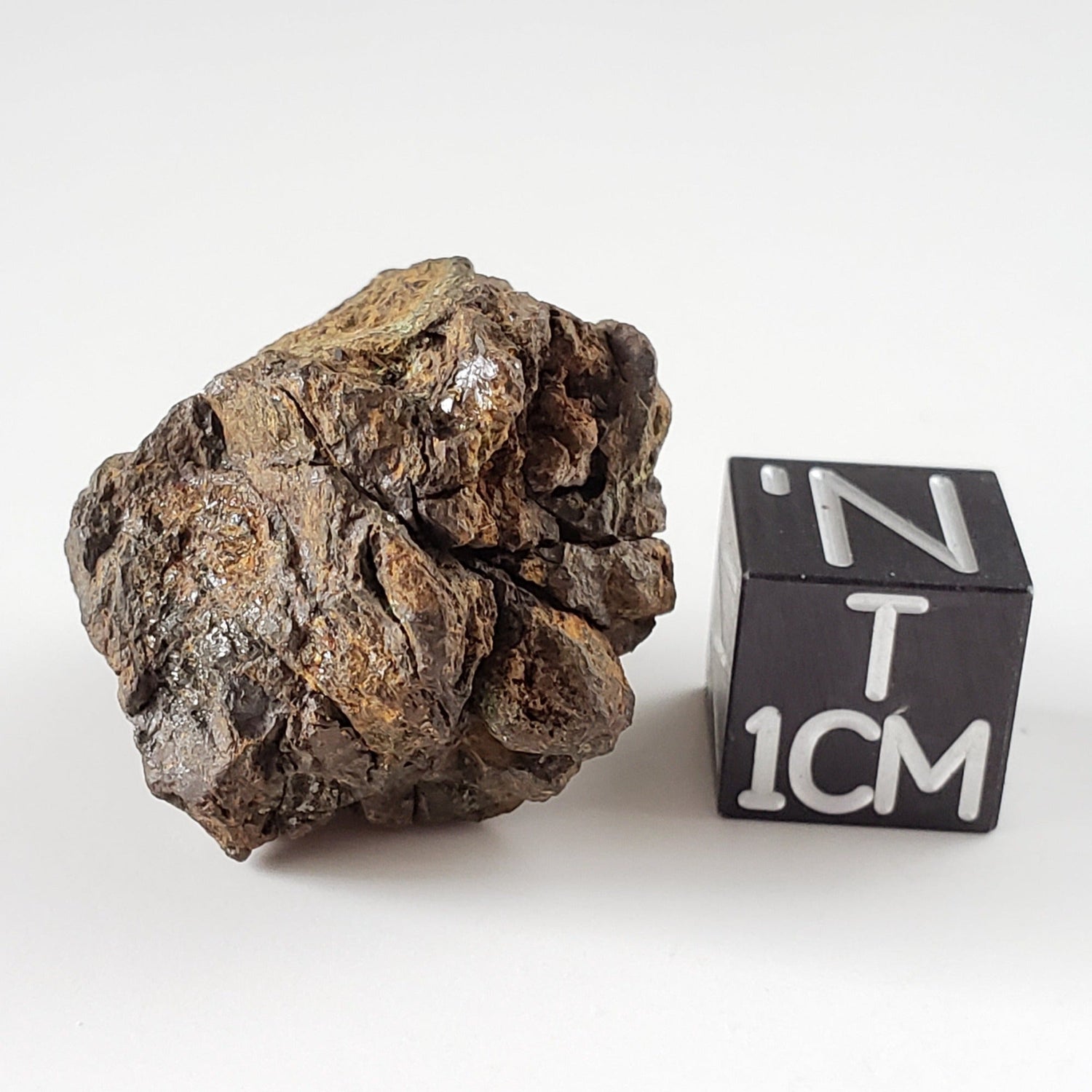
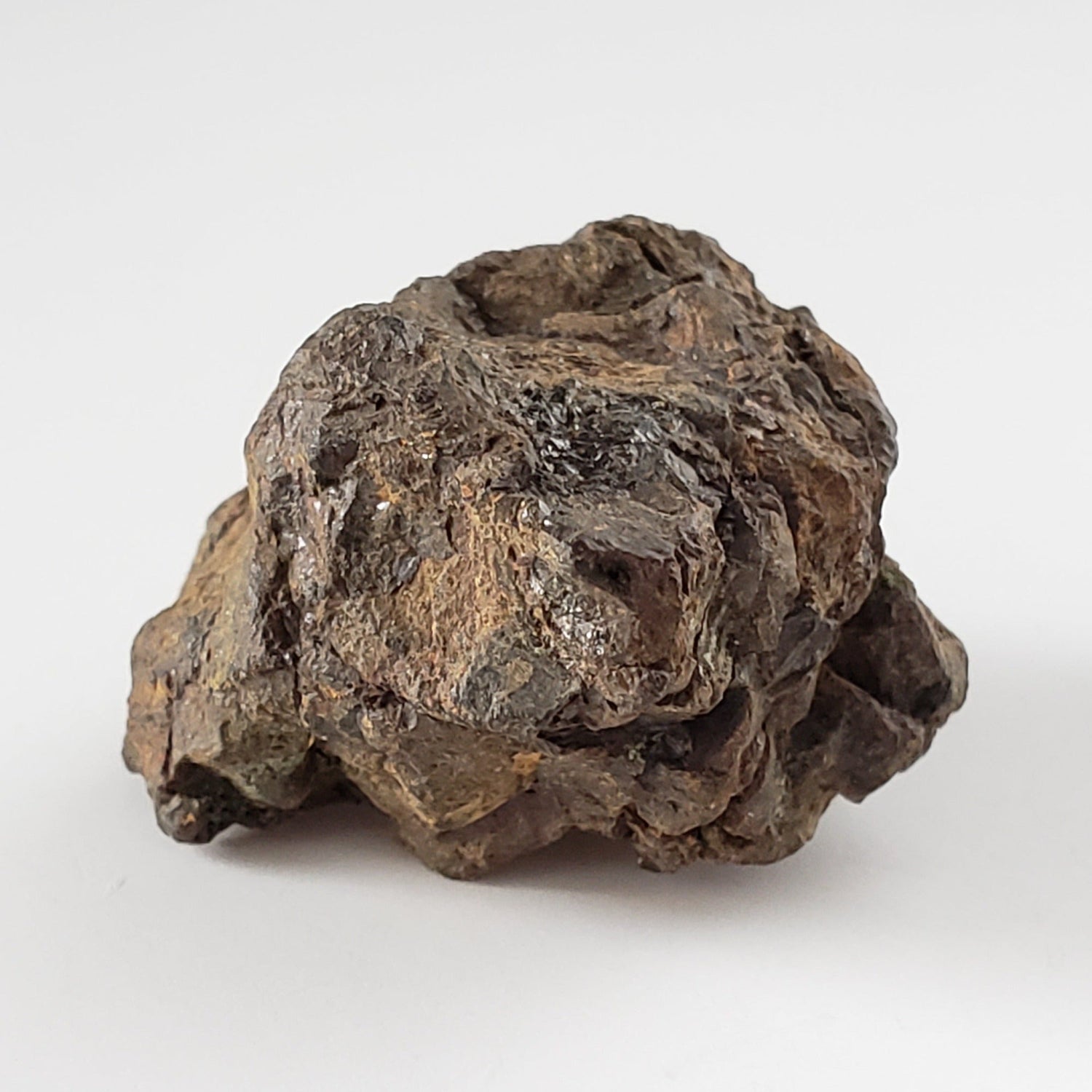
This is a fabulous 10.45 gram Sericho Pallasite Main Group meteorite, it measures 22x20x14. In 2016, two brothers were searching for their camels and came across several large, dense stones west of the village of Habaswein and south of Sericho, Kenya. Though recognized as meteorites in 2016, the masses had been known to camel-herders for decades. One village elder said that as a child, he and his brothers would play on top of the stones. It is classified as an Iron Pallasite main group with low weathering and is 1 of only 68 approved meteorites classified as such, with a recovered weight of about 2.8 T.
This piece displays extremely well and is a nice size showing great features. Would be a beautiful addition to any new or existing collection. Comes with a Canagem Collection specimen card.


This is a superb looking Stony-iron or Mesosiderite Vaca Muerta (Dead Cow) classified meteorite end cut weighing 5.62 grams. Its dimensions are 19x15x11 mm.
This classified meteorite was found in 1861 in the driest desert of the world called the Atacama, in Chile. Mesosiderites are formed on the surface of a parent body as a result of impacts with another body. The impact mixed broken fragments of surface eucrites with iron and olivine from deep within the body. Eucrites are believed to have come from the asteroid Vesta. Analysis has shown, however, that the Vaca Muerta eucrite inclusions are not consistent with other eucrites and possibly originated on a different parent body. Although most have a weathered exterior, they also have lots of metal inside and can be prepared and cut to show this.
This piece displays extremely well and would be a beautiful addition to any new or existing collection. Comes with ELKK Meteorites and Canagem® specimen cards.


This is a fabulous 16.2 gram Sericho Pallasite Main Group meteorite, it measures 28x26x17. In 2016, two brothers were searching for their camels and came across several large, dense stones west of the village of Habaswein and south of Sericho, Kenya. Though recognized as meteorites in 2016, the masses had been known to camel-herders for decades. One village elder said that as a child, he and his brothers would play on top of the stones. It is classified as an Iron Pallasite main group with low weathering and is 1 of only 68 approved meteorites classified as such, with a recovered weight of about 2.8 T.
This piece displays extremely well and is a nice size showing great features. Would be a beautiful addition to any new or existing collection. Comes with a Canagem Collection specimen card.


This is a beautiful specimen of golden brown Vesuvianite crystals on a white carbonate matrix from Mexico. A great addition to any collection! It was first discovered on Mount Vesuvius in Italy in the 18th century, hence its name.
Vesuvianite typically occurs as a green, brown, yellow, or blue-green crystal, and is often found in metamorphic and igneous rocks. The alternate name, Idocrase, is from the Greek eidos “form”, and krasis “mixture”, because Vesuvianite often appears to combine the crystal forms of other minerals. It is used as a gemstone.
Name: Vesuvianite Crystal
Specimen Size: Miniature-Sized
Dimensions: 56x29x26mm / 2.2x1.1x1.0 inches
Weight: 46 grams / 1.6 Ounces
Origin: Sierra de Cruces, Coahuila, Mexico


This is an Adamite Crystals on Limonite matrix mined in Mina Ojuela, Mapimi, Durango, Mexico. Adamite typically occur as small, brightly colored, prismatic or blocky crystals, or as crusts or aggregates. It is commonly found in association with other minerals such as limonite, calcite, and smithsonite. Adamite colors include green, yellow, white, and reddish-brown. The green color of adamite is caused by the presence of traces of copper in its crystal structure. One of the unique features of adamite is its strong fluorescence under ultraviolet (UV) light. It can exhibit vibrant green or yellow fluorescence.
Adamite was first discovered in 1866 in the Ojuela Mine in Durango, Mexico. It was named after French mineralogist Gilbert-Joseph Adam (1795-1881), who studied the mineralogy of the mine.
Adamite is associated with joy, creativity, and the balancing of energies. Some believe it can enhance one's ability to express themselves and promote a positive outlook. It is highly valued by collectors for its bright colors and distinctive crystal habits and would be a great addition to any new or existing collection.
Name: Adamite Crystals on Limonite Matrix
Specimen Size: Cabinet-Sized
Dimensions: 70x25x39 mm / 2.7x1.0x1.5 inches
Weight: 77.1 Grams / 2.7 Ounces
Origin: Mined in Mina Ojuela, Mapimi Durango, Mexico


Here we have for you a nice looking tumbled individual of a Sahara Desert NWA unclassified meteorite weighing 75.5 grams. Its dimensions are 49x39x29mm. This never classified North West Africa stone was found in the Sahara desert around 2000.
It's a good quality individual NWA meteorite specimen. Would be a beautiful addition to any new or existing collection. Comes with a Canagem Collection specimen card.


This is a beautiful cluster of clear quartz crystals on a carpet of green pistacite, also known as epidote. The epidote underneath are clearly visible through the quartz.
Pistacite is a historical term once commonly used to describe a green variety of epidote, named for its pistachio-like color. While the term is still recognized among collectors and in older literature, it has largely been replaced in modern mineralogy by the more general name green epidote.
Pistacite (green epidote) is often associated with growth, release, and emotional healing. Some believe it helps clear negative energy and encourages letting go of patterns or emotions that no longer serve you. It’s thought to support personal transformation by boosting a sense of hope and forward movement, especially during times of change or recovery.
This large specimen would be a beautiful addition to any new or existing collection.
Name: Clinozoisite var. Pistacite and Quartz Cluster
Specimen Size: Cabinet-Sized
Dimensions: 85x70x57 mm / 3.3x2.7x2.2 inches
Weight: 326.4 Grams / 11.5 ounces
Origin: Mined in Alicante, Valencian Community, Spain

Canagem is proud to be professional member of The International Gem Society(IGS) the world's top resource for gem professionals, enthusiasts, and industry content.