

📢 Notice to ALL Customers 📢
376 products
Sort by:
376 products
376 products


Awesome variscite ball on quartz matrix with good luster. From a rare location Wiśniówka Wielka in Poland. Wisniowka is a village located near Kielce in Holly Cross Mountains. Cambrian quarzite sandstones occur there. Trace fossils of trilobite Olenus rarus Orlovskii as well as Diplocraterion and Bergaueria perata can be found in this area. Wiśniówka Wielka is also a well known locality of beautiful crystals of Variscite and Wavellite
This is a quality specimen and would be a beautiful addition to any new or existing rock collection.
Name: Variscite and Quartz
Specimen Size: Miniature-Sized
Dimensions: 47x42x21 mm / 1.8x1.6x0.8 inches
Weight: 38 grams / 1.3 oz
Origin: Wiśniówka Wielka, Kielce County, Świętokrzyskie Voivodeship, Poland


Microcline is one of the most common feldspar minerals. It can be colorless, white, cream to pale yellow, salmon pink to red, or bright green to blue-green. Microcline forms short prismatic or tabular crystals that are often of considerable size: single crystals can weigh several tons and reach yards in length. Crystals are often multiply twinned, with two sets of fine lines at right angles to each other. This gives a plaid effect that is unique to microcline among the feldspars. The nice patch of Quartz crystals makes this a spectacular piece.
This is a quality specimen that would be a beautiful addition to any new or existing rock collection.
Name: Microcline and Quartz
Specimen Size: Cabinet-Sized
Dimensions: 67x55x28 mm / 2.6x2.2x1.1 inches
Weight: 116 grams / 4.1 oz
Origin: Czarne - Poland


Cubic and crystallized pyrite matrix with calcite crystal cluster. This top Peruvian specimen is in very good condition. Would be a beautiful addition to any new or existing collection.
Name: Pyrite with Calcite Crystal Cluster
Specimen Size: Miniature-Sized
Dimensions: 51x40x19 mm / 2x1.6x0.7 inches
Weight: 60.2 Grams / 2.1 oz
Origin: Mined in Peru


This is an attractive specimen consisting of natural pale gray transparent crystals of Calcite on a green crystal matrix from Morocco. Very beautiful material.
Calcite is found throughout the world in sedimentary, metamorphic, and igneous rocks. Some geologists consider it to be a "ubiquitous mineral" - one that is found everywhere. Calcite is the principal constituent of limestone and marble.
Name: Calcite Crystal
Specimen Size: Cabinet-Sized
Dimensions: 75x59x28 mm/ 2.9x2.3x1.1 inches
Weight: 153.7 Grams / 5.4 Ounces
Origin: Mined in Morocco


Celestite, also known as celestine, typically ranges in color from light blue to pale blue, though it can also be colorless, white, or shades of yellow and pink. Celestite is a strontium sulfate mineral which crystallizes in the orthorhombic crystal system, typically forming well-defined, prismatic crystals. This celestite specimen is a nice example of a prismatic crystal form.
Celestite is often associated with calming energy and is believed to aid in meditation and spiritual development. It is said to promote mental clarity and enhance communication with higher realms.
Name: Celestite Prismatic Crystal Cluster
Specimen Size: Cabinet-Sized
Dimensions: 71x32x38 mm / 2.8x1.3x1.5 inches
Weight: 61 Grams / 2.2 Ounces
Origin: Mined in Morocco


Cubic and crystallized Pyrite matrix with Marmatite crystal cluster.
Some of the more important Colorado localities for specimens of well-crystallized pyrite include mines at cli- max, Gilman, Leadville, Rico, Ouray, Telluride, Creede, Alicante, Alice, and State Bridge. Specimens from each of these localities often have distinctive crystal habits and mineral associations. The Eagle mine is probably best known for its pyritohedral Pyrite specimens. This cluster is a good representative Eagle mine Pyrite showing typical striated pyritohedra with sharp, lustrous faces plus some Marmatite opaque black iron-rich crystals.
This top specimen is in very good condition. Would be a beautiful addition to any new or existing collection.
Name: Pyrite with Marmatite Crystal Cluster
Specimen Size: Cabinet-Sized
Dimensions: 70x52x34 mm / 2.8x2x1.3 inches
Weight: 209.7 Grams / 7.4 oz
Origin: Mined in Gilman, Colorado, USA


Cubic and crystallized pyrite matrix with Marmatite crystal cluster.
Some of the more important Colorado localities for specimens of well-crystallized pyrite include mines at cli- max, Gilman, Leadville, Rico, Ouray, Telluride, Creede, Alicante, Alice, and State Bridge. Specimens from each of these localities often have distinctive crystal habits and mineral associations. The Eagle mine is probably best known for its pyritohedral Pyrite specimens. This cluster is a good representative Eagle mine Pyrite showing typical striated pyritohedra with sharp, lustrous faces plus some Marmatite opaque black iron-rich crystals.
This top specimen is in very good condition. Would be a beautiful addition to any new or existing collection.
Name: Pyrite with Marmatite Crystal Cluster
Specimen Size: Cabinet-Sized
Dimensions: 61x39x28 mm / 2.4x1.5x1.1 inches
Weight: 123.9 Grams / 4.4 oz
Origin: Mined in Gilman, Colorado, USA


Cubic and crystallized pyrite matrix with Marmatite and Quartz crystal cluster.
Some of the more important Colorado localities for specimens of well-crystallized pyrite include mines at cli- max, Gilman, Leadville, Rico, Ouray, Telluride, Creede, Alicante, Alice, and State Bridge. Specimens from each of these localities often have distinctive crystal habits and mineral associations. The Eagle mine is probably best known for its pyritohedral Pyrite specimens. This cluster is a good representative Eagle mine Pyrite showing typical striated pyritohedra with sharp, lustrous faces plus some Marmatite opaque black iron-rich crystals.
This top specimen is in very good condition. Would be a beautiful addition to any new or existing collection.
Name: Pyrite with Marmatite and Quartz Crystal Cluster
Specimen Size: Cabinet-Sized
Dimensions: 61x47x29 mm / 2.4x1.8x1.1 inches
Weight: 191.8 Grams / 6.8 oz
Origin: Mined in Gilman, Colorado, USA


Amber golden calcite from Mexico is a beautiful variety of calcite known for its rich golden to honey-colored tones. It often forms in sharp, well-shaped crystals like dogtooth clusters or larger, chunky crystals with smooth faces. These pieces can have a soft glow when light passes through them, making them visually warm and inviting. Much of this material comes from regions like Durango and Chihuahua, areas well known for producing high-quality calcite in many colors.
Amber golden calcite is often associated with confidence, warmth, and personal growth. Some believe it helps boost self-esteem and encourages a positive, motivated outlook, making it a helpful stone during times of change or new beginnings. It's also thought to carry a gentle grounding energy, helping balance emotions while keeping one connected to a sense of inner strength.
Name: Amber Golden Calcite Spray
Specimen Size: Large Cabinet-Sized
Dimensions: 145x72x48 mm / 5.7x2.8x1.9 inches
Weight: 395 Grams / 14 Ounces
Origin: Mined in Mexico
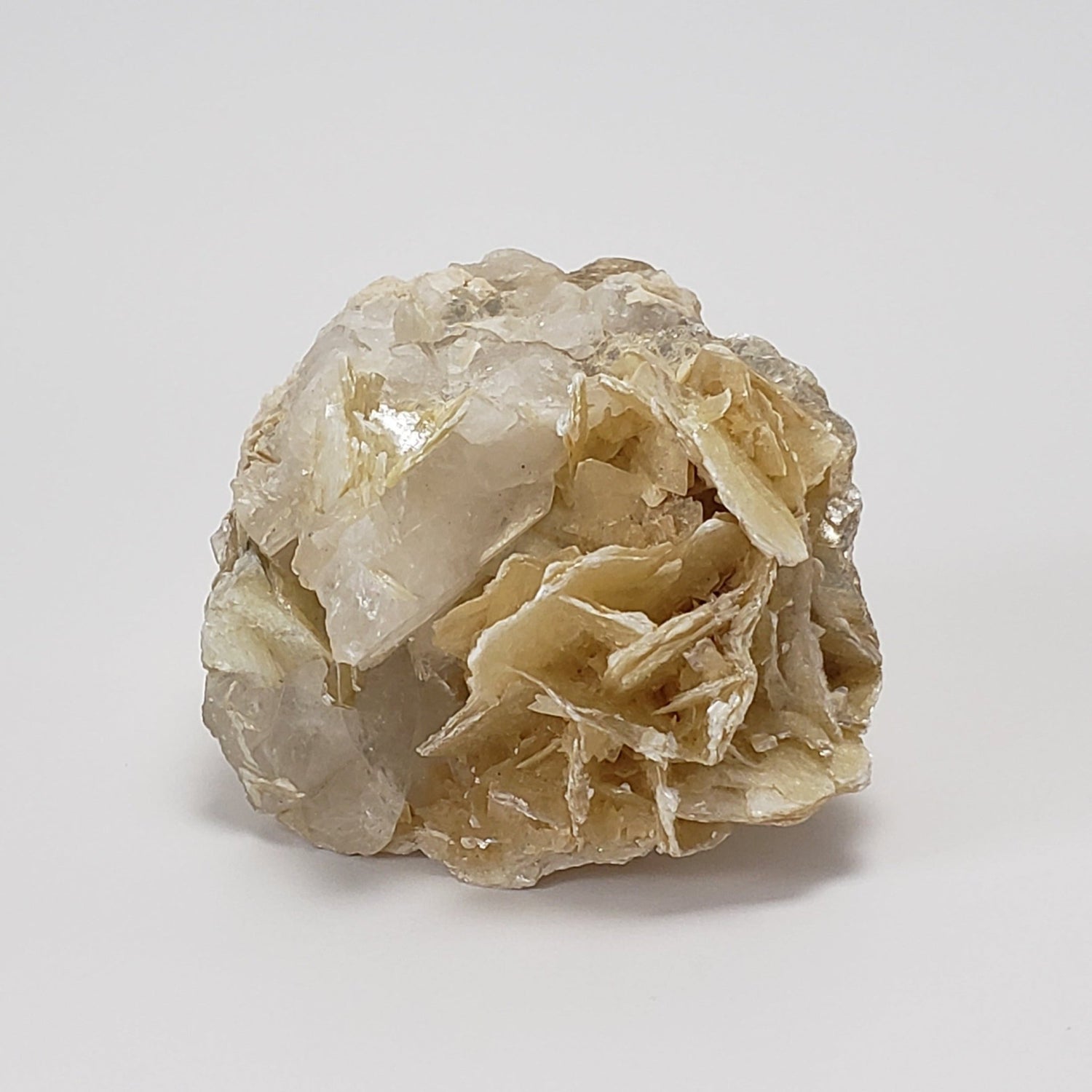

This is a specimen of Star Mica or Muscovite and Quartz cluster. These clusters show crystals that grow in sheets or book formations. It is silvery gold with good transparency when held up to the light. The name Muscovite comes from the term Muscovy Glass which was a name for the thick sheets of Mica used as a substitute for glass Russia. The name Mica is derived from the Greek word that means to split.
On this nice specimen, the matrix faces are covered with beautiful golden yellow point stars of muscovite mica, a typical shape for this rare mica formation. The stars are the result of twinning; the points show a bit of wear but this does not detract from the beauty of such a piece.
Name: Star Mica - Muscovite with Quartz
Specimen Size: Miniature-Sized
Dimensions: 47x30x39 mm / 1.8x1.2x1.5 inches
Weight: 51.4 Grams / 1.8 ounces
Origin: Mined in Minas Gerais, Brazil


Cubic and crystallized pyrite matrix with Marmatite and Quartz crystal cluster.
Some of the more important Colorado localities for specimens of well-crystallized pyrite include mines at cli- max, Gilman, Leadville, Rico, Ouray, Telluride, Creede, Alicante, Alice, and State Bridge. Specimens from each of these localities often have distinctive crystal habits and mineral associations. The Eagle mine is probably best known for its pyritohedral Pyrite specimens. This cluster is a good representative Eagle mine Pyrite showing typical striated pyritohedra with sharp, lustrous faces plus some Marmatite opaque black iron-rich crystals.
This top specimen is in very good condition. Would be a beautiful addition to any new or existing collection.
Name: Pyrite with Marmatite and Quartz Crystal Cluster
Specimen Size: Cabinet Sized
Dimensions: 62x49x33 mm / 2.4x1.9x1.3 inches
Weight: 185.7 Grams / 6.5 oz
Origin: Mined in Gilman, Colorado, USA


This is a specimen of Star Mica or Muscovite and Quartz cluster. These clusters show crystals that grow in sheets or book formations. It is silvery gold with good transparency when held up to the light. The name Muscovite comes from the term Muscovy Glass which was a name for the thick sheets of Mica used as a substitute for glass Russia. The name Mica is derived from the Greek word that means to split.
On this nice specimen, the matrix faces are covered with beautiful golden yellow point stars of muscovite mica, a typical shape for this rare mica formation. The stars are the result of twinning; the points show a bit of wear but this does not detract from the beauty of such a piece.
Name: Star Mica - Muscovite with Quartz
Specimen Size: Miniature-Sized
Dimensions: 54x37x20 mm / 2.1x1.5x0.8 inches
Weight: 38.7 Grams / 1.4 ounces
Origin: Mined in Minas Gerais, Brazil


Quartz is considered a “master healer.” It's said to amplify energy by absorbing, storing, releasing, and regulating it. It's also said to aid concentration and memory. Physically, clear crystals are claimed to help stimulate the immune system and balance out your entire body.
Quartz is also said to be a power gemstone that harmonizes and balances; enhancing energy and thoughts as well as purifying the spiritual, mental and physical. Quartz is associated with the crown chakra.
The weight and dimensions of the Lemon Quartz are as follows:
A. 7.2gr / 27x15x18 | 0.25oz / 1.1x0.6x0.7inB. 6.3gr / 35x13x11 | 0.22oz / 1.4x0.5x0.4in
C. 6.4gr / 34x13x11 | 0.23oz / 1.3x0.5x0.4in


Lapis lazuli or lapis for short, is a deep-blue metamorphic rock used as a semi-precious stone that has been prized since antiquity for its intense color. Lapis lazuli commonly contains pyrite and white calcite. The pyrite inclusions in natural stones are randomly scattered throughout the stone and have irregular outlines that are surrounded by darker blue rings.
Lapis Lazuli encourages taking charge of life. It is said to reveal inner truth, encourage self-awareness, and self-expression without holding back or compromising. This stone is believed to bring the enduring qualities of honesty, compassion and uprightness to the personality.
Lapis Lazuli is said to bond relationships in love and friendship and aid in expressing feelings and emotions.
Product Type: Lapis Lazuli Sphere
Dimensions: 43 mm / 1.7 inches
Weight: 125 Grams / 4.4 Ounces
Origin: Afghanistan


Phantom quartz is a variety of quartz, or "rock crystal", that forms over pre-existing crystals. The included crystal is visible due to some variation in composition making the boundary of the included crystal visible. Such crystals display the outlines of numerous smaller crystals, known as phantoms. Great crystal to acquire.
Quartz is considered a “master healer.” It's said to amplify energy by absorbing, storing, releasing, and regulating it. It's also said to aid concentration and memory. Physically, clear crystals are claimed to help stimulate the immune system and balance out your entire body.
Name: Quartz
Specimen Size: Thumbnail-Sized
Dimensions: 22x15x13 mm / 0.9x0.5x0.5 Inches
Weight: 6.8 Grams / 0.2 Ounces
Details: Brazil


These are perfectly fossilized and highly polished natural Ammonites from Morocco, which are perfect for gift giving to a new fossil collector. Ammonites are perhaps the most widely known fossil, possessing the typically ribbed spiral-form shell. These creatures lived in the seas between 240 - 65 million years ago, when they became extinct along with the dinosaurs. They belong to a group of predators known as cephalopods, which includes their living relatives the octopus, squid, cuttlefish and nautilus. It is probably going to be one of the rarest collection item you'll ever own. These are perfect if you make jewelry and similar crafts or as a fossil collection item.
You will receive the exact Ammonite pictured for the item number you choose.
Details of the Ammonites are as follows:
A - 38x31 mm / 30.7 Grams
B - 38x29 mm / 28.6 Grams
C - 40x32 mm / 18.4 Grams
D - 38x31 mm / 28.8 Grams
E - 38x33 mm / 28.2 Grams
F - 38x27 mm / 36.5 Grams
G - 38x30 mm / 17.5 Grams
H - 39x33 mm / 23.8 Grams
J - 40x32 mm / 32.9 Grams

Canagem is proud to be professional member of The International Gem Society(IGS) the world's top resource for gem professionals, enthusiasts, and industry content.