

📢 Notice to ALL Customers 📢
376 products
Sort by:
376 products
376 products


Indochinite is a variety of the mineral tektite, which is a natural glass formed by the intense heat and pressure of a meteorite impact. These tektites are usually found as small, aerodynamically shaped objects, often teardrop or irregular in shape, resulting from the molten material solidifying as it cooled rapidly after being ejected from the impact site.
Indochinites are believed to have formed around 780,000 to 800,000 years ago, following a significant meteorite impact event that likely created the Southeast Asian tektite strewn field. The strewn field is quite large, and the tektites can be found scattered over a vast area which includes Vietnam, Laos, and Thailand.
This piece displays very well, showing multiple characteristics of its origin. The specimen has a weigh of 51 grams and dimensions of 45x32x23. Comes with a Canagem Collection specimen card.


This is natural rough tourmaline from Mount Mica Quarry, Paris, Oxford County, Maine, USA. Mount Mica is one of the most well-known sources of high-quality tourmaline in the world, and it has been a significant site for gem mining since the 1800s. This tourmaline crystal cluster will come protected in a Perky Box.
It is believed that Tourmaline can be used to repel negativity. It is said to enhance one's physical wellbeing by providing an increase in physical vitality, emotional stability, and intellectual acuity.
Name: Tourmaline Cluster
Specimen Size: Thumbnail-Sized
Dimensions: Specimen 25x17 mm / 1.0x0.7 inches
Specimen Box 33x33 mm / 1.3x1.3 inches
Weight: 11.8 Grams / 0.4 Ounces (including box)
Origin: Mined in Mount Mica Quarry, Paris, Oxford County, Maine, USA


Prehnite is a green to yellowish-green colored mineral that belongs to the phyllosilicate family. It is composed of calcium, aluminum, and silicate, with traces of iron, magnesium, and other elements. Prehnite crystals have a unique pearly luster and can form in a variety of shapes, including tabular, prismatic, and stalactitic formations.
Prehnite is believed to have a calming effect on the mind and emotions, promoting relaxation and inner peace. It is also said to be a stone of unconditional love, compassion, and healing.
These Prehnite clusters originate from Africa. The dimensions of the clusters are listed below:
A: 31x24x20 mm/1.2x0.9x0.8 in | 20 gr/0.7 oz | 100.5 carats
B: 42x28x24 mm/1.6x1.1x0.9 in | 36 gr/1.3 oz | 182.5 carats
C: 43x32x31 mm/1.7x1.3x1.2 in | 59 gr/2.1 oz | 295.8 carats
D: 60x43x28 mm/2.4x1.7x1.1 in | 84 gr/3.0 oz | 420.6 carats


This is a superb looking Arroyo Aguiar meteorite part slice weighing 1.57 grams and measuring 16x8x3 mm. This H5 chondrite classified meteorite fell in the summer of 1950. The total weight of the single stone is 7.45 Kg.
The meteorite was seen to fall by a rancher who found it soon after. It had penetrated some 50 cm into the soil. The meteorite fell near the railway Station Arroyo Aguiar, La Capital Department, Santa Fe Province, Argentina.
Would be a beautiful addition to any new or existing collection. Will come with a Canagem Collection and a Naturalia specimen card.


Barite clusters are beautiful mineral specimens that feature intergrown crystals forming visually appealing arrangements. It is typically found as thick to thin tabular crystals, usually in clusters with the crystals growing parallel to one another, or nearly so. It can also occur as bladed, blocky, or even rosette-like aggregates. This is a fine cluster of bladed barite crystals. Would be a beautiful addition to any new or existing collection.
Name: Barite Cluster Crystal
Specimen Size: Miniature-Sized
Dimensions: 55x35x35 mm / 2.2x1.4x1.4 inches
Weight: 66.97 Grams / 2.4 ounces
Origin: Mined in northern Nevada barite belt, Nevada, USA


Barite clusters are beautiful mineral specimens that feature intergrown crystals forming visually appealing arrangements. It is typically found as thick to thin tabular crystals, usually in clusters with the crystals growing parallel to one another, or nearly so. It can also occur as bladed, blocky, or even rosette-like aggregates. This is a fine cluster of blocky barite crystals. Would be a beautiful addition to any new or existing collection.
Name: Barite Cluster Crystal
Specimen Size: Miniature-Sized
Dimensions: 54x39x31 mm / 2.1x1.5x1.2 inches
Weight: 68.76 Grams / 2.4 ounces
Origin: Mined in northern Nevada barite belt, Nevada, USA


This is a must have 26.7 gram Impact Melt Rock from the Dellen Crater, north of Stokholm, Sweden. Some locals call these rocks by the name of “dellenites”, although officially they are impact melt rocks. Although not a meteorite, impactites are directly linked to them and their impacts and are probably going to be one of the rarest collection items you'll ever own. Impactite is a slag-like glassy object found on the surface of the earth, formed from rock melted by the impact of a meteorite.
The term impactite encompasses shock-metamorphosed target rocks, melts or suevites and mixtures of the two, as well as sedimentary rocks with significant impact-derived components and shocked mineral grains, tektites, anomalous geochemical signatures, etc.
This impactite was formed approx. 89 million years ago when a meteorite crashed into the earth making a round crater which is now a lake about 11 miles wide. Dellen impactites were divided into three impactite groups: (i) suevitic impact breccias with lithic and melt clasts, (ii) impact melt rocks, and (iii) shocked (parautochthonous) target rock. In turn, impact melt rocks were divided into (i) clast-rich, (ii) clast-poor, and (iii) clast-free types. The Dellenite type material was classified as clast poor impact melt breccia.
This gorgeous slice displays very well. It is amazingly light considering its mass of 70x32x8 mm. Would be a beautiful addition to any new or existing collection. Comes with a Canagem Collection specimen card.


This is a must have 29.55 gram Impact Breccia also referred to as Suevite coming from the famous Rochechouart impact structure in South Western France, near the village of Chassenon. Although not a meteorite, impactites are directly linked to them and their impacts and are probably going to be one of the rarest collection items you'll ever own. Impactite is a slag-like glassy object found on the surface of the earth, formed from rock melted by the impact of a meteorite.
Named after the town of Rochechouart, the Rochechouart impact structure is located on the western margin of the French Massif Central near the city of Limoges, approximately 350 km (220 mi) south of Paris. Rochechouart (population about 3800) is built with rocks created or modified by the impact (impactites). Chassenon, a third of the size of Rochechouart, is also built of impactites. Impactite was used 2000 years ago for building Chassenon's monumental Roman baths of Cassinomagus.
The very fine materials (impactoclastites) are preserved forming a very fine layered horizontal deposits on top of the melt rich suevite (breccia with a debris matrix and both rock debris and melt fragments as clasts) near Chassenon.
The term impactite encompasses shock-metamorphosed target rocks, melts or suevites and mixtures of the two, as well as sedimentary rocks with significant impact-derived components and shocked mineral grains, tektites, anomalous geochemical signatures, etc. This impactite was formed 186 million years ago. This deformed rock fragments and partly molten are imbedded in a melt matrix showing typical flow structures from former melt.
This gorgeous slice displays very well with a mass of 49x48x9 mm. Would be a beautiful addition to any new or existing collection. Comes with a Canagem Collection specimen card.
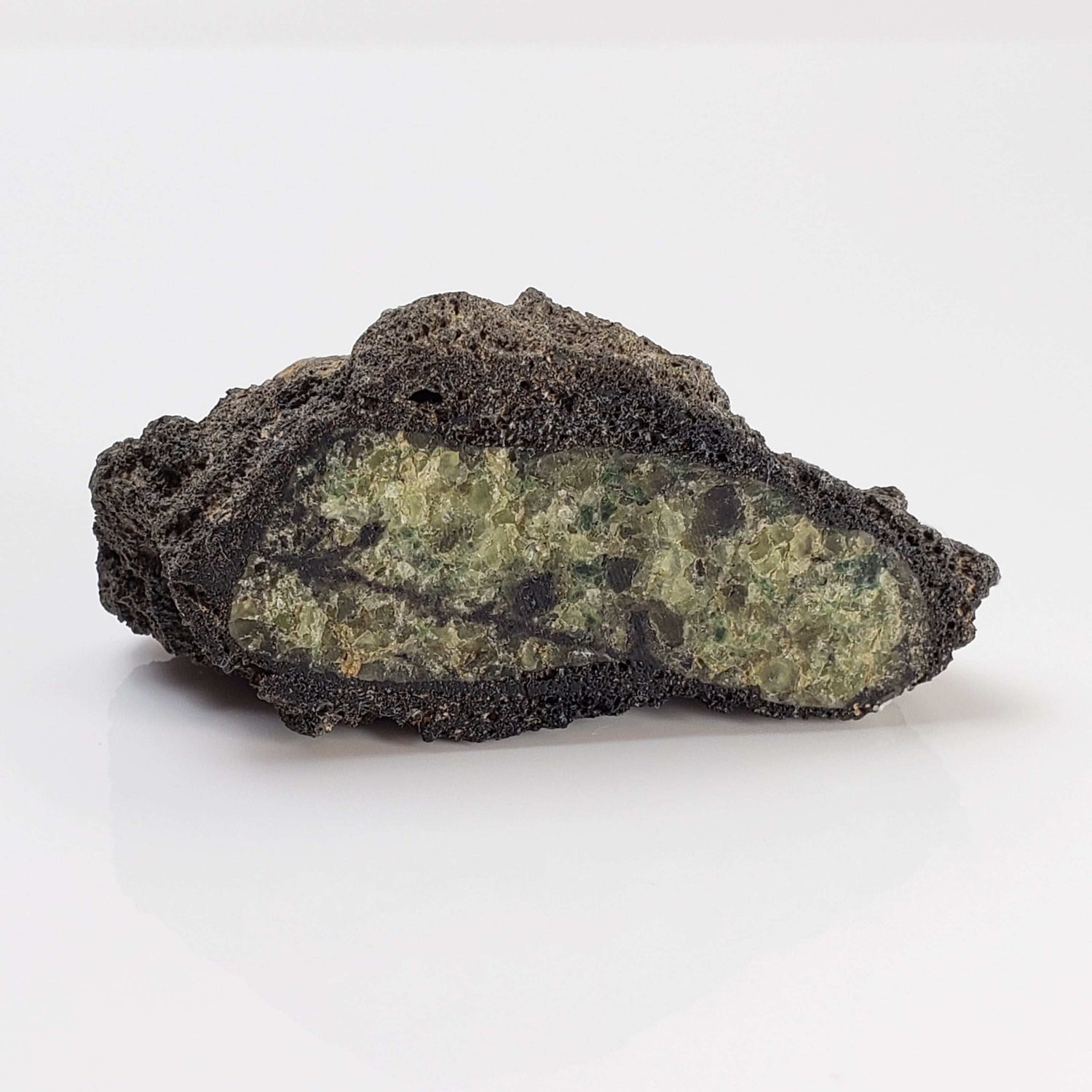
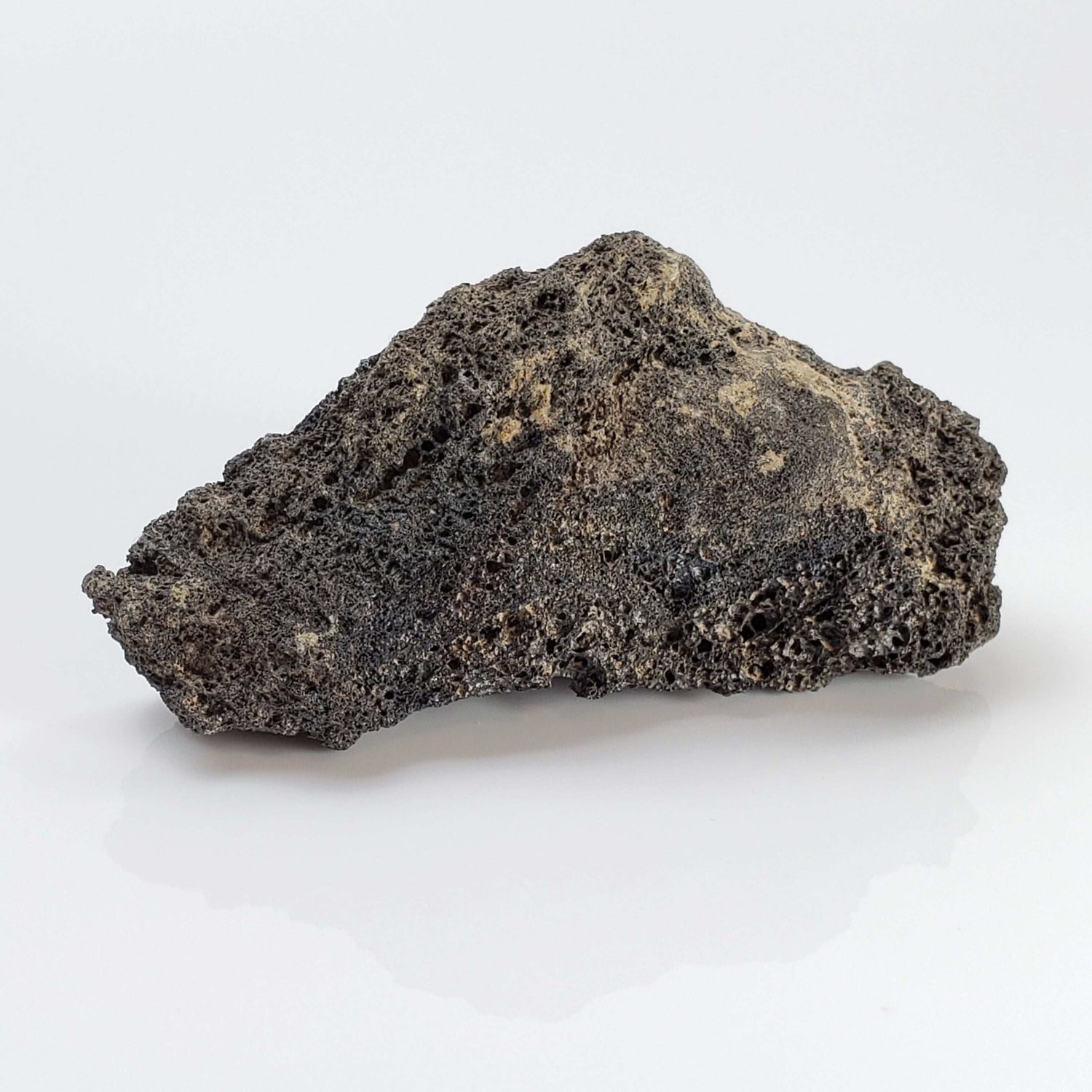
An olivine volcanic bomb is a type of volcanic rock that contains olivine crystals and has been ejected during a volcanic eruption. Olivine is a mineral that is commonly found in the Earth's mantle and is one of the first minerals to crystallize as magma cools.
Volcanic bombs are large clots of lava that are ejected from a volcano during an explosive eruption. They can vary in size, and their shapes are often streamlined due to their molten nature as they are thrown through the air. When these volcanic bombs contain olivine crystals, they are referred to as olivine volcanic bombs.
This piece has been cut to showcase the beautiful green olivine crystals. It would be a beautiful addition to any new or existing collection. Comes with a Canagem Collection specimen card.
Name: Olivine Volcanic Bomb
Specimen Size: Cabinet-Sized
Dimensions: 60x29x22 mm / 2.4x1.1x0.9 Inches
Weight: 38.4 Grams / 1.3 Ounce
Details: Volcanic activity Mortlake, Victoria, Australia


This is a natural yellow quartz crystal bracelet, from Dong Hai, Jiang Su Province in China.
Product Type: Yellow Quartz Bracelet
Gem Type: Natural Quartz
Net Weight: 31 grams / 1.1 oz
Bead Diameter: 9 mm / 0.3 inches
Bracelet Diameter: 177 mm / 7 inches


Pseudomorphs are mineral specimens that have the external shape of one mineral but are composed of another. The pseudomorph goethite after marcasite forms when marcasite is exposed to oxidizing conditions and starts to oxidize and break down. As the marcasite breaks down, goethite replaces it in the crystal structure, preserving the shape of the original marcasite crystal. The resulting specimen appears as a marcasite crystal, but is actually composed of goethite.
The Farafra Oasis, in the White Desert, has been known for a number of years to deliver incredible pseudomorph specimens. The pseudomorphs occur within the Cretaceous Khoman Chalk, from which the White Desert derives its name.
These specimens are remarkable for their relatively sharp marcasite crystal forms in aesthetic crystal clusters. They are in excellent condition. This collector's specimen is unique, of great quality and ready for display.
Name: Goethite After Marcasite Pseudomorph
Specimen Size: Miniature-Sized Specimen
Dimensions: 34x30x33 mm / 1.3x1.2x1.3 inches
Weight: 38 grams / 1.3 ounces
Origin: White Desert, Farafra Oasis, Egypt


Pseudomorphs are mineral specimens that have the external shape of one mineral but are composed of another. The pseudomorph goethite after marcasite forms when marcasite is exposed to oxidizing conditions and starts to oxidize and break down. As the marcasite breaks down, goethite replaces it in the crystal structure, preserving the shape of the original marcasite crystal. The resulting specimen appears as a marcasite crystal, but is actually composed of goethite.
The Farafra Oasis, in the White Desert, has been known for a number of years to deliver incredible pseudomorph specimens. The pseudomorphs occur within the Cretaceous Khoman Chalk, from which the White Desert derives its name.
These specimens are remarkable for their relatively sharp marcasite crystal forms in aesthetic crystal clusters. They are in excellent condition. This collector's specimen is unique, of great quality and ready for display.
Name: Goethite After Marcasite Pseudomorph
Specimen Size: Miniature-Sized Specimen
Dimensions: 31x22x23 mm / 1.2x0.9x0.9 inches
Weight: 17 grams / 0.6 ounces
Origin: White Desert, Farafra Oasis, Egypt


Lapis lazuli or lapis for short, is a deep-blue metamorphic rock used as a semi-precious gemstone that has been prized since antiquity for its intense color. This specimen shows deep blue with sparks of pyrite and is in great condition.
Product Type: Lapis Lazuli Rough
Specimen Size: Miniature-Sized
Dimensions: 51x51x26 mm / 2.0x2.0x1.0 inches
Weight: 83.7 Grams / 2.9 ounces
Origin: Afghanistan


This is an attractive specimen of calcite crystals from the Wessels Mine, Kuruman, South Africa. The entire top surface of the specimen is covered with many sharp well formed calcite crystals. Some are a frosted snow white ball shape which sit amongst a sharper sparkly druzy calcite. It is in excellent condition.
Calcite is found throughout the world in sedimentary, metamorphic, and igneous rocks. Some geologists consider it to be a "ubiquitous mineral" - one that is found everywhere. Calcite is the principal constituent of limestone and marble.
Name: Calcite Crystal
Specimen Size: Cabinet-Sized
Dimensions: 61x50x35 mm/ 2.4x2.0x1.4 inches
Weight: 96.82 Grams / 3.4 Ounces
Origin: Mined in Wessels Mine, Kuruman, South Africa


This is a beautiful, fully terminated thumbnail sized Quartz Point.
Quartz crystals are among the most abundant and well-known minerals on Earth. Quartz belongs to the hexagonal crystal system. It typically forms six-sided prismatic crystals with a pointed termination. Its crystals can be colorless or exhibit a wide range of colors. The color variations are often due to the presence of impurities or trace elements during the crystal's formation. Quartz is transparent to translucent.
This specimen would be a beautiful addition to any new or existing collection.
Name: Quartz Point
Specimen Size: Thumbnail-Sized
Dimensions: Specimen 26x8x8 mm / 1.0x0.3x0.3 inches
Specimen Box 33x33 mm / 1.3x1.3 inches
Weight: 11.2 Grams / 0.4 Ounces (including box)
Origin: Bennet Quarry, Buckfield, Maine


Pseudomorphs are mineral specimens that have the external shape of one mineral but are composed of another. The pseudomorph goethite after marcasite forms when marcasite is exposed to oxidizing conditions and starts to oxidize and break down. As the marcasite breaks down, goethite replaces it in the crystal structure, preserving the shape of the original marcasite crystal. The resulting specimen appears as a marcasite crystal, but is actually composed of goethite.
The Farafra Oasis, in the White Desert, has been known for a number of years to deliver incredible pseudomorph specimens. The pseudomorphs occur within the Cretaceous Khoman Chalk, from which the White Desert derives its name.
These specimens are remarkable for their relatively sharp marcasite crystal forms in aesthetic crystal clusters. They are in excellent condition. This collector's specimen is unique, of great quality and ready for display.
Name: Goethite After Marcasite Pseudomorph
Specimen Size: Miniature-Sized Specimen
Dimensions: 35x22x20 mm / 1.4x0.9x0.8 inches
Weight: 17 grams / 0.6 ounces
Origin: White Desert, Farafra Oasis, Egypt

Canagem is proud to be professional member of The International Gem Society(IGS) the world's top resource for gem professionals, enthusiasts, and industry content.