



1386 products
Sort by:
1386 products


This is a strand of clear crystal beads with an overall length of 37 cm (14.5 inches). The individual beads are faceted tube in shape and range in size from 8x5 to 9x5 mm. In total, the bead strand contains over 62ct of crystal beads.
Product Type: Crystal Beads
Approx Weight (per Strand): 62.6ct
Bead Size: 8x5 to 9x5 mm
Strand Length: 37 cm / 14.5 inches
Shape: Faceted Tube Shape
Color: Clear White

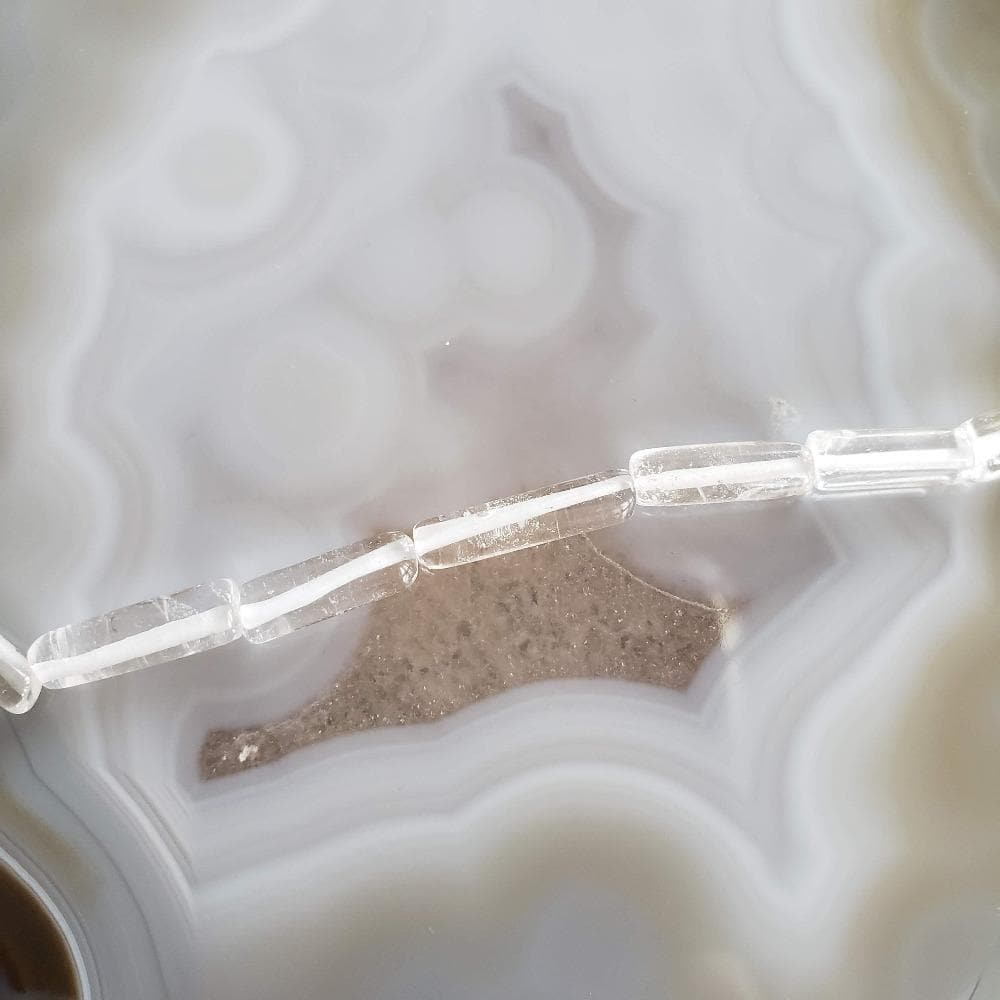
This is a strand of clear crystal beads with an overall length of 40 cm (15.5 inches). The individual beads are tube shaped and range in size from 10x4 to 15x4 mm. In total, the bead strand contains over 72ct of crystal beads.
Product Type: Crystal Beads
Approx Weight (per Strand): 72.45ct
Bead Size: 10x4 to 15x4 mm
Strand Length: 40 cm / 15.5 inches
Shape: Tube Shape
Color: Clear White


Cubanite is a rare copper-iron sulfide mineral prized by collectors for its distinctive brassy-yellow metallic luster and geometric crystal forms. This exceptional specimen originates from the now-closed Henderson No. 2 Mine in Chibougamau, Québec—a historically significant locality that produced some of the finest cubanite crystals in North America.
At 6.27 grams, this piece represents a substantial and well-formed example of the species. The mine's closure adds to the collectability and scarcity of material from this source.
This top specimen is in very good condition and would be a beautiful addition to any new or existing collection.
Name: Cubanite on Matrix
Specimen Size: Thumbnail-Sized
Dimensions: 28x16x8 mm / 1.1x0.6x0.3 inches
Weight: 6.27 Grams / 0.2 oz
Origin: Mined in Henderson No. 2 mine, Chibougamou, Québec, Canada


This is a stunning specimen of calcite cubes on mordenite druse. The crystals are well defined and look beautiful together.
Calcite is found throughout the world in sedimentary, metamorphic, and igneous rocks. Some geologists consider it to be a "ubiquitous mineral" - one that is found everywhere. Calcite is the principal constituent of limestone and marble.
Mordenite was first described in 1864 by Henry How. He named it after the small community of Morden, Nova Scotia, Canada, along the Bay of Fundy, where it was first found. It is one of the most abundant zeolites and is found in volcanic rock such as rhyolite, andesite, and basalt. It is associated with other zeolites such as stilbite and heulandite.
Name: Calcite Cubes on Mordenite Druse
Specimen Size: Large Cabinet-Sized
Dimensions: 228x152x127 mm / 9x6x5 inches
Weight: 3.43 KG / 7 lbs 9 ounces
Details: Mined in Nashik, India


Another beautiful specimen featuring large cubic green apophyllite with delicate scolecite.
Stilbite is a zeolite mineral appreciated for its delicate crystal formations and pastel hues, ranging from colorless to white, yellow, pink, and peach. It forms distinctive tabular crystals with a bowtie or butterfly shape and exhibits a vitreous to pearly luster. Commonly found in cavities in volcanic rocks, stilbite is associated with other zeolite minerals. It is valued for its aesthetic appeal and is believed by some to have calming energy, supporting spiritual growth and emotional healing.
One of the distinguishing features of apophyllite is its ability to form well-defined crystals with a pyramid-like shape. These crystals often exhibit a prismatic or pseudo-cubic habit and have a vitreous luster. Apophyllite is transparent to translucent and is commonly found in colorless or white varieties, although it can also occur in shades of green, pink, yellow, or brown.
Scolecite forms as vertically striated, thin, prismatic crystals. Scolecite may also occur as radiating fibrous masses. The colour may be white, yellowish, or colourless. It is a transparent to translucent mineral, and it has a vitreous to silky luster.
Name: Apophyllite, Stilbite, Scolecite Crystals
Specimen Size: Large Cabinet-Sized
Dimensions: 171x108x101 mm / 6.75x4.25x4 inches
Weight: 812 grams / 12.6 oz
Details: Mined in Nasik, India


This is an incredibly colorful and beautiful crystal specimen. The Apophyllite is deep green and contrasts beautifully with the white Scolecite. It is a large specimen and displays beautifully.
Stilbite is a zeolite mineral appreciated for its delicate crystal formations and pastel hues, ranging from colorless to white, yellow, pink, and peach. It forms distinctive tabular crystals with a bowtie or butterfly shape and exhibits a vitreous to pearly luster. Commonly found in cavities in volcanic rocks, stilbite is associated with other zeolite minerals. It is valued for its aesthetic appeal and is believed by some to have calming energy, supporting spiritual growth and emotional healing.
One of the distinguishing features of apophyllite is its ability to form well-defined crystals with a pyramid-like shape. These crystals often exhibit a prismatic or pseudo-cubic habit and have a vitreous luster. Apophyllite is transparent to translucent and is commonly found in colorless or white varieties, although it can also occur in shades of green, pink, yellow, or brown.
Scolecite forms as vertically striated, thin, prismatic crystals. Scolecite may also occur as radiating fibrous masses. The colour may be white, yellowish, or colourless. It is a transparent to translucent mineral, and it has a vitreous to silky luster.
Name: Apophyllite, Stilbite, Scolecite Crystals
Specimen Size: Large Cabinet-Sized
Dimensions: 150x110x80 mm / 5.9x4.3x3.1 inches
Weight: 1.33 KG / 2 lbs 14 oz
Details: Mined in Panvel, India
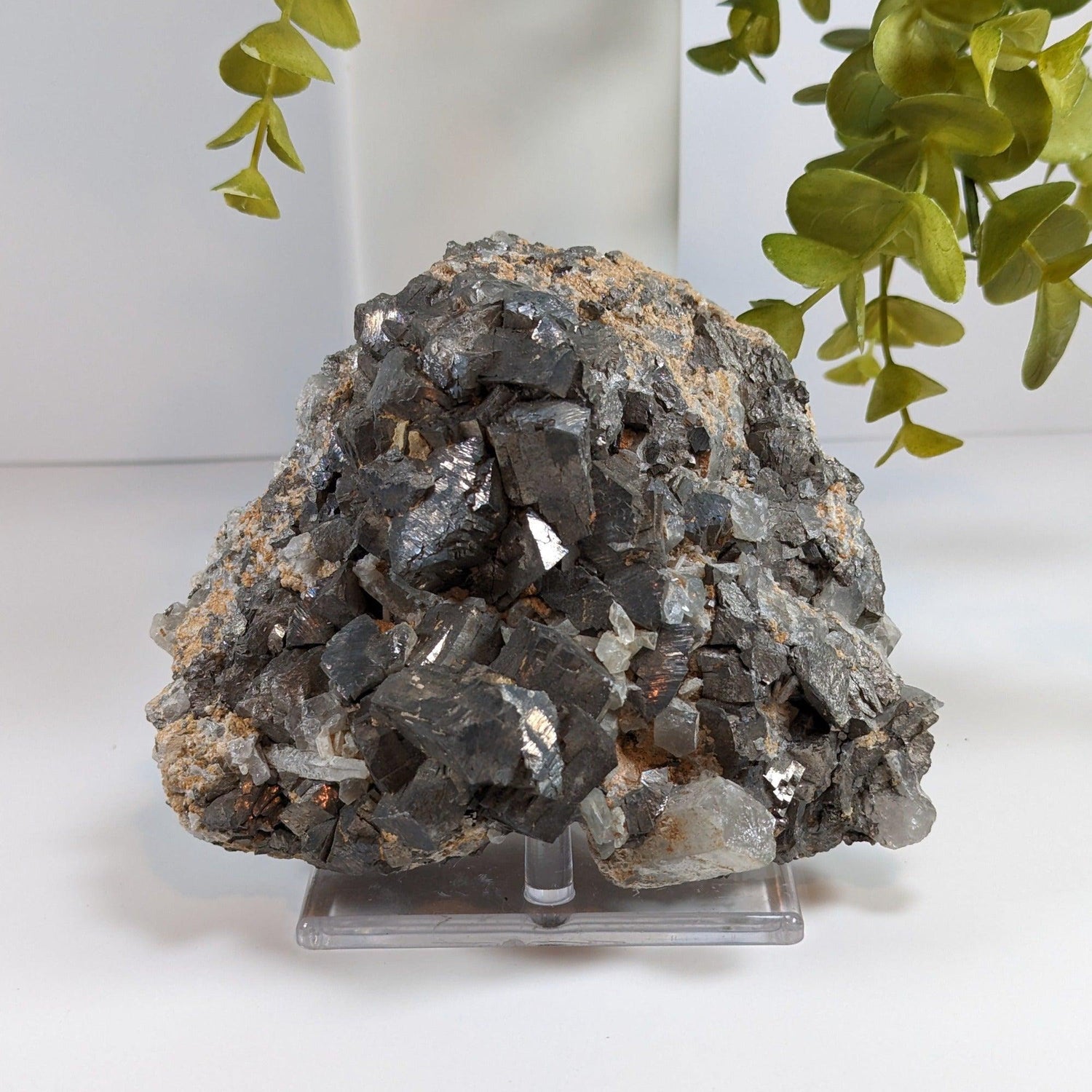
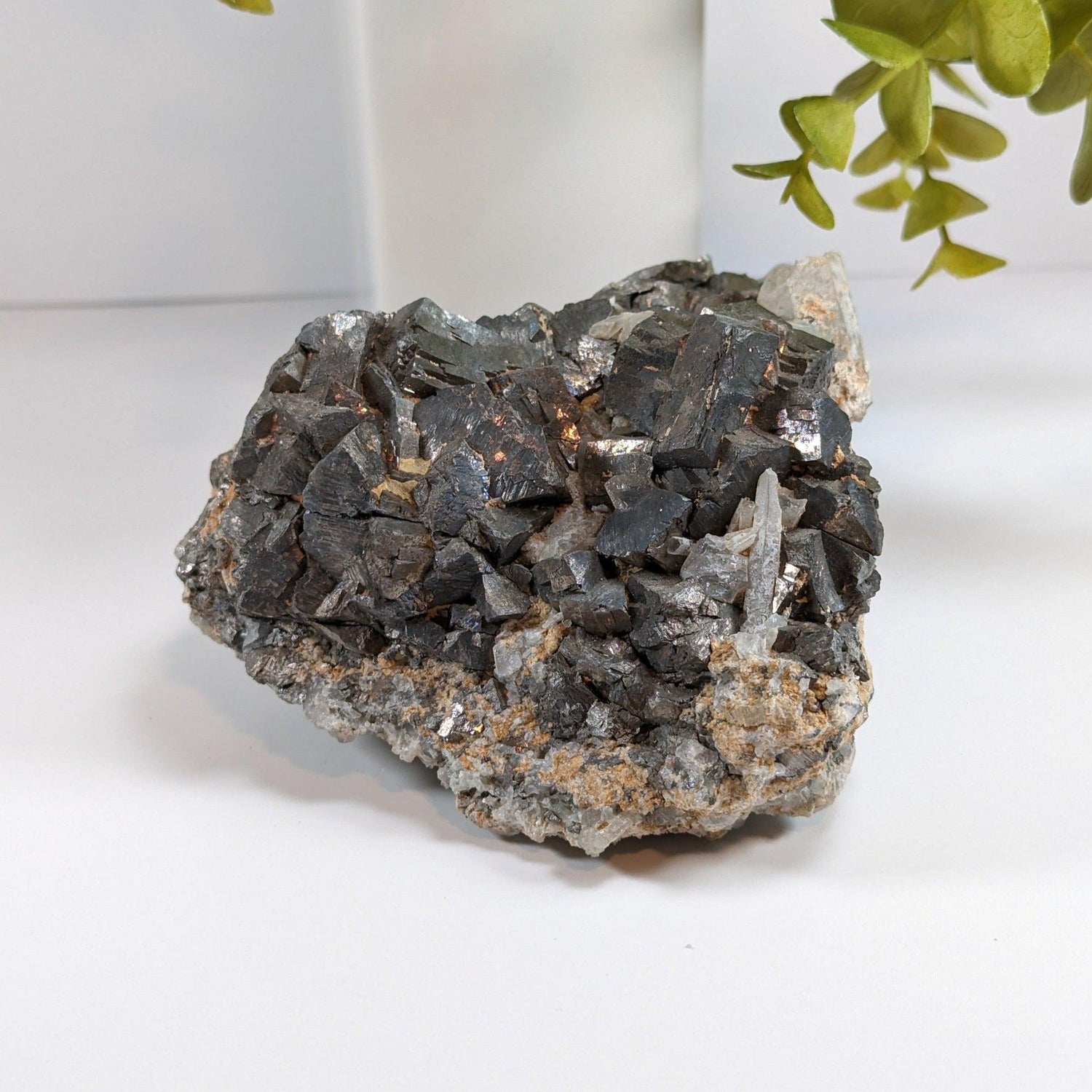
This top specimen is covered with huge pyrite interlocked cubes with quartz crystals and galena. This specimen is in very good condition. Would be a beautiful addition to any new or existing collection.
Name: Pyrite, Quartz and Galena Crystal Cluster
Specimen Size: Large Cabinet-Sized
Dimensions: 131x123x79 mm / 5.2x4.8x3.1 inches
Weight: 1,456 Grams / 3 lbs 3 oz
Origin: Mined in Peru

This is an aluminum label with all the information regarding the Cumberland Falls, Kentucky, USA meteorite. This flat model fits nicely in a Riker type box or our own Alder wooden boxes. An excellent way of identifying and displaying your collection of meteorites.
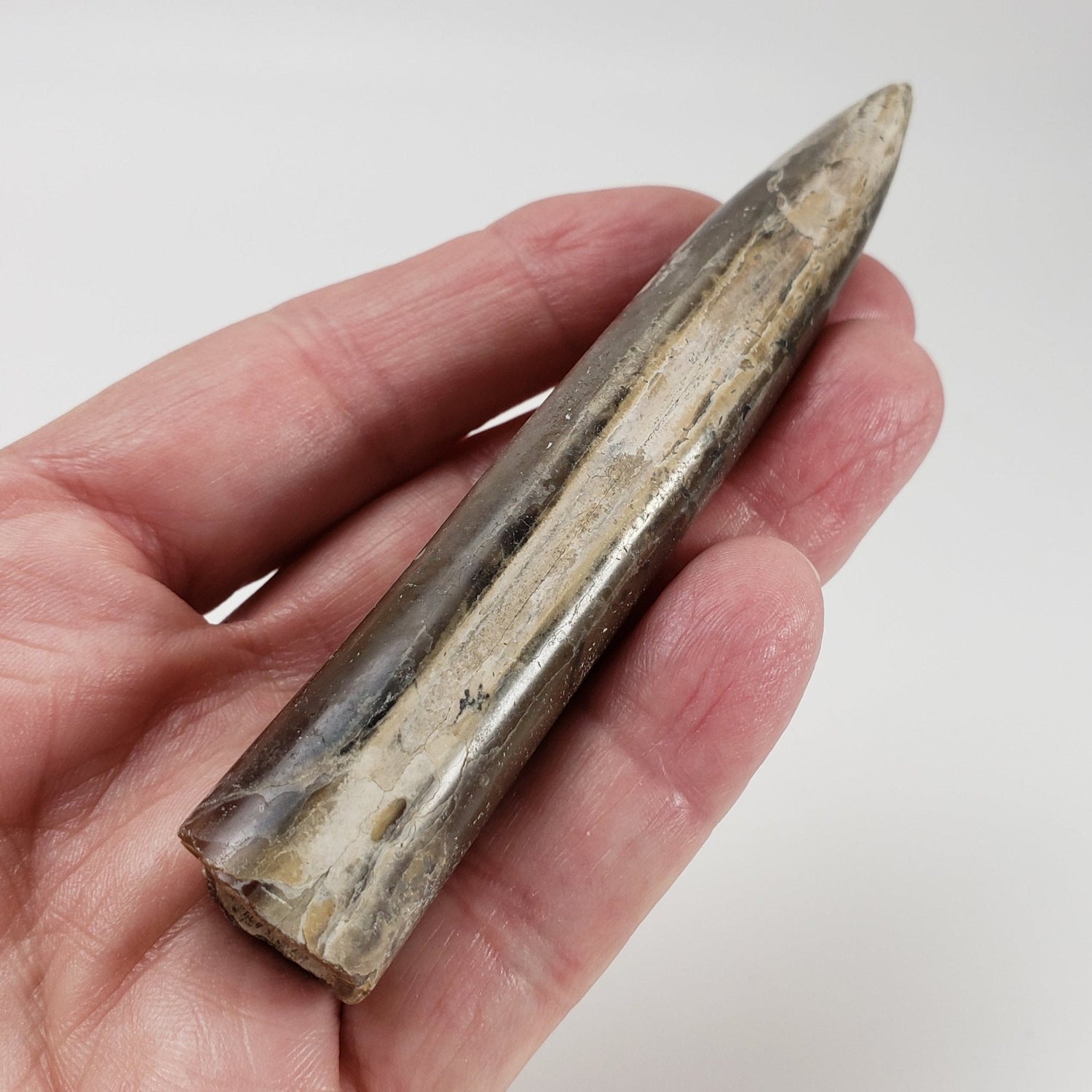
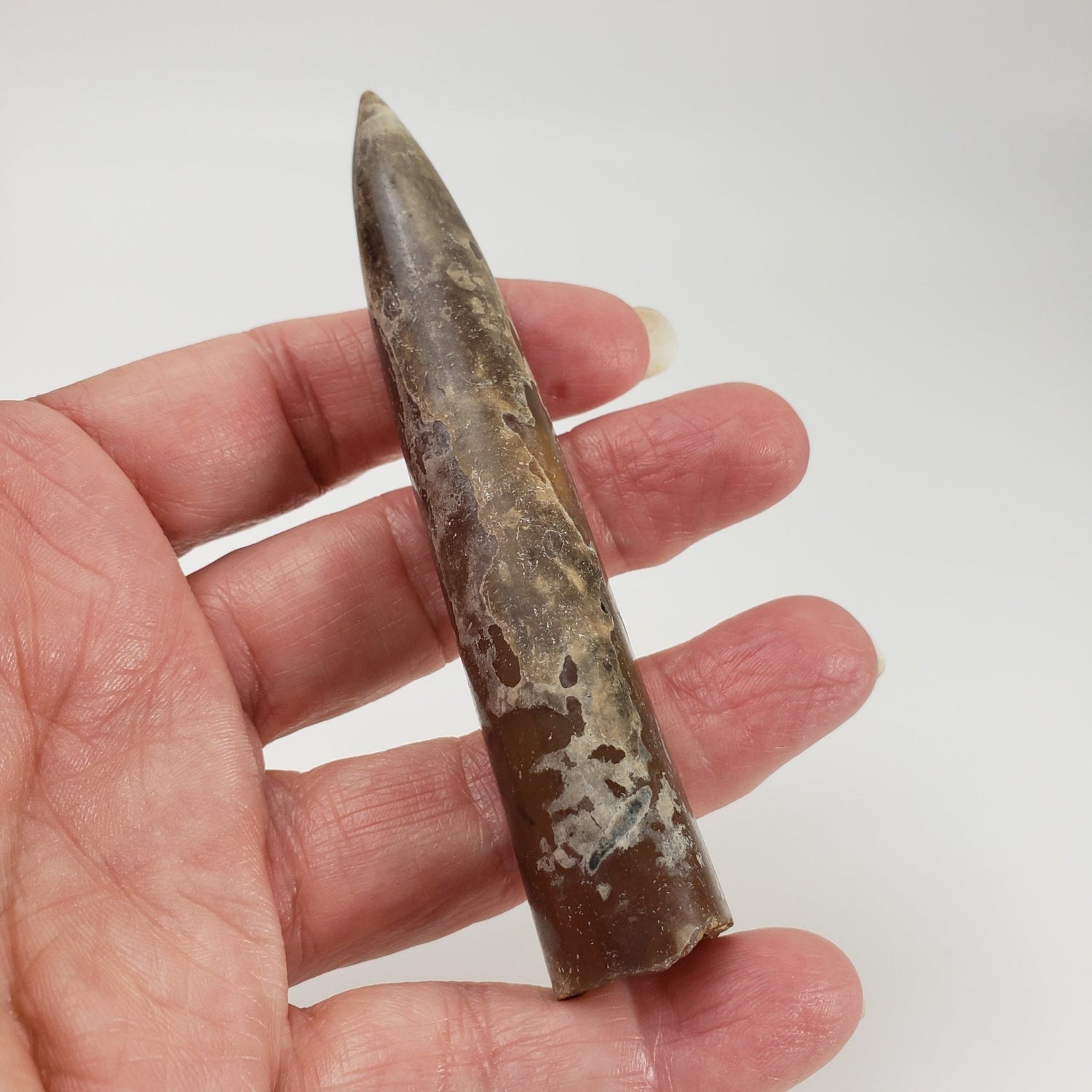
The belemnites are a monophyletic group of superorder status, called the Belemnoidea. There are four orders . The belemnites evolved from nautiloids, which are the basal group of cephalopods. Well-formed belemnite guards can be found in rocks dating from the Mississippian (or Lower Carboniferous).
The belemnites on offer are of Cylindroteuthis and Pachyteuthis genus. They date from the Callovian era. In the geologic timescale, the Callovian is an age and stage in the Middle Jurassic and It is the last stage of the Middle Jurassic, following the Bathonian and preceding the Oxfordian. They were found in Mikhailov, Ryazan region. Russia.
Cylindroteuthis is a common find from several Jurassic formations. The most commonly preserved part of the animal is its guard, or rostrum, which was composed of calcite. The guard housed a phragmacone, which allowed Cylindroteuthis to maintain buoyancy in water. Some better-preserved specimens have features similar to modern squid, such as ten arm-like appendages and an ink sac, intact.
Pachyteuthis is a genus of belemnite that lived from the Early Jurassic to the Early Cretaceous and has been found in Asia, Europe and North America. The type species is P. densus.
Name: Cylindroteuthis
Age: Middle Jurassic
Location: Ryazan region, Russia
Dimensions: 87 - 112 mm / 3.4 - 4.4 inches

This is an aluminum label with all the information regarding the Dalgety Downs, W. Australia meteorite. This flat model fits nicely in a Riker type box or our own Alder wooden boxes. An excellent way of identifying and displaying your collection of meteorites.

Canagem is proud to be professional member of The International Gem Society(IGS) the world's top resource for gem professionals, enthusiasts, and industry content.