

Sort by:
292 products
292 products


Name: Sea Agate Rough
Dimensions: 72x58x44 mm - 2.8x2.3x1.7 inches
Weight: 204 grams - 7.2 oz
Origin: Nova Scotia, Canada
This is a beautiful piece of colored sea agate from the Bay of Fundy, Nova Scotia. It features Lavender, white and red colors and even a couple of druse pockets making it a quality lapidary material.


This is a quality lapidary material with a nicely contrasted piece of dark blue sodalite var. hackmanite and white microcline from the famous Mont-Saint-Hilaire in Quebec. It is highly florescent orange under Longwave UltraViolet (LUV) Light.
Sodalite is usually found in the massive form, rather than crystals. Its name is derived from its sodium content. This stone is frequently found with lapis lazuli, but contains little or no golden pyrite specks in it as lapis does. It may, however, contain patches or streaks of white calcite. Although some people think that sodalite resembles lapis in some ways, it is entirely different in chemical composition and has more of a navy blue coloring. Would be a quality lapidary material or a beautiful addition to any new or existing rock collection.
Name: Sodalite var. Hackmanite and Microcline
Specimen Size: Large Cabinet-Sized
Dimensions: 127x110x94 mm / 5x4.3x3.7 inches
Weight: 900 grams / 1 lb 15.7 oz
Origin: Mont-Saint-Hilaire, Quebec


Approx Weight (per piece): 49.54ct
Size: 24x22mm
Shape: Baguette Cabochon
Color: White with Silver Spots
Clarity: Transparent
Origin: Brazil


Gyrolite often forms nodular aggregates that can appear glassy, dull or even fibrous. The aggregate nodules often accompany many fine and rare minerals such as Apophyllite and Okenite plus many of the Zeolites.
Calcite is found throughout the world in sedimentary, metamorphic, and igneous rocks. Some geologists consider it to be a "ubiquitous mineral" - one that is found everywhere. Calcite is the principal constituent of limestone and marble.
Name: Gyrolite and Calcite on Quartz Matrix Cluster Crystal
Specimen Size: Cabinet-Sized
Dimensions: 95x57x57 mm / 3.75x2.25x2.25 inches
Weight: 240 Grams / 8.5 Ounces
Origin: Mined in Dindoshi, India


These beautiful Rose Quartz stones, from Madagascar, are polished on one side. Rose quartz has been revered by ancient civilizations for its symbolic connection to love and harmony. Often referred to as the "stone of love," rose quartz is believed to attract and nurture love in all its forms, from self-love and friendship to romantic relationships. Its gentle energy is also associated with the heart chakra, promoting emotional balance, forgiveness, and compassion.
The weight and dimensions of the pieces are as follows:
A - 53x46x23 mm / 2.1x1.8x0.9 in | 80.1 gr / 2.8 oz
B - 56x40x18 mm / 2.2x1.6x0.7 in | 59.1 gr / 2.1 oz
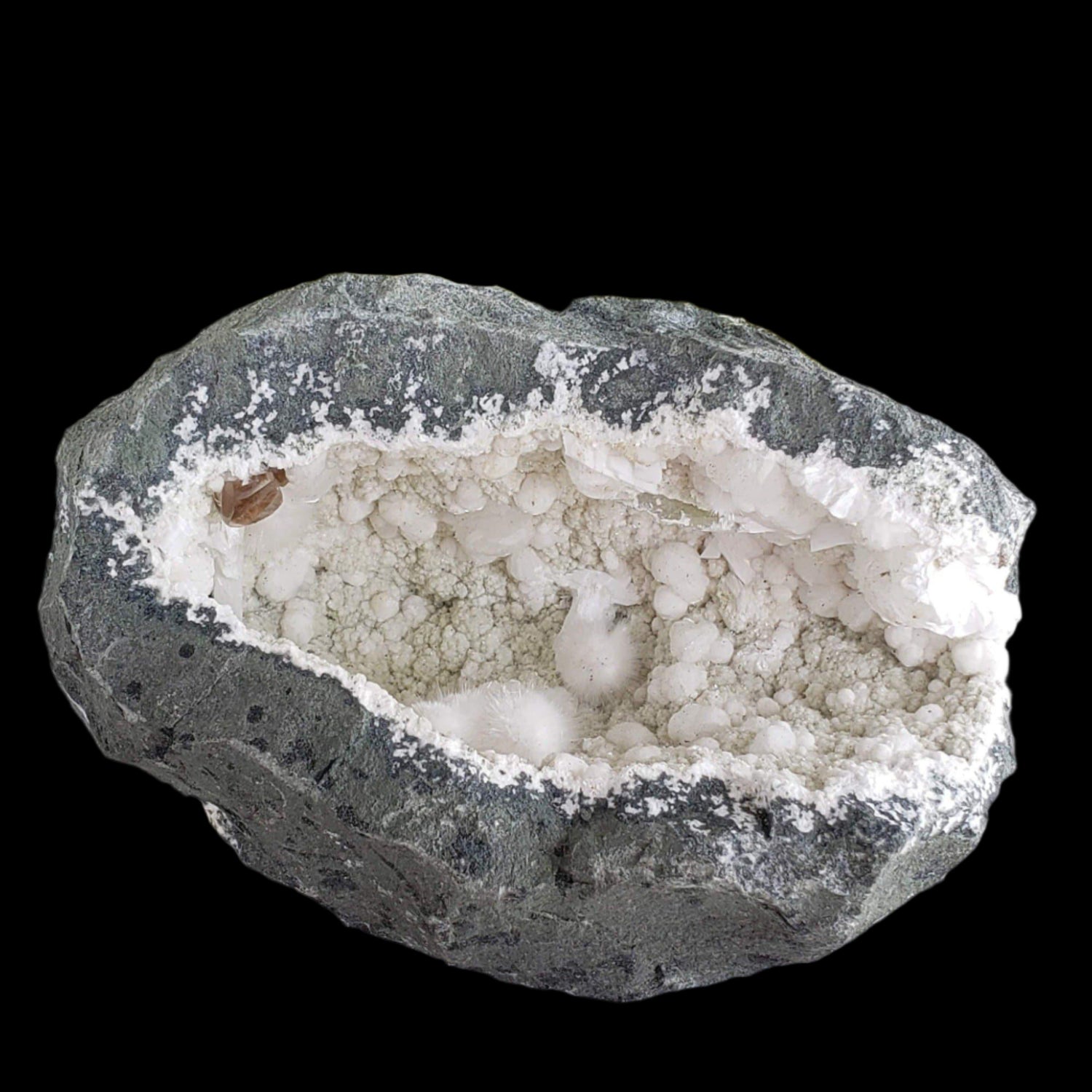
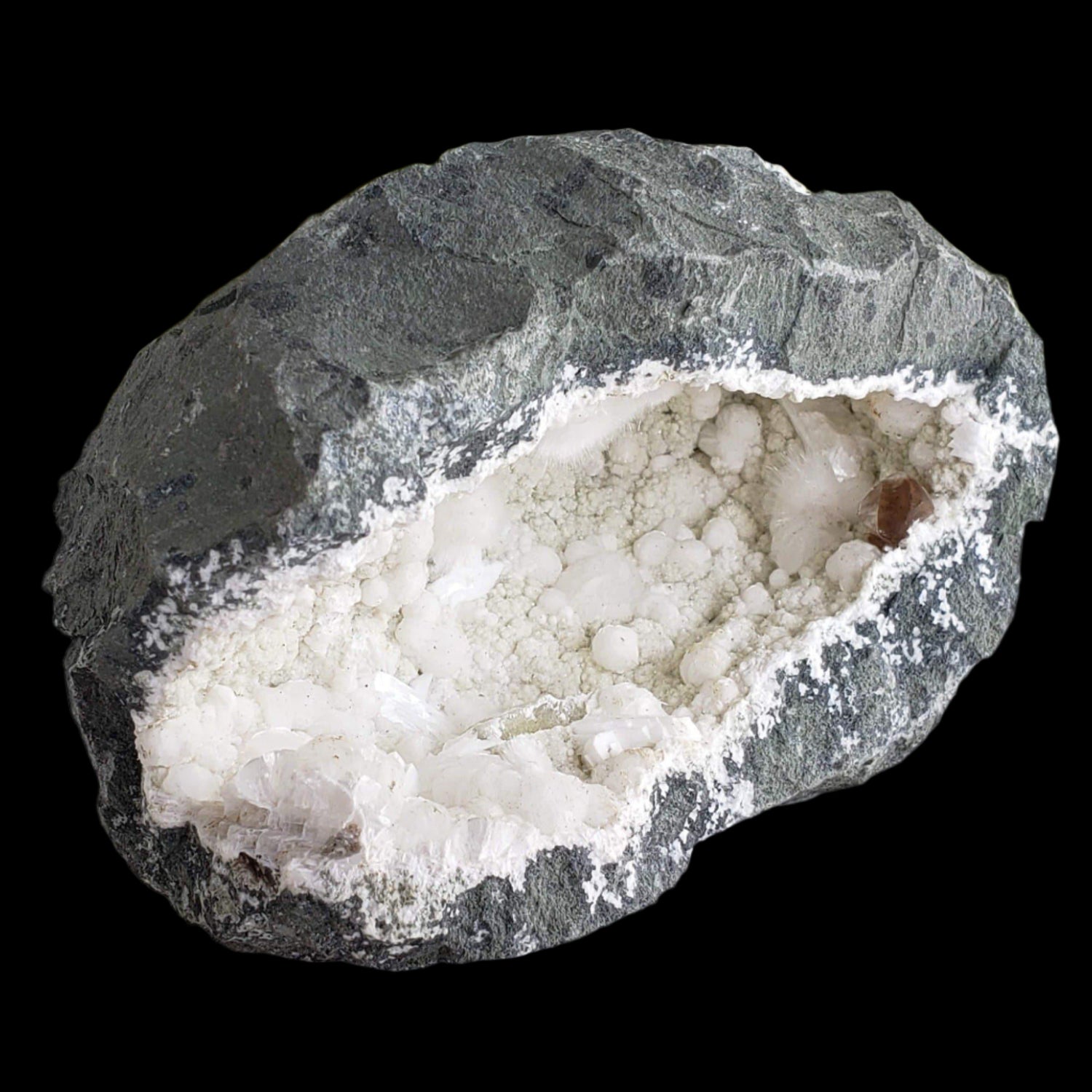
Okenite, Calcite, Prehnite and Smoky Quartz in Geode | 796 grams | Dindoshi, India
$220.00 CAD
Unit price perOkenite, Calcite, Prehnite and Smoky Quartz in Geode | 796 grams | Dindoshi, India
$220.00 CAD
Unit price perOkenite is a silicate mineral that is usually associated with zeolites. It most commonly is found as small white "cotton ball" formations within basalt geodes. These formations are clusters of straight, radiating, fibrous crystals that are both bendable and fragile.
Calcite is found throughout the world in sedimentary, metamorphic, and igneous rocks. Some geologists consider it to be a "ubiquitous mineral" - one that is found everywhere. Calcite is the principal constituent of limestone and marble.
Quartz crystals are among the most abundant and well-known minerals on Earth. It belongs to the hexagonal crystal system, and typically forms six-sided prismatic crystals with a pointed termination. Its crystals can be colorless or exhibit a wide range of colors. The color variations are often due to the presence of impurities or trace elements during the crystal's formation. Quartz is transparent to translucent.
Prehnite can form prismatic, tabular, or pyramidal crystals, but usually occurs in botryoidal, reniform, stalactitic, granular, or compact habits. It is usually green in colour, but may be white, colourless, yellow, or gray. It has a colourless streak. Prehnite is transparent to translucent, with a vitreous to pearly luster. Prehnite forms in cavities in basaltic lavas.
Name: Okenite, Calcite, Quartz and Prehnite Geode
Specimen Size: Large Cabinet-Sized
Dimensions: 120.7x88.9x76.2 mm / 4.75x3.5x3 inches
Weight: 796 Grams / 28.1 ounces
Origin: Mined in Dindoshi, India


Quartz crystals are among the most abundant and well-known minerals on Earth. It belongs to the hexagonal crystal system, and typically forms six-sided prismatic crystals with a pointed termination. Its crystals can be colorless or exhibit a wide range of colors. The color variations are often due to the presence of impurities or trace elements during the crystal's formation. Quartz is transparent to translucent.
Name: Quartz
Specimen Size: Miniature-Sized
Dimensions: 50x45mm / 2x1.8 inches
Weight: 58 Grams / 2 Ounces
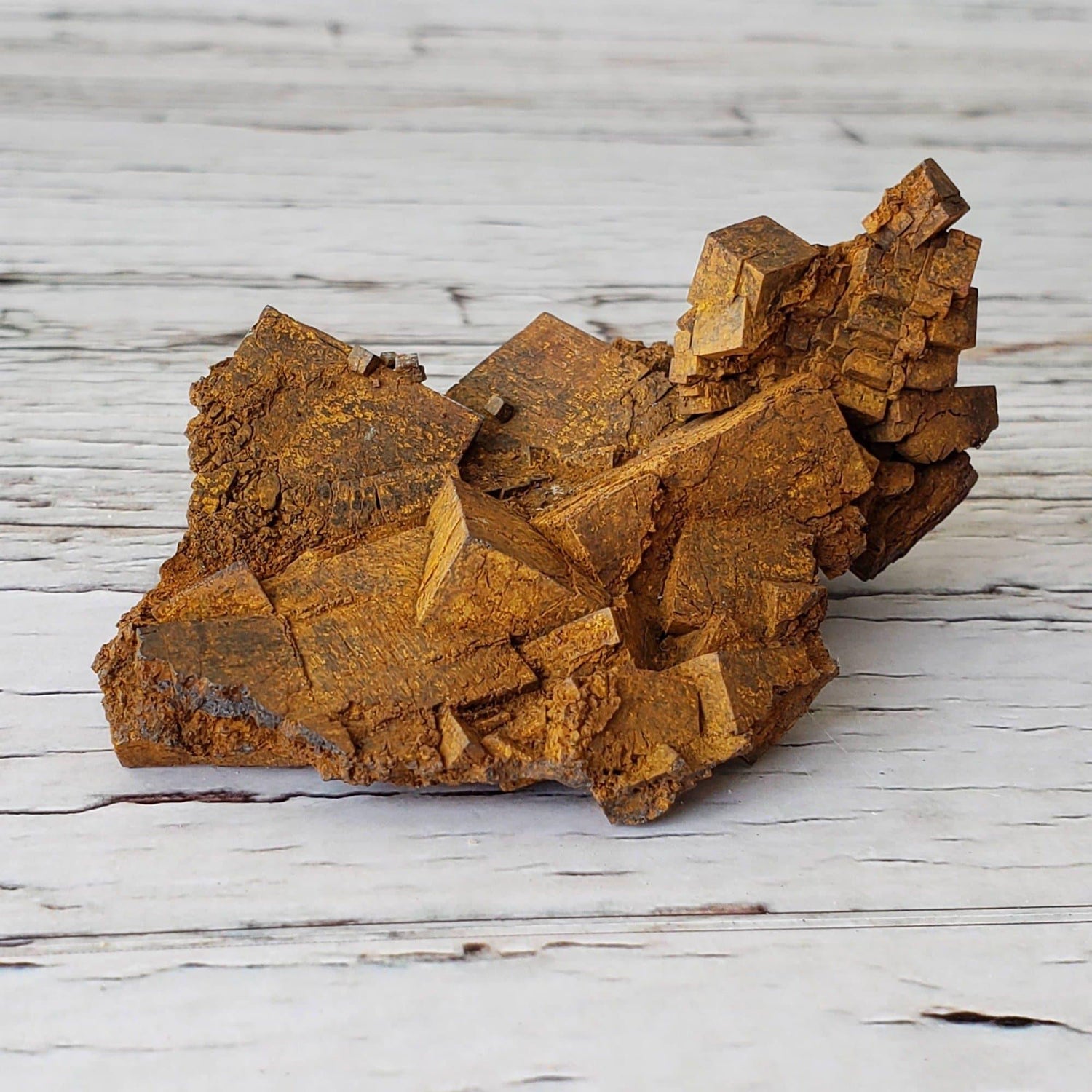
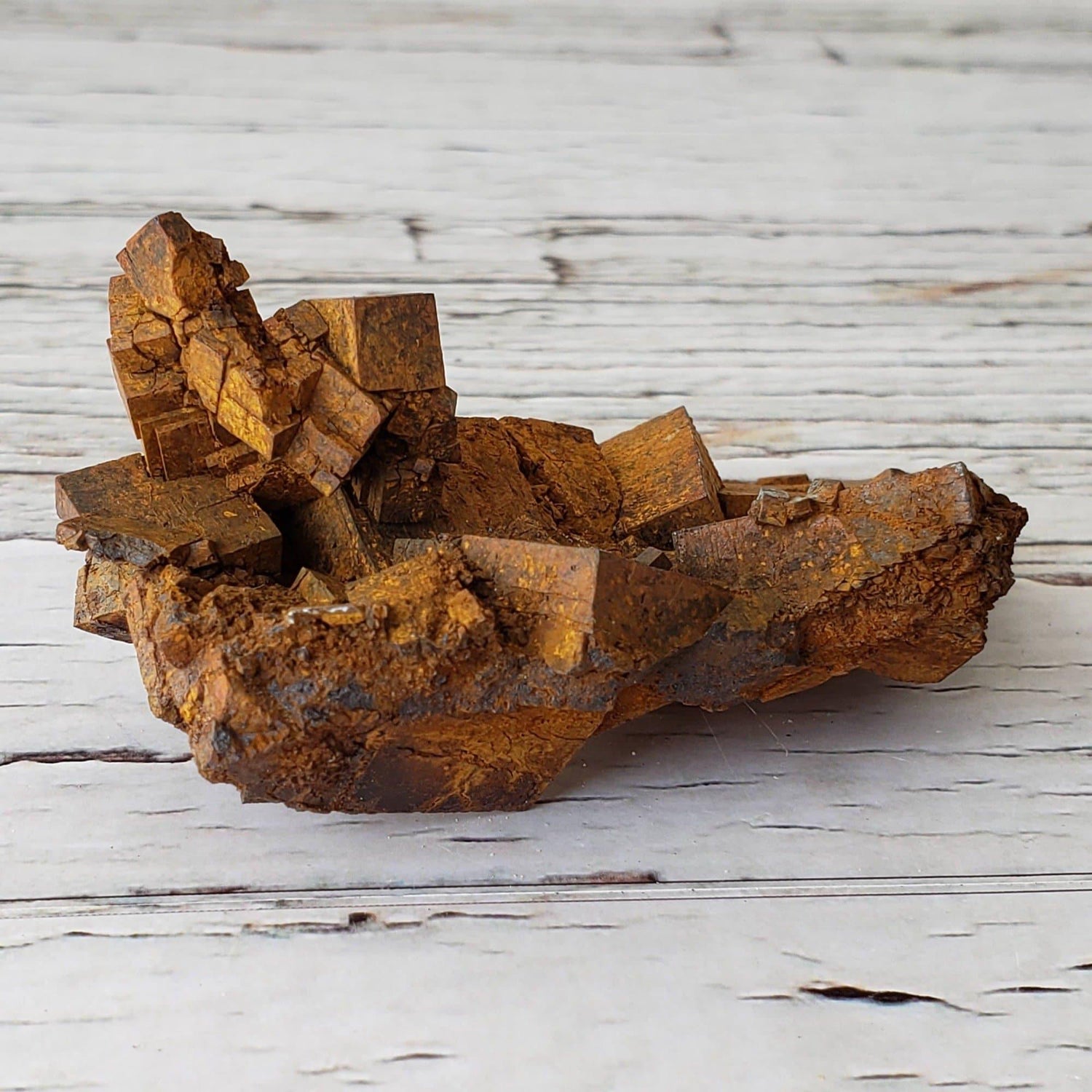
Limonite after Pyrite Mineral Cluster | 99.7 gr | Carratraca, Spain | SO24
$54.97 CAD
Unit price perLimonite after Pyrite Mineral Cluster | 99.7 gr | Carratraca, Spain | SO24
$54.97 CAD
Unit price perThis is a sculpted plate of Limonite after Pyrite. What was once Pyrite crystals transformed into iron oxide that is this hydrated Limonite. It's a great specimen from Spain.
Name: Limonite after Pyrite Cluster
Specimen Size: Cabinet-Sized
Dimensions: 84x60x30 mm / 3.3x2.4x1.2 inches
Weight: 99.7 Grams / 3.5 oz
Origin: Mined in Carratraca, Spain


Mesolite is a fragile member of the zeolite group and forms almost exclusively in delicate, needle-like crystal habits.
Stilbite is perhaps the most popular zeolite mineral for collectors. It is a handsome specimen with its pearly luster and sometimes colorful pink tints.
Name: Mesolite and Stilbite Geode
Specimen Size: Cabinet-Sized
Dimensions: 69.9x69.9x63.5 mm / 2.75x2.75x2.5 inches
Weight: 352 Grams / 12.4 Ounces
Origin: Mined in Dindoshi, India


Heulandite is one of the most common and well known members of the Zeolite Group. It has a nice pearly luster and lovely colored hues. It forms wonderfully complex and quite unique crystals and is often associated with other rare and beautiful minerals.
Mordenite was first described in 1864 by Henry How. He named it after the small community of Morden, Nova Scotia, Canada, along the Bay of Fundy, where it was first found. It is one of the most abundant zeolites and is found in volcanic rock such as rhyolite, andesite, and basalt. It is associated with other zeolites such as stilbite and heulandite.
Name: Heulandite and Mordenite Crystals
Specimen Size: Cabinet-Sized
Dimensions: 88.9x69.9x31.8 mm / 3.5x2.75x1.25 inches
Weight: 160 Grams / 5.6 Ounces
Details: Mined in Jalgaon, India

Canagem is proud to be professional member of The International Gem Society(IGS) the world's top resource for gem professionals, enthusiasts, and industry content.