

📢 Notice to ALL Customers 📢
288 products
Sort by:
288 products
288 products


This is a beautiful cluster of intergrown pyrite and tetrahedrite. When these two minerals form in the same location, they create interesting clusters where the sharp, cubic crystals of pyrite contrast with the more blocky, tetrahedral crystals of tetrahedrite. The contrast in their appearance is striking.
Pyrite is known for its ability to shield against negativity, boost confidence, and attract prosperity, while tetrahedrite promotes emotional healing, spiritual connection, and inner balance. Together, this cluster is believed to help manifest success, encourage personal growth, and maintain focus and clarity.
This top specimen is in very good condition. Would be a beautiful addition to any new or existing collection.
Name: Cubic Pyrite and Tetrahedrite Crystal Cluster
Specimen Size: Cabinet-Sized
Dimensions: 66x51x22 mm / 2.6x2x.9 inches
Weight: 117 Grams / 4.1 oz
Origin: Mined in Peru


This beautiful cluster of tetrahedrite with calcite, small terminated quartz crystals and tiny flecks of pyrite.
Tetrahedrite crystals are fascinating minerals known for their distinctive tetrahedral shape and shiny, metallic luster. It typically forms in well-defined tetrahedral crystals, which can be grouped in clusters. The color range includes shades of metallic gray, black, and sometimes reddish hues due to the presence of copper and other trace elements. Tetrahedrite is commonly found in hydrothermal veins and is often associated with other minerals such as quartz, galena, and sphalerite.
Tetrahedrite is believed to promote emotional healing and provide a protective shield against negativity. It is thought to enhance creativity and clarity, helping individuals connect with their inner selves.
This top specimen is in very good condition. Would be a beautiful addition to any new or existing collection.
Name: Tetrahedrite, Calcite and Quartz Crystal Cluster
Specimen Size: Miniature-Sized
Dimensions: 56x47x23 mm / 2.2x1.9x0.9 inches
Weight: 59.20 Grams / 2.1 oz
Origin: Mined in Peru


Approx Weight (per piece): 49.54ct
Size: 24x22mm
Shape: Baguette Cabochon
Color: White with Silver Spots
Clarity: Transparent
Origin: Brazil


Gyrolite often forms nodular aggregates that can appear glassy, dull or even fibrous. The aggregate nodules often accompany many fine and rare minerals such as Apophyllite and Okenite plus many of the Zeolites.
Calcite is found throughout the world in sedimentary, metamorphic, and igneous rocks. Some geologists consider it to be a "ubiquitous mineral" - one that is found everywhere. Calcite is the principal constituent of limestone and marble.
Name: Gyrolite and Calcite on Quartz Matrix Cluster Crystal
Specimen Size: Cabinet-Sized
Dimensions: 95x57x57 mm / 3.75x2.25x2.25 inches
Weight: 240 Grams / 8.5 Ounces
Origin: Mined in Dindoshi, India


Here we have for you a nice looking end cut of a Sahara Desert NWA unclassified meteorite weighing 95 grams. Its dimensions are 59x41x29mm. This never classified North West Africa stone was found in the Sahara desert around 2000.
It's a good quality cut NWA meteorite specimens showing interesting internal structure (L5?) and somewhat attractive with a mottled interior with chondrules and metallic flakes. Some weathering shows the meteorite's time spent aging in the desert. Displays nicely with a ground and rough polished without a mirror finish.
Would be a beautiful addition to any new or existing collection. Comes with a Canagem Collection specimen card.


Heulandite is one of the most common and well known members of the Zeolite Group. It has a nice pearly luster and lovely colored hues. It forms wonderfully complex and quite unique crystals and is often associated with other rare and beautiful minerals.
Mordenite was first described in 1864 by Henry How. He named it after the small community of Morden, Nova Scotia, Canada, along the Bay of Fundy, where it was first found. It is one of the most abundant zeolites and is found in volcanic rock such as rhyolite, andesite, and basalt. It is associated with other zeolites such as stilbite and heulandite.
Name: Heulandite and Mordenite Crystals
Specimen Size: Cabinet-Sized
Dimensions: 88.9x69.9x31.8 mm / 3.5x2.75x1.25 inches
Weight: 160 Grams / 5.6 Ounces
Details: Mined in Jalgaon, India


This beautiful sphere was polished from natural yellow Jade. Beautifully blended yellow and cream colors make this sphere very attractive. Jade is a well known stone throughout the world and has been highly regarded since ancient times in many cultures.
Name: Jade Sphere
Dimensions: 55.5 mm / 2.2 inches
Weight: 243.7 Grams / 8.6 oz
Origin: China


This beautiful sphere was polished from natural Siberian Jade. Beautifully blended green, black and white colors makes this sphere look very attractive. Jade is a well known stone throughout the world and has been highly regarded since ancient times in many cultures.
Name: Jade Sphere crystal
Dimensions: 50.25 mm / 2 inches
Weight: 180.3 Grams / 6.36 oz
Origin: Russia

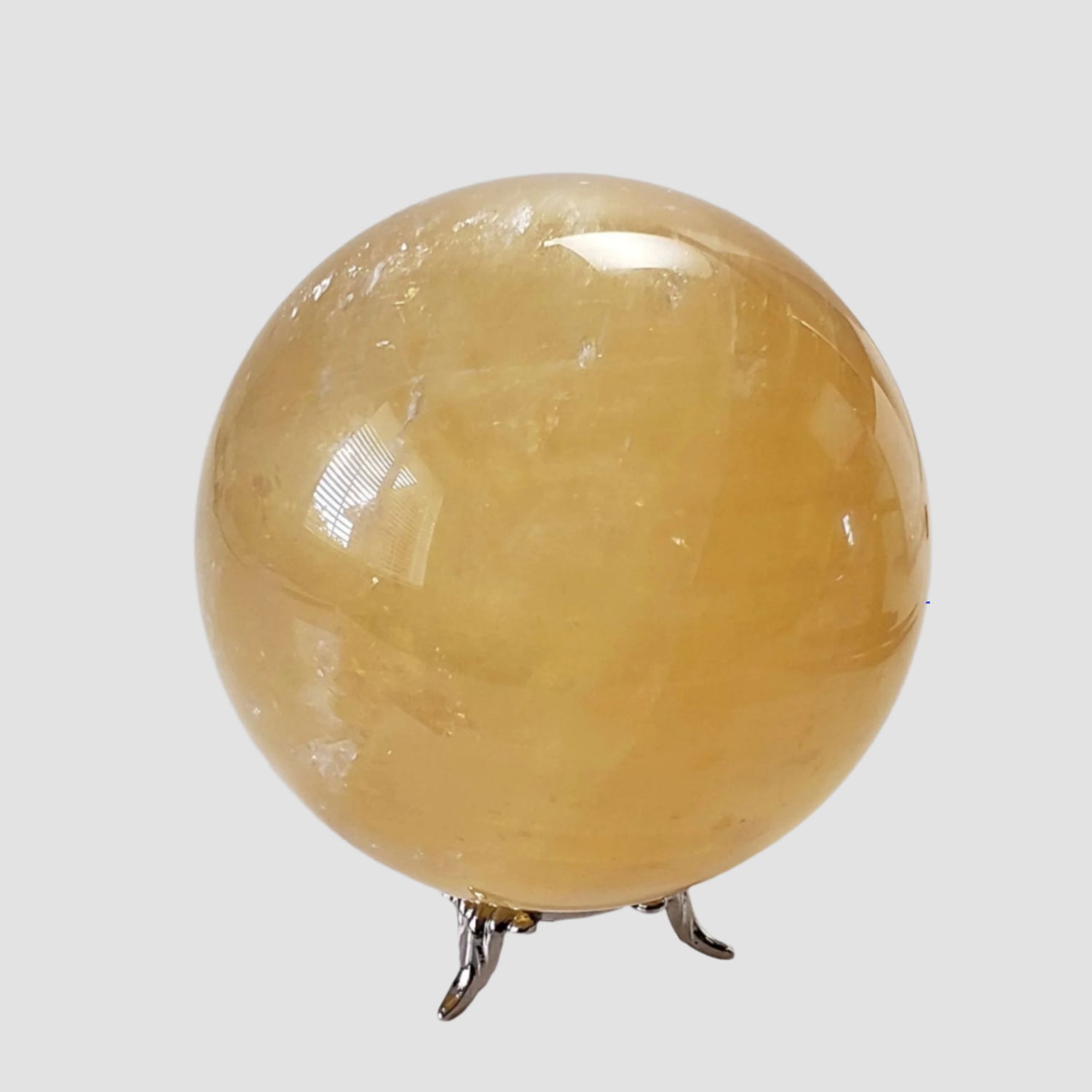
While it's commonly colorless or white, Calcite can also appear in various hues, including shades of green, blue, yellow, orange, red, brown, and even black. This sphere is a beautiful example of yellow calcite. The coloration is often due to impurities or exposure to different minerals during formation. Calcite is typically transparent to translucent, allowing light to pass through and sometimes exhibit a phenomenon called double refraction. is found throughout the world in sedimentary, metamorphic, and igneous rocks.
Calcite is associated with clarity, amplification of energy, and cleansing. It is believed it can help with emotional healing, motivation, and creativity.
Name: Calcite Sphere
Dimensions: 87 mm / 3.4 inches
Weight: 952 Grams / 2.2 Lbs
Origin: China
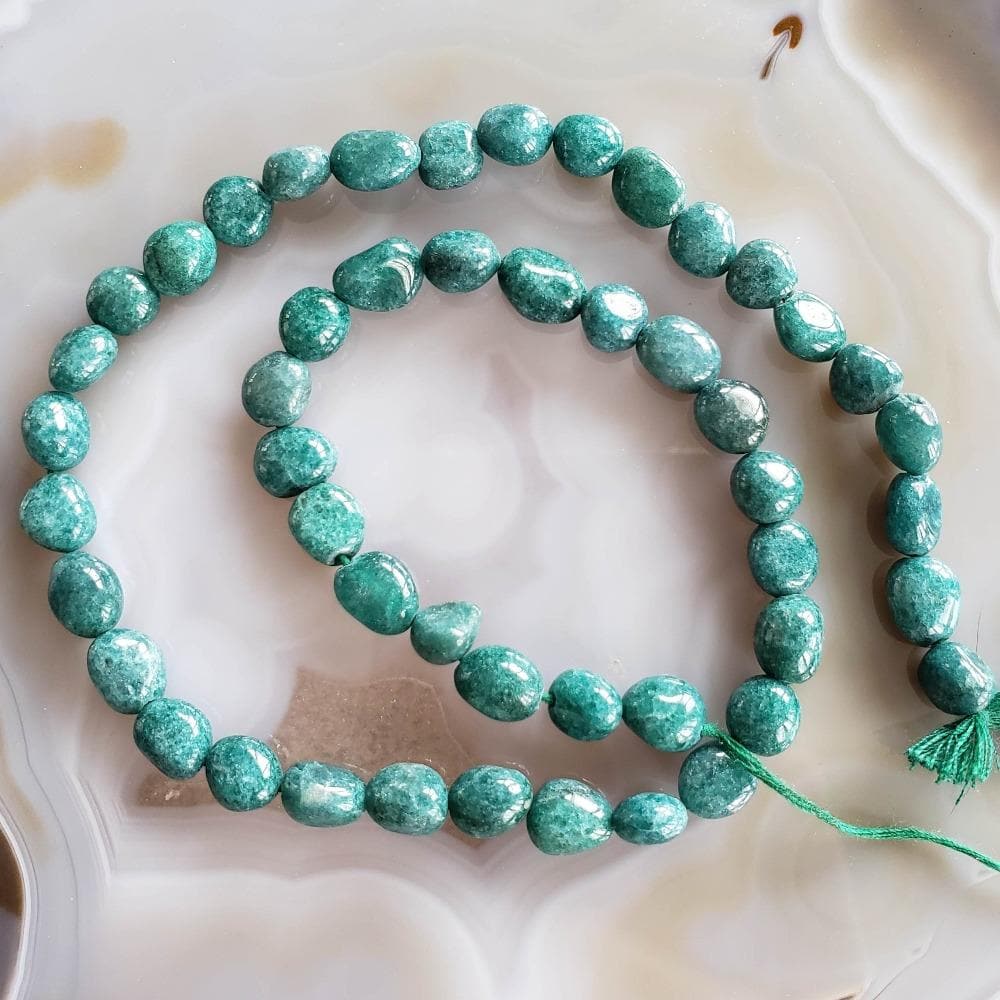
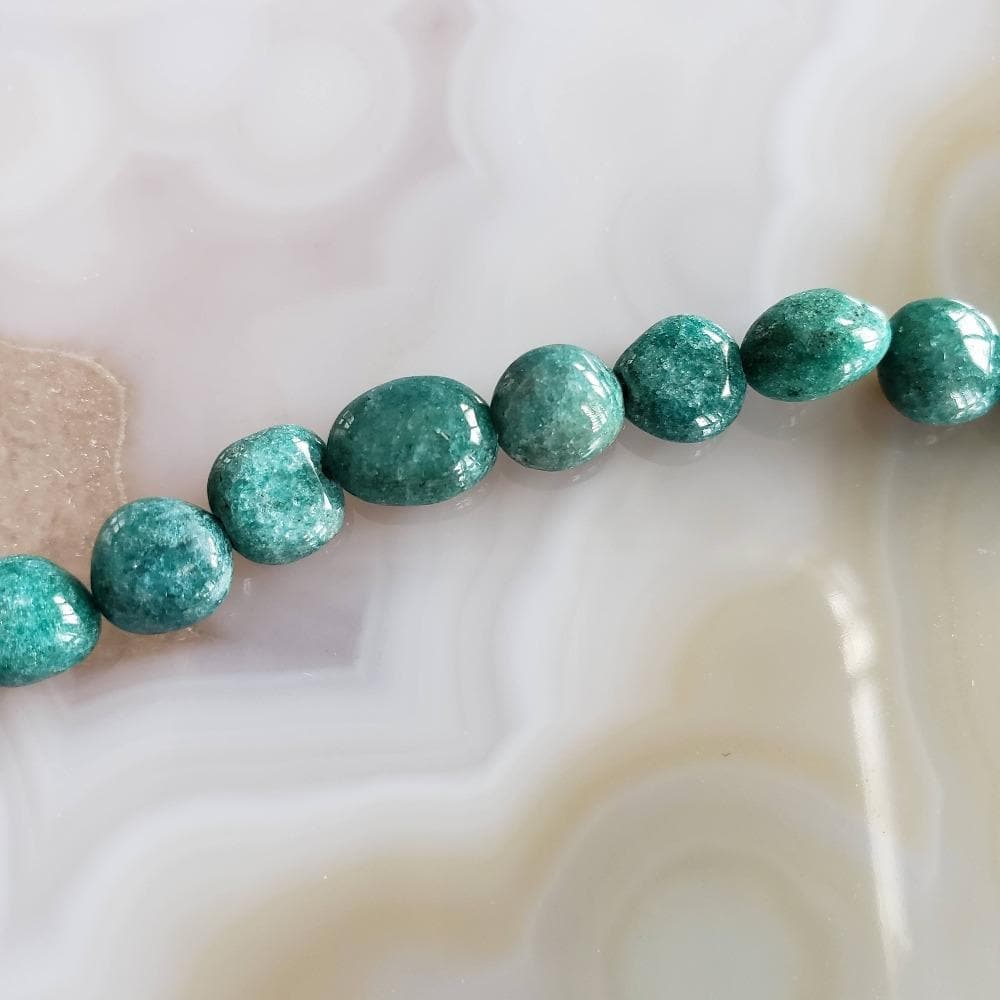
This is a strand of lovely green Aventurine beads with an overall length of 38 cm (15 inch). The individual gemstone beads are oval in shape and range in size from 7x6 to 10x6 mm. In total, the bead strand contains over 99ct of natural Aventurine beads.
Product Type: Aventurine Beads
Approx Weight (per Strand): 99.7ct
Bead Size: 7x6 to 10x6 mm
Strand Length: 38 cm Total
Shape: Oval
Color: Green

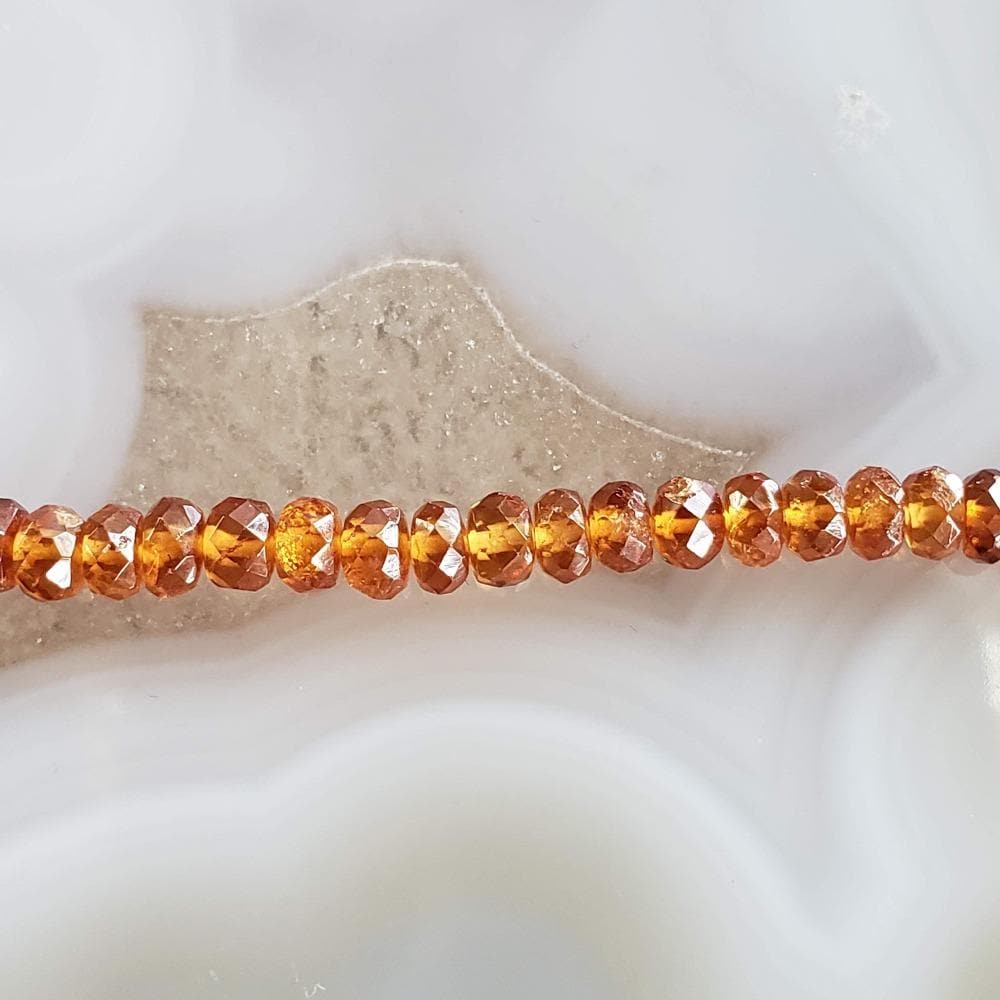
This is a strand of natural Hessonite Garnet beads with an overall length of 42 cm (16.5 inches). The individual gemstone beads are faceted rondelle shaped and range in size from 3 to 5.5 mm. In total, the bead strand contains over 63ct of natural Hessonite Garnet beads.
Also known as the cinnamon stone, hessonite is the yellow orange to reddish orange variety of grossular garnet.
Hessonite is said to impart self-respect and eliminate feeling of guilt and inferiority. It is also believed to aid one in seeking out new challenges.
Product Type: Hessonite Garnet Beads
Approx Weight (per Strand): 63.2ct
Bead Size: 3 to 5.5 mm
Strand Length: 42 cm /16.5 inches
Shape: Faceted Rondelle
Color: Cinnamon


The NWA 267 meteorite fragment offered here is in as found condition. It weighs 10.8 grams, with dimensions of 31x22x16 mm. The meteorite will come with two specimen description cards including a signed "The Mark Bostick Collection" card.
This meteorite was once a pile of weathered unclassified meteorite fragments brought to the 2000 Denver show by a Moroccan fossil dealer. These fragments, 73.9 kg. worth, where purchased by Canadian meteorite dealer Dean Bessey, who was told the following on the meteorites: "A nomad found an area with a lot of unusual strange stones near the Morocco/Algeria border. He brought one to a fossil dealer and asked: "I hear that you will pay money for stones like this". After shaking his head in disbelief at a positive response, the nomad gathered up all his camels, wives and children and brought them into the desert to search over his personal strewn field." Or at least that is how the story goes.
Many thousands of stones, 73.9 kilograms, were recovered, most of these fragments under 20 grams. Then 356 grams and a thin section of the meteorite was donated to the Vernadaky Institute of Geochemistry and Analytical Chemistry, part of the Russian Academy of Sciences, Moscow, where it was classified by M. Ivanova. This meteorite, an ordinary stone chondrite, H4 class has a Shock Rating of 2 and a Weathering Grade of 2-3 and the classification information was published in Meteoritical Bulletin 85.
While the stone did not get a heavy weathering grade, very few specimens show any crust. This meteorite is believed to have come from the Hebe class asteroids. I've included an informational photo of a NWA 267 Meteorite thin section which are used in earth geology, and in meteorites to identify the minerals in them. The photo shows a large imperfect elongated chondrule. Chondrules are unique features to meteorites. The chondrule shown is composed of mostly pyroxene and the bright colored minerals scattered throughout the thin section is mostly olivine.
One of the fun facts is that the NWA 267 was also the first meteorite ever minted onto a real legal tender coin. The National Bank of Liberia made 999 of these $10.00 Silver coins in 2004. The meteorite used in the coin, was supplied by Mark Bostick himself and his name and signature came on the certificate with the coin. The provided images of the coin shows a nomad on a camel on the obverse. A meteorite is falling through the star filled sky in the background. Reverse of coin has a seal of the Liberia Government and notes its value. We include 2 specimen cards but unfortunately the thin section and coin used in the ad are NOT included!


The principal member of the Aragonite Group, aragonite is the second most common polymorph of natural calcium carbonate (the most common is calcite). It is significantly less widespread and abundant than calcite and is formed under a much narrower range of physiochemical conditions. It is metastable relative to calcite and often converts to calcite accompanying changes in the environment. It is nearly always a low-temperature, near surface mineral.
Name: Aragonite Sphere
Dimensions: 67 mm / 2.6 inches diameter
Weight: 427 grams / 15.1 ounces
Origin: China


Quartz crystals are among the most abundant and well-known minerals on Earth. It belongs to the hexagonal crystal system, and typically forms six-sided prismatic crystals with a pointed termination. Its crystals can be colorless or exhibit a wide range of colors. The color variations are often due to the presence of impurities or trace elements during the crystal's formation. Quartz is transparent to translucent.
Phantom quartz is a variety of quartz, or "rock crystal", that forms over pre-existing crystals. The included crystal is visible due to some variation in composition making the boundary of the included crystal visible. Such crystals display the outlines of numerous smaller crystals, known as phantoms. Great crystal to acquire.
Name: Quartz
Specimen Size: Large Cabinet-Sized
Dimensions: 113x66x75 mm / 4.4x2.6x3 inches
Weight: 498 Grams / 17.6 Ounces
Origin: Mined in China


Calcite is found throughout the world in sedimentary, metamorphic, and igneous rocks. Some geologists consider it to be a "ubiquitous mineral" - one that is found everywhere. Calcite is the principal constituent of limestone and marble. Nice clear crystal with a small cloud passing by.
Name: Calcite Sphere
Dimensions: 53 mm / 2.1 inches
Weight: 209 Grams / 7.4 Ounces
Origin: Brazil


Labradorite is an unusual mineral. It can display a beautiful iridescent play of colors, caused by internal fractures in the mineral that reflect light back and forth, dispersing it into different colors. This effect, known as labradorescence, gives Labradorite its appeal and fame.
Product Type: LabradoriteSpecimen Size: Miniature-Sized
Dimensions: 54x45 mm / 2.1x1.8 inches
Weight: 160 grams / 5.6 ounces
Origin: Madagascar

Canagem is proud to be professional member of The International Gem Society(IGS) the world's top resource for gem professionals, enthusiasts, and industry content.