

📢 Notice to ALL Customers 📢
Search results
947 results
Search results


Mangano Calcite is a beautiful soft pink colour, often with white banding. It is very strongly UV reactive, glowing a bright orange-pink colour under UV light. The pink colour comes from Manganese and the best specimen often comes from Peru. Specimen will also combine clear Quartz, Pyrite and white Calcite.
Mangano Calcite is said to be a loving and nurturing stone that helps us to be kind to ourselves and to accept and give love. It is also said to be a powerful stress reliever.
This top Peruvian specimen is in very good condition. Would be a beautiful addition to any new or existing collection.
Name: Mangano Calcite Crystal Cluster
Specimen Size: Miniature-Sized
Dimensions: 50x32x22 mm / 2.0x1.3x0.9 inches
Weight: 20.25 Grams / 0.7 oz
Origin: Mined in Peru


This is a rare 21.69-gram Kamensk Crater Impactite end cut specimen from the impact crater located 10 to 15 kilometres (6.2 to 9.3 mi) to the north of Kamensk-Shakhtinsky town in Rostov Oblast, Russia. Its dimensions are 57x43x12 mm.
Kamensk crater is 25 km (16 mi) in diameter and the age is estimated to be 49.0 ± 0.2 million years old (Eocene). The crater is not exposed at the surface. It may have formed at the same time as the smaller and nearby Gusev crater. Although not a meteorite, impactites are directly linked to them and their impacts and are probably going to be one of the rarest collection pieces you'll ever own.
Take a closer look at a piece of history with this remarkable impactite. A highly unique addition to any new or existing collection. Comes with a Canagem Collection specimen card.


Here we have for you a superb looking Stony-iron or Mesosiderite Vaca Muerta (Dead Cow) classified meteorite weighing 34 grams. Its dimensions are 34x24x26 mm.
This classified meteorite was found in 1861 in the driest desert of the world called the Atacama, in Chile. Mesosiderites are formed on the surface of a parent body as a result of impacts with another body. The impact mixed broken fragments of surface eucrites with iron and olivine from deep within the body. Eucrites are believed to have come from the asteroid Vesta. Analysis has shown, however, that the Vaca Muerta eucrite inclusions are not consistent with other eucrites and possibly originated on a different parent body. Although most have a weathered exterior, they also have lots of metal inside and can be prepared and cut to show this.
This piece displays extremely well and would be a beautiful addition to any new or existing collection. Comes with a Canagem® specimen card.


This is a must have 51.4 gram Impact Breccia also referred to as Suevite coming from the famous Rochechouart impact structure in South Western France,. Although not a meteorite, impactites are directly linked to them and their impacts and are probably going to be one of the rarest collection items you'll ever own. Impactite is a slag-like glassy object found on the surface of the earth, formed from rock melted by the impact of a meteorite.
Named after the town of Rochechouart, the Rochechouart impact structure is located on the western margin of the French Massif Central near the city of Limoges, approximately 350 km (220 mi) south of Paris. Rochechouart (population about 3800) is built with rocks created or modified by the impact (impactites).
The term impactite encompasses shock-metamorphosed target rocks, melts or suevites and mixtures of the two, as well as sedimentary rocks with significant impact-derived components and shocked mineral grains, tektites, anomalous geochemical signatures, etc. This impactite was formed 186 million years ago. This deformed rock fragments and partly molten are imbedded in a melt matrix showing typical flow structures from former melt.
This gorgeous slice displays very well with a mass of 81x58x8 mm. Would be a beautiful addition to any new or existing collection. Comes with a Canagem Collection specimen card.


Here we have for you a nice looking end cut of a Sahara Desert NWA unclassified meteorite weighing 147.64 grams. Its dimensions are 41x38x49mm. This never classified North West Africa stone was found in the Sahara desert around 2000.
It's a good quality cut NWA meteorite specimens showing interesting internal structure (L5?) and somewhat attractive with a mottled interior with chondrules and metallic flakes. Some weathering shows the meteorite's time spent aging in the desert. Displays nicely with a ground and rough polished without a mirror finish.
Would be a beautiful addition to any new or existing collection. Comes with a Canagem Collection specimen card.

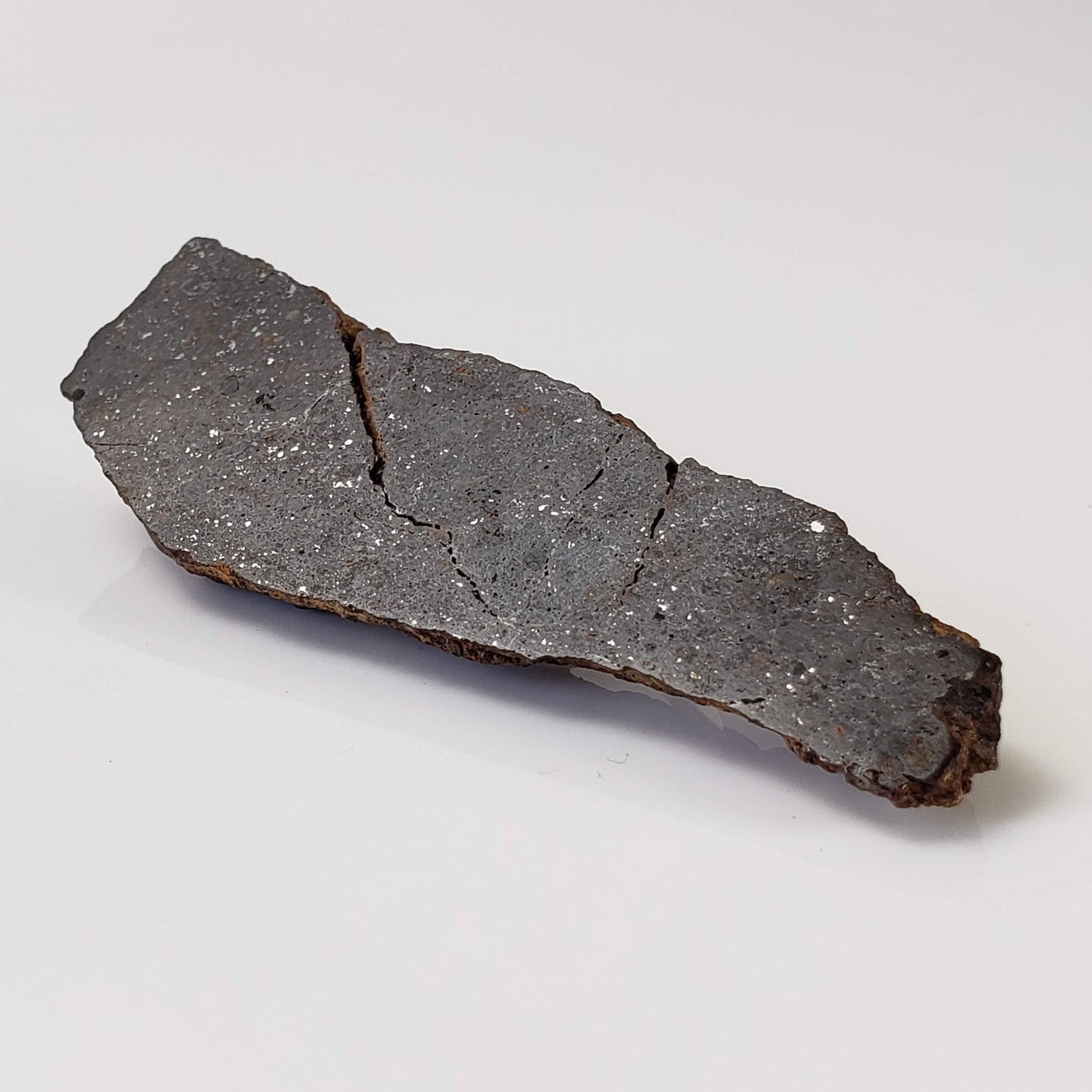
This is an incredible Korra Korrabes meteorite end cut of 18.1 grams, it measures 68x22x9 mm. This gorgeous classified meteorite is an H3 Chondrite and part of a 22 kg stone plus 11 smaller pieces totaling ~18 kg that were found November 1996 in a dry river bed by a farmer who was searching for Gibeon irons.
People searching with metal detectors recovered hundreds of additional buried, more weathered pieces within 50 m of the original material since 2000 November, bringing the total mass to ~120–130 kg. The largest specimen was used in a garden wall until August 2000.
This amazing piece was professionally prepared and would be a beautiful addition to any new or existing collection. Comes with a Canagem Collection specimen card.


This is a great looking part slice of the Ashmore Olivine-Bronzite H5 Chondrite classified meteorite. The part slice weighs 0.4 grams.
A mass of 55.4 kg was found in 1969 by Paul Caughron during deep plowing. It lay at a depth of approximately 18 inches within the soil, with its large side down and its nose up.
The specimen comes with a BA-Meteorites.de.vu and a Canagem specimen card. Would be a beautiful addition to any new or existing collection.


This is a superb individual Tsarev meteorite weighing 122.9 grams. Its dimensions are 58x44x40 mm. Twenty-eight specimens of this L5 classified meteorite were found in fields. The largest mass weighs 284 kg, the smallest 761 gr with a total weight of 1.23 Tons. The greatest distance between the find sites was 6.0 km.
In 1968, amidst a global surge in conflicts, a remarkable discovery was made in a small village in Volgograd Oblast. This region, known as the primary site of the Battle of Stalingrad—one of the largest and bloodiest battles in history—yielded an extraordinary find in the quiet fields near the rural village of Tsarev.
The Tsarev meteorite, named after the Russian word for czar, is a stone meteorite responsible for one of the largest meteorite showers in Russian history. This meteorite shower occurred on December 6, 1922, but the stones were not discovered until 1968 and only recognized in 1979. The Tsarev meteorite's mineral composition matches that of ordinary chondrites, including olivine, orthopyroxene, clinopyroxene, maskelynite, calcium phosphates, nickel-iron, troilite, chromite, ilmenite, and rutile.
Academic analysis of the Tsarev meteorite reveals significant features: large grains of nickel-iron, light grey areas with well-preserved chondritic texture, and dark areas containing a matrix with olivine grains and remnants of chondrules.
This specimen would be a beautiful addition to any new or existing collection. Will come with a Canagem specimen card.
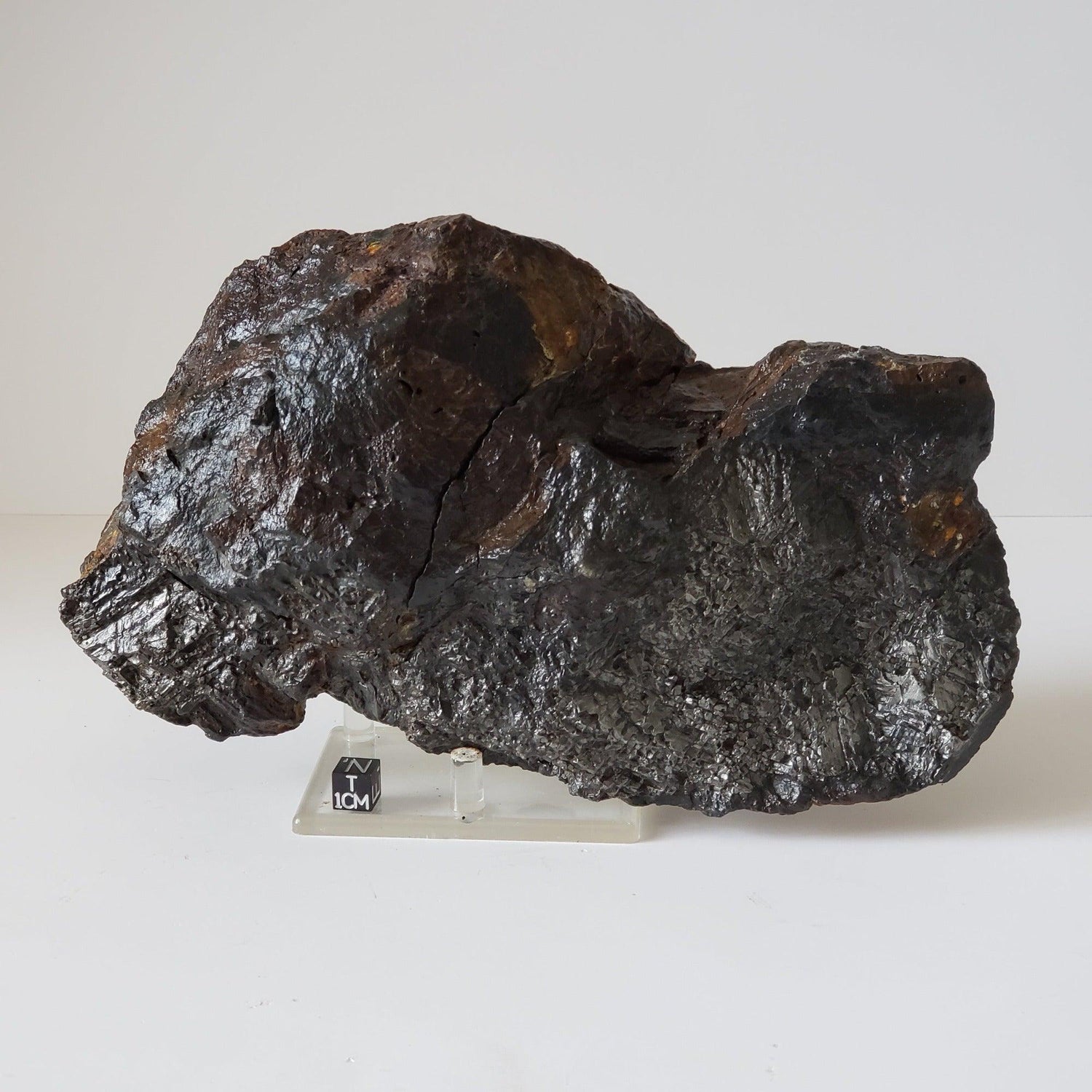

Nantan Meteorite | 6.6 KG | Rare Museum Grade | IAB-MG Iron | Guangxi China
This is a unique and rare museum grade 6.6 Kg (14.5 lbs) Nantan meteorite directly from Guangxi, China. Its dimensions are 23.5X14X9.5 cm (9.25x5.5x3.75 in.).
The Nantan meteorites, named "One of the oldest objects anywhere on Earth", are a must for all collectors, more so that it is now impossible to find worthy specimen. At about 4.5 billion years old, the Nantan meteorite is as ancient as the Earth itself. They are a very interesting IAB-MG iron discovered in 1958, although thought to have fallen in 1516. There is an estimated 9.5 T of this amazing space voyageur. This is 1 of 88 approved meteorites classified as Iron, IAB-MG.
Would be a beautiful addition to any new or existing collection. Comes with a Canagem Collection specimen card.


This is a great looking NWA 1108 L6 Chondrite classified meteorite slice weighing 47.16 grams. Its dimensions are 50x31x21 mm. This L6 (S3/W2) chondrite classified meteorite was found in the Sahara Desert in 2003.
The petrography shows some metal and sulfide grains are elongated, metal and sulfide veins are also present. Chondrules are poorly defined and very recrystallized. Some plagioclase grains are 50 μm in size. A few olivine grains contain planar fractures.
The official total weight of the 25 pieces recovered is recorded as 2.8 KG. This beautiful meteorite comes from the Michael Cottingham Meteorite Collection.
Would be a beautiful addition to any new or existing collection. Comes with a Canagem Collection and a Michael Cottingham Collection specimen cards.


This is a fabulous 27 gram Sericho Pallasite Main Group meteorite, it measures 31x28x23 mm. In 2016, two brothers were searching for their camels and came across several large, dense stones west of the village of Habaswein and south of Sericho, Kenya. Though recognized as meteorites in 2016, the masses had been known to camel-herders for decades. One village elder said that as a child, he and his brothers would play on top of the stones. It is classified as an Iron Pallasite main group with low weathering and is 1 of only 68 approved meteorites classified as such, with a recovered weight of about 2.8 T.
This piece displays extremely well and is a nice size showing great features. Would be a beautiful addition to any new or existing collection. Comes with a Canagem Collection specimen card.


This is a superb looking fragment of the Columbus classified meteorite weighing 4.57 grams. Its dimensions are 18x15x10 mm. This rare H5 classified meteorite was found in Luna County, New Mexico USA in 1997. The total weight of the stones recovered is recorded as a minuscule 165 grams.
Here's what the finder, Michael Cottingham told us: "This is the Meteorite that started it all for me! My wife and I were out looking for meteorites on a dry lake bed in Southern New Mexico and I found one! This was a new meteorite discovery and it only took me 300 hours of searching to find my First One! The COLUMBUS Meteorite was found by me in January of 1997. It was Classified by A. Rubin at UCLA as a H5 Chondrite. It was found near Columbus, Luna County, New Mexico and the Total Known Weight is ONLY 184 grams. Very Rare indeed."
This piece is part of America's history and is 1 of 228 approved meteorites from that location. Would be a beautiful addition to any new or existing collection. Comes with a Michael Cottingham Meteorites and a Canagem Collection specimen cards.


This is a rare Iron ungrouped classified Taza Northwest Africa 859 specimen, in an as found state. It weighs 3.4 grams and measures 15x10x6 mm.
The NWA 859 was found in 2001 in Taza, Morocco. A total weight of 75.3 kg of mostly small pieces was classified by UCLA as an Iron, ungrouped; it is one of 157 meteorites classified as such.
This specimen displays extremely well and would be a beautiful addition to any new or existing collection. Comes in a gem jar with a Canagem Collection specimen card.


This is a rare and fantastic 41.8 gram Libyan Desert Glass from Kuffra, Libya, with dimensions of 44x38x24 mm. Although its exact origin is still debated, the leading theory suggests it was formed by a high-energy event, such as a meteoric impact or airburst, that melted the desert sand directly where it lay, without being ejected into the atmosphere and re-entering. This results in different physical characteristics compared to tektites.
Libyan Desert Glass is found specifically in the Great Sand Sea of the Eastern Sahara, within a more localized area spanning parts of western Egypt and eastern Libya. Characterized by its yellow to greenish-yellow color, it lacks the aerodynamic shapes of tektites and often appears as irregularly shaped pieces. It is almost pure silica (around 98%) with very few impurities. Throughout history, it has been regarded as a mystical and powerful material, sometimes used in talismans and amulets.
This piece displays extremely well and is a quality translucent specimen. It has an aesthetic shape with a beautiful wind eroded body from the years spent in the Desert. Would be a beautiful addition to any new or existing collection. Comes with a Canagem Collection specimen card.


This is a rare and fantastic 50.9 gram Libyan Desert Glass from Kuffra, Libya, with dimensions of 65x44x19 mm. Although its exact origin is still debated, the leading theory suggests it was formed by a high-energy event, such as a meteoric impact or airburst, that melted the desert sand directly where it lay, without being ejected into the atmosphere and re-entering. This results in different physical characteristics compared to tektites.
Libyan Desert Glass is found specifically in the Great Sand Sea of the Eastern Sahara, within a more localized area spanning parts of western Egypt and eastern Libya. Characterized by its yellow to greenish-yellow color, it lacks the aerodynamic shapes of tektites and often appears as irregularly shaped pieces. It is almost pure silica (around 98%) with very few impurities. Throughout history, it has been regarded as a mystical and powerful material, sometimes used in talismans and amulets.
This piece displays extremely well and is a quality translucent specimen. It has an aesthetic shape with a beautiful wind eroded body from the years spent in the Desert. Would be a beautiful addition to any new or existing collection. Comes with a Canagem Collection specimen card.
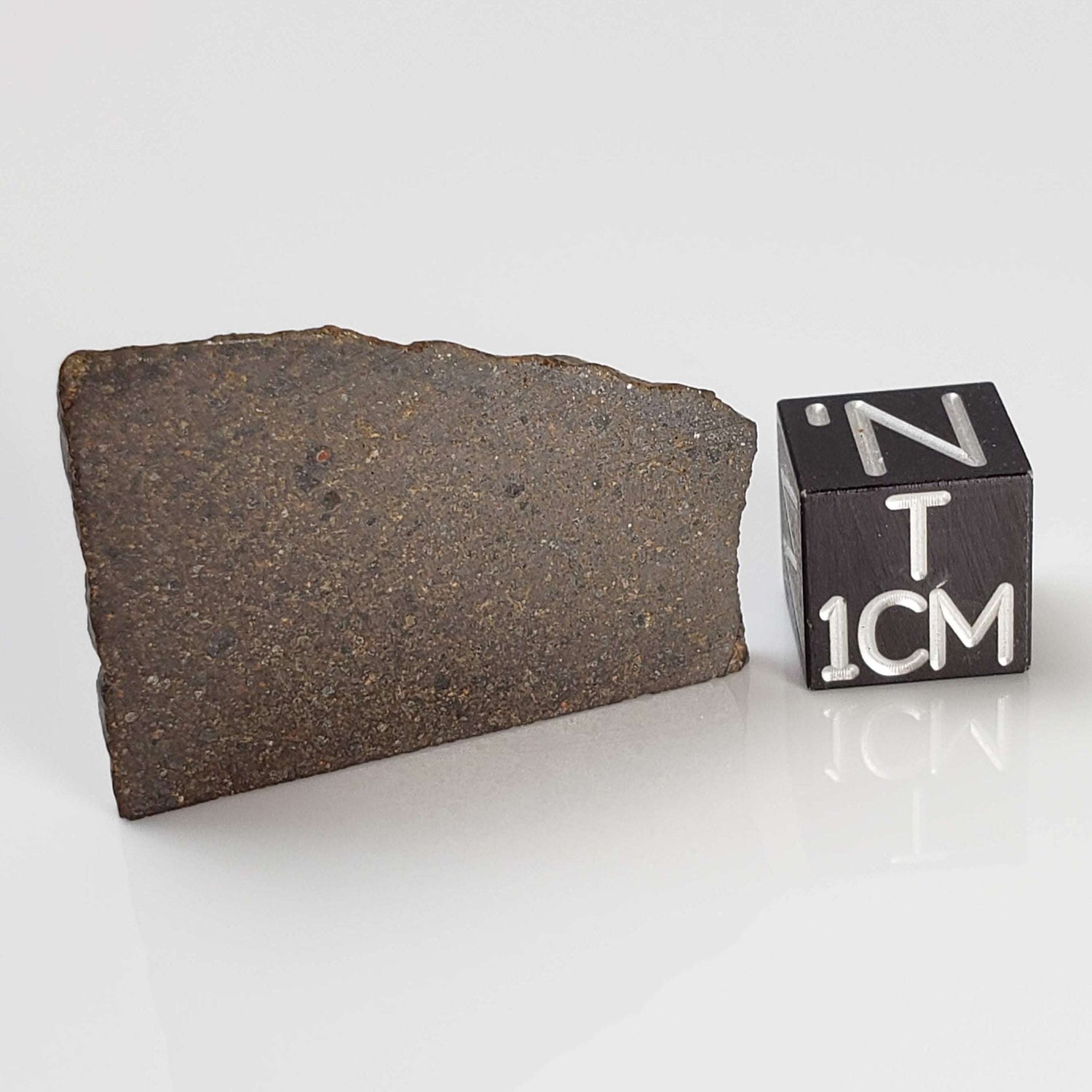
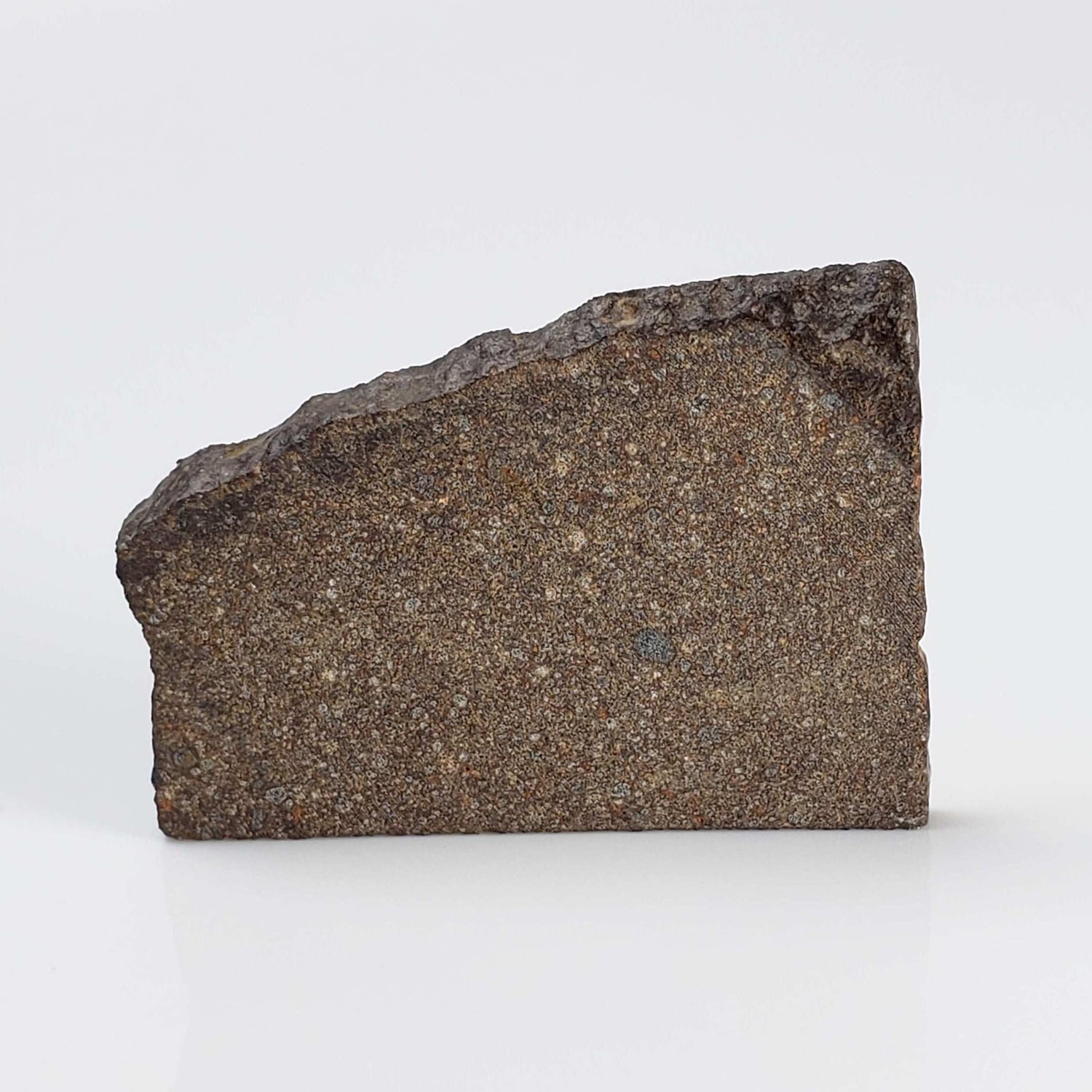
This is a superb looking part slice of Sahara Desert NWA 2663 meteorite. It weighs 3.24 grams and measures 29x21x2 mm. Although still considered unclassified, this meteorite was given the provisional class of CO3.1.
This is a great specimen with many multicolored chondrules and CAIs. It's a Ted Bunch meteorite but unfortunately this find was never fully submitted for analysis. It is a shame for this particular specimen, as it is just special.
This piece displays extremely well with its professionally finished cut face. Would be a beautiful addition to any new or existing collection. Comes with a Canagem Collection specimen card.
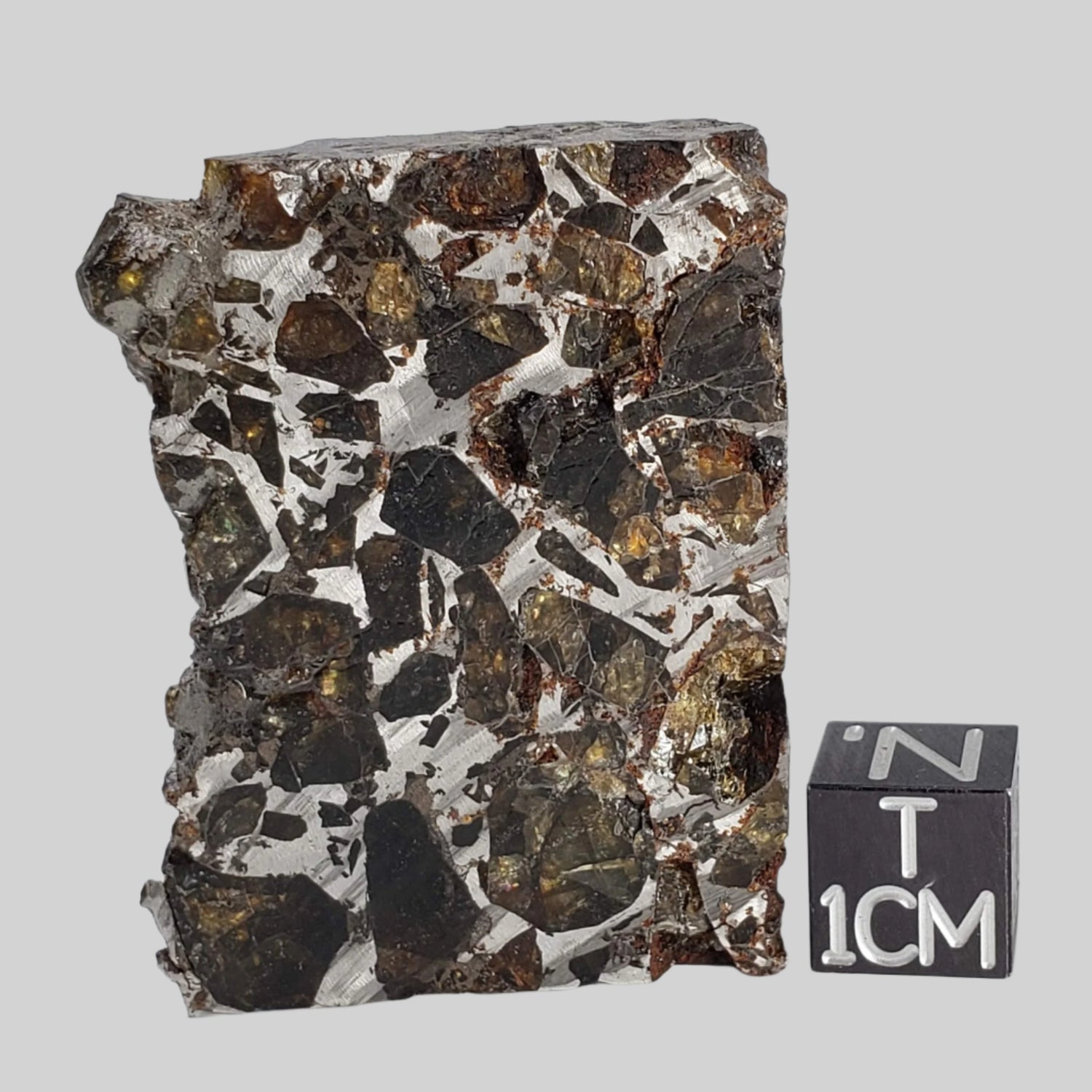
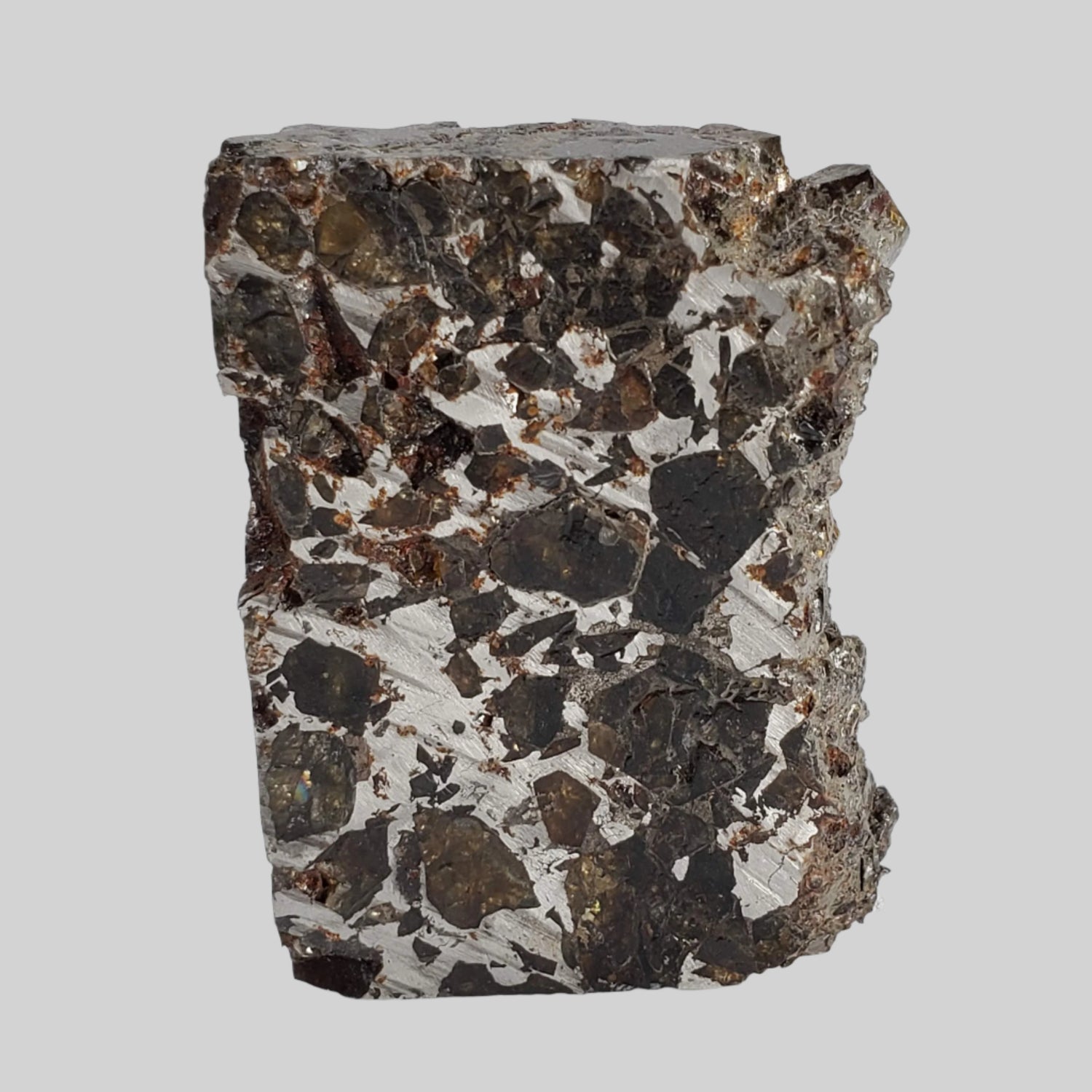
This is a fabulous 40.08 grams Brahin Pallasite stony iron classified meteorite part slice with dimensions of 42x32x7 mm. This superb meteorite was found in Minsk, Gomel Region, Belarus in 1810 and the Total Known Weight is ~ 823 kg.
This piece displays extremely well and is a highly desirable size showing great features. Would be a beautiful addition to any new or existing collection. Comes with a Canagem Collection specimen card and a metal specimen label.


Here we have for you a nice looking individual fragment of a Sahara Desert NWA unclassified meteorite weighing 108.23 grams. Its dimensions are 67x55x35mm. This never classified North West Africa stone was found in the Sahara desert around 2000.
It's a good quality individual fragment NWA meteorite specimen. Some weathering shows the meteorite's time spent aging in the desert. Would be a beautiful addition to any new or existing collection. Comes with a Canagem Collection specimen card.


Here we have for you a very interesting looking tumbled individual of a Sahara Desert NWA unclassified meteorite weighing 45.5 grams. Its dimensions are 42x28x26mm. This never classified North West Africa stone was found in the Sahara desert around 2000.
It's a good quality individual NWA meteorite specimen. Would be a beautiful addition to any new or existing collection. Comes with a Canagem Collection specimen card.


This meteorite came from the Elbert King meteorite collection. Labeled as "UNDOCUMENTED" and side noted, "#2". The stone was first recognized as a meteorite by KSU geologist Doug Brookins at the university in Manhattan, Kansas.
The meteorite was "discovered" on the desk of a university secretary where it was being used as a paper weight. A fitting job for any meteorite. The original find date is unknown. Elbert King acquired the aerolite from Brookins in a trade. It was unclassified and part of the King collection at the time of his death. A single stone, 301 grams, is all that is known of this find.
The Kansas Meteorite Society acquired it in 2004 and sent 26 grams to UCLA were it was classified by Alan Rubin in October of that year. The meteorite is a stone chondrite H4, W3, S1. Officially named the "Kansas State University" Meteorite in February 2005.
This piece is part of Kansas history and a special specimen of great importance for the collector of interesting material. Would be a beautiful addition to any new or existing collection. Comes with a Mark Bostick Collection and a Canagem Collection specimen card.
Recently viewed products
Featured


Canagem is proud to be professional member of The International Gem Society(IGS) the world's top resource for gem professionals, enthusiasts, and industry content.