

📢 Notice to ALL Customers 📢
Search results
946 results
Search results


This is a rare Iron ungrouped classified Taza Northwest Africa 859 specimen, in an as found state. It weighs 2.8 grams and measures 14x11x5 mm.
The NWA 859 was found in 2001 in Taza, Morocco. A total weight of 75.3 kg of mostly small pieces was classified by UCLA as an Iron, ungrouped; it is one of 157 meteorites classified as such.
This specimen displays extremely well and would be a beautiful addition to any new or existing collection. Comes in a gem jar with a Canagem Collection specimen card.
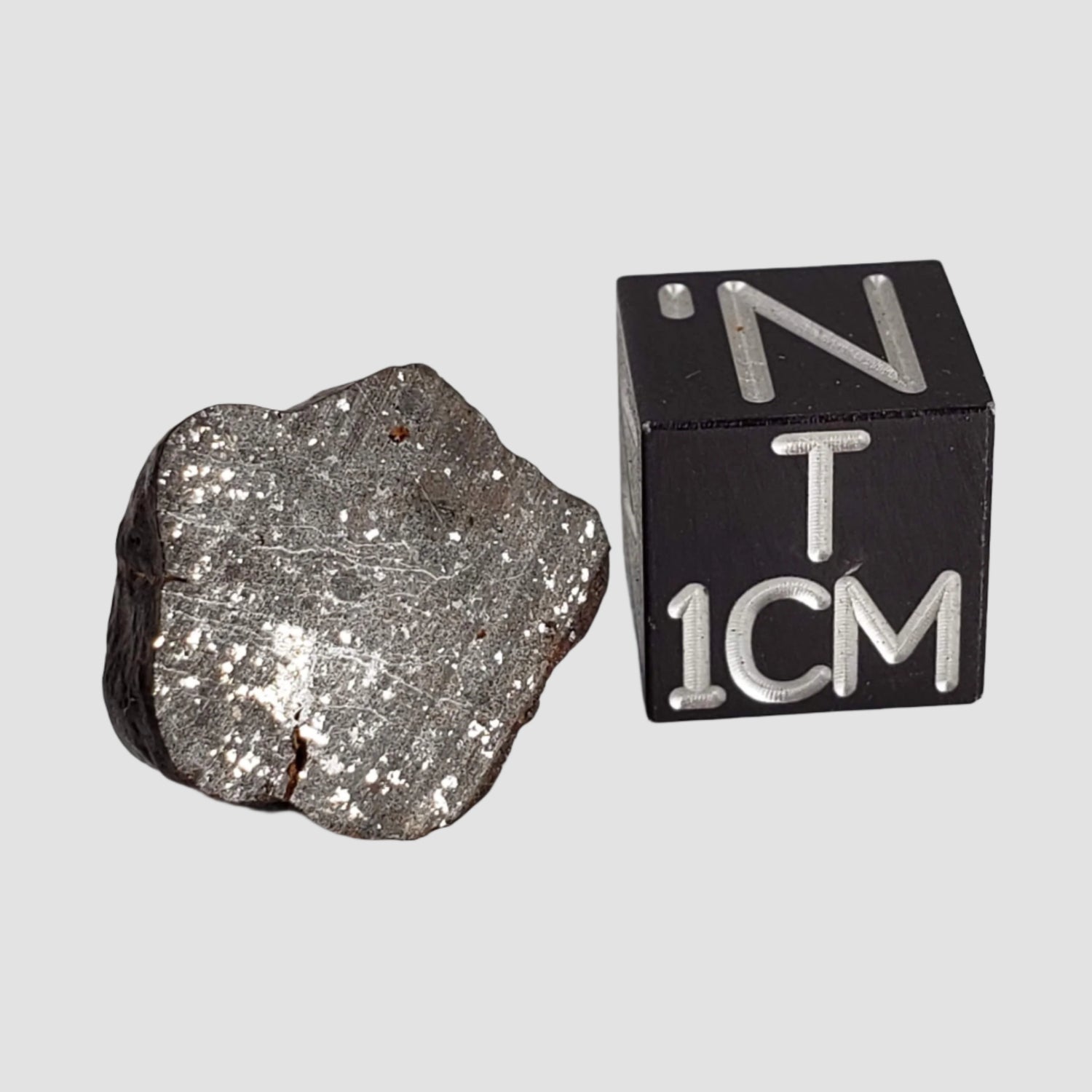
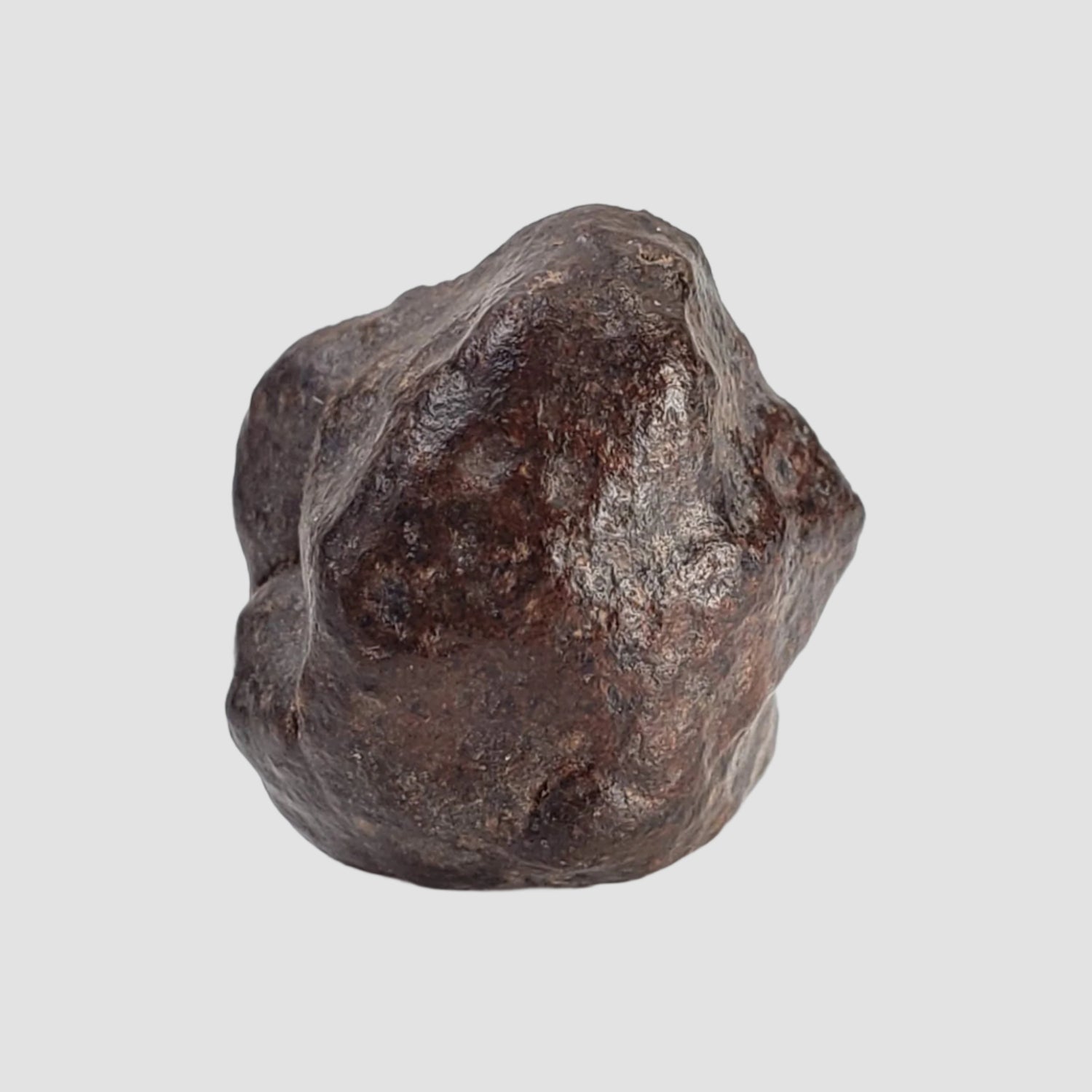
This is a great looking Northwest Africa 2521 H/L3.7 classified meteorite end cut. It weighs 2.472 grams and measures 14x13x7 mm. This meteorite was found in the Sahara Desert in 2004 and has a total recovered weight recorded as a very low 47.8 grams. It has a Shock stage of 3/4 and a Weathering grade of 2. A very good cut, ground and polished end cut.
This is the only approved meteorite classified as H/L3.7
The specimen comes with a Meteoritica and a Canagem Collection specimen card. Would be a beautiful addition to any new or existing collection.


This is a rare and fantastic 43.8 gram Libyan Desert Glass from Kuffra, Libya, with dimensions of 52x37x31 mm. Although its exact origin is still debated, the leading theory suggests it was formed by a high-energy event, such as a meteoric impact or airburst, that melted the desert sand directly where it lay, without being ejected into the atmosphere and re-entering. This results in different physical characteristics compared to tektites.
Libyan Desert Glass is found specifically in the Great Sand Sea of the Eastern Sahara, within a more localized area spanning parts of western Egypt and eastern Libya. Characterized by its yellow to greenish-yellow color, it lacks the aerodynamic shapes of tektites and often appears as irregularly shaped pieces. It is almost pure silica (around 98%) with very few impurities. Throughout history, it has been regarded as a mystical and powerful material, sometimes used in talismans and amulets.
This piece displays extremely well and is a quality translucent specimen. It has an aesthetic shape with a beautiful wind eroded body from the years spent in the Desert. Would be a beautiful addition to any new or existing collection. Comes with a Canagem Collection specimen card.
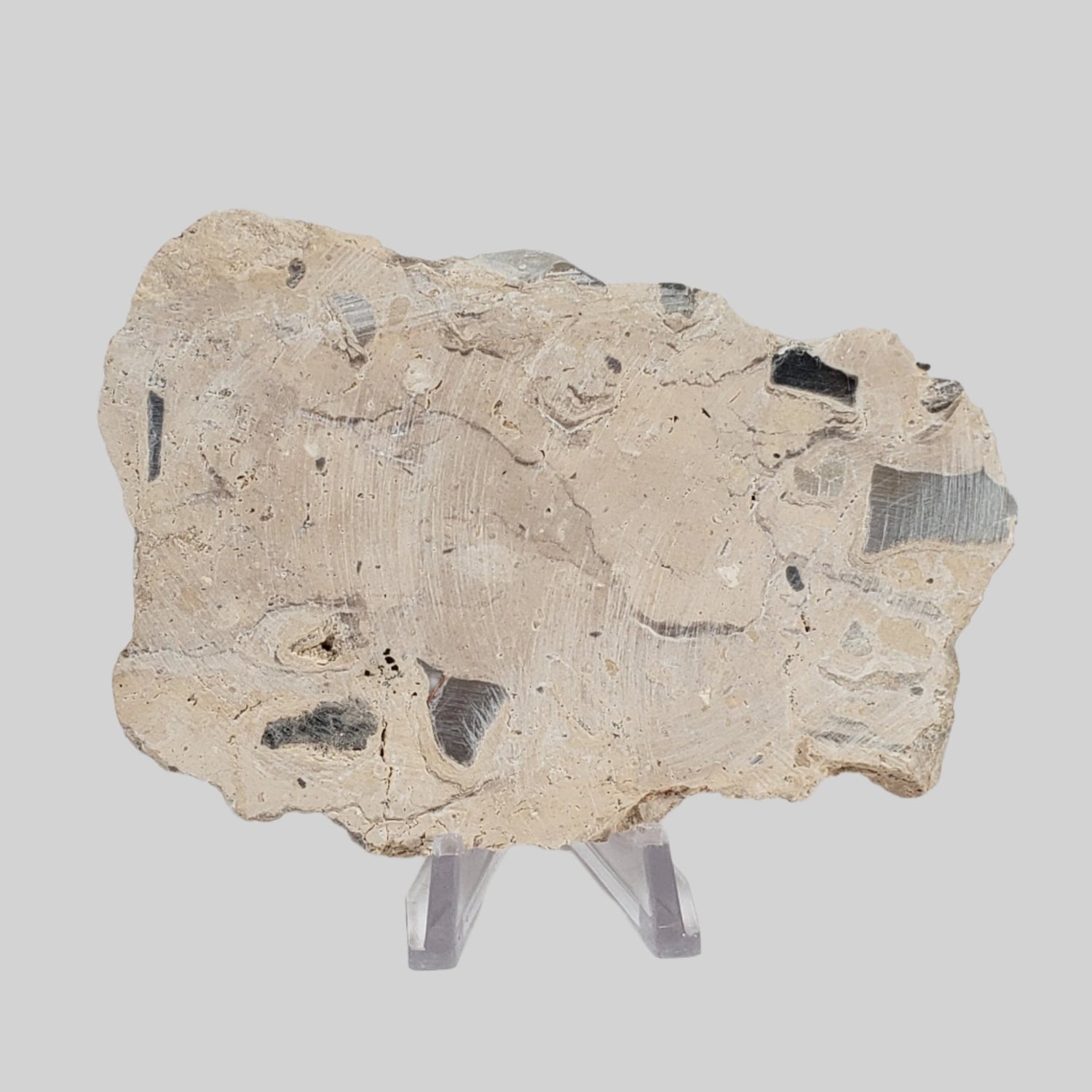
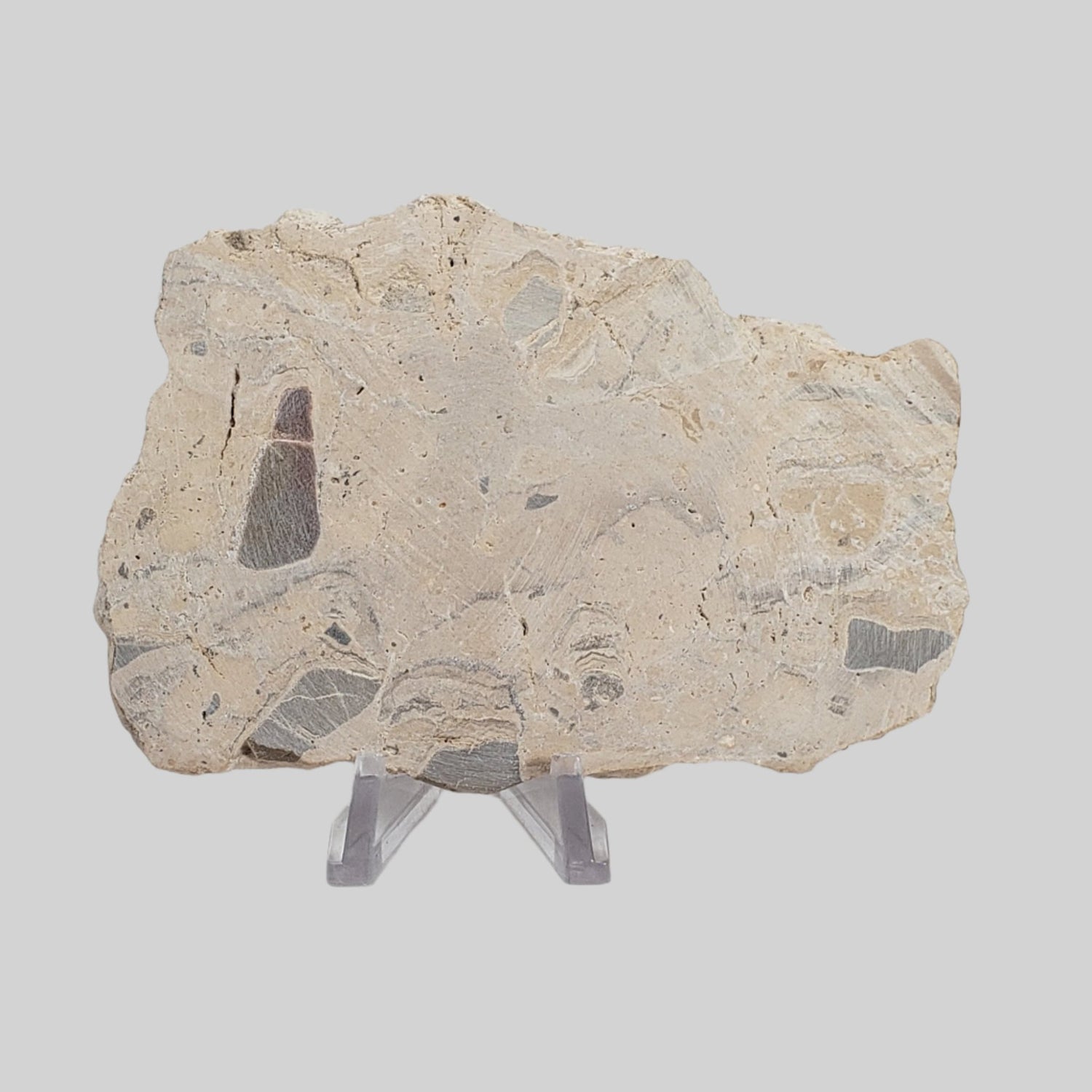
The Azuara polymict impact breccia refers to the impact material from the 38 million year old twin (multiple) impact structures Azuara / Rubielos de la Cerida in Northern Spain.
This impact breccia was found in the area of the village of Fuendetodos near the center area of this large multiple impact structure. This is partly melted and/or decarbonized limestone fragments in a dense and extremely hard matrix showing flow texture. The breccia is considered an equivalent to suevite impactites in other impact structures. This beautiful slice has dimensions of 117x79x9 mm and weighs 163 grams.
Would be a beautiful addition to any new or existing collection. Comes with a Canagem Collection specimen card.


This is a superb looking fragment of the Columbus classified meteorite weighing 3.83 grams. Its dimensions are 16x13x12 mm. This rare H5 classified meteorite was found in Luna County, New Mexico USA in 1997. The total weight of the stones recovered is recorded as a minuscule 165 grams.
Here's what the finder, Michael Cottingham told us: "This is the Meteorite that started it all for me! My wife and I were out looking for meteorites on a dry lake bed in Southern New Mexico and I found one! This was a new meteorite discovery and it only took me 300 hours of searching to find my First One! The COLUMBUS Meteorite was found by me in January of 1997. It was Classified by A. Rubin at UCLA as a H5 Chondrite. It was found near Columbus, Luna County, New Mexico and the Total Known Weight is ONLY 184 grams. Very Rare indeed."
This piece is part of America's history and is 1 of 228 approved meteorites from that location. Would be a beautiful addition to any new or existing collection. Comes with a Michael Cottingham Meteorites and a Canagem Collection specimen card.


This is a fabulous 11.3 gram Sericho Pallasite Main Group meteorite, it measures 26x21x17 mm. In 2016, two brothers were searching for their camels and came across several large, dense stones west of the village of Habaswein and south of Sericho, Kenya. Though recognized as meteorites in 2016, the masses had been known to camel-herders for decades. One village elder said that as a child, he and his brothers would play on top of the stones. It is classified as an Iron Pallasite main group with low weathering and is 1 of only 68 approved meteorites classified as such, with a recovered weight of about 2.8 T.
This piece displays extremely well and is a nice size showing great features. Would be a beautiful addition to any new or existing collection. Comes with a Canagem Collection specimen card.


This is a great looking Tagounite 018 L4 classified meteorite part slice with some nice crust. It weighs 2.72 grams and measures 32x17x2 mm. This meteorite was found in the Sahara Desert in 1999 and has a total recovered weight recorded as a very low 12 kilograms. Shock stage and Weathering grade are not recorded. A very good cut, ground and polished slice. A great piece with big chondrules in a mottled brown matrix.
As reported by IMCA, these specimens are not in the meteorite bulletin as they are labeled. This means that the provisional name or the field name was not used as was assumed at the time of labeling. So the only information for the specimen is as provided by Mark Bostick.
This interesting specimen comes in a protective case with a signed Mark Bostick Collection and a Canagem Collection specimen card. Would be a beautiful addition to any new or existing collection.


Here we have for you a large 57.56 grams superbly shaped Indochinite Tektite from Maoming City, Guangdong Province, China. Although not a meteorite, tektite is directly linked to them or their impacts, just consider its age of around 780,000 years old.
Tektite can still be interesting because of the persistent mystery has that resisted clear explanations of their creation for generations of geologists. Dimensions are 64x19x36 mm.
This piece displays very well and is a very nice size showing multiple characteristics of its origin. Would be a beautiful addition to any new or existing collection. Comes with a Canagem Collection specimen card.


This is a fabulous 8.38 gram Sericho Pallasite Main Group meteorite, it measures 30x15x12. In 2016, two brothers were searching for their camels and came across several large, dense stones west of the village of Habaswein and south of Sericho, Kenya. Though recognized as meteorites in 2016, the masses had been known to camel-herders for decades. One village elder said that as a child, he and his brothers would play on top of the stones. It is classified as an Iron Pallasite main group with low weathering and is 1 of only 68 approved meteorites classified as such, with a recovered weight of about 2.8 T.
This piece displays extremely well and is a nice size showing great features. Would be a beautiful addition to any new or existing collection. Comes with a Canagem Collection specimen card.


This is a great looking fresh individual Gao-Guenie H5 classified meteorite. It weighs 7.87 grams and measures 18x17x14 mm. Picked up right after the fall, It is 100% fresh fusion crusted which is the most desirable specimen state.
This H5 classified meteorite was observed falling at about 17:00 March 5, 1960 near the village of Gao in Africa. There is no total known weight recorded for this meteorite.
Would be a beautiful addition to any new or existing collection. Comes with a Canagem® Collection specimen card.


This is a fine part slice specimen of the Northwest Africa (NWA) 2771 meteorite found in the Sahara Desert in 2004. This nice collectible H5 chondrite consists of a brecciated matrix with light and dark clasts and is characterized by abundant chondrules and metal flakes. The total Mass is registered at 390 grams from a single stone. The Shock stage is recorded at 1 and the Weathering grade is also a 1. This is a nice piece weighing 4.9 grams with dimensions of 29x16x4 mm.
This piece displays very well and would be a beautiful addition to any new or existing collection. Comes in a display box with a Canagem Collection specimen card.


This is a fabulous 7.5 grams Brahin Pallasite stony iron classified meteorite part end cut with dimensions of 31x30x6 mm. This superb meteorite was found in Minsk, Gomel Region, Belarus in 1810 and the Total Known Weight is ~ 823 kg.
This piece displays extremely well and is a highly desirable size showing great features. Would be a beautiful addition to any new or existing collection. Comes with a Canagem Collection specimen card.


Here we have for you a nice looking end cut of a Sahara Desert NWA unclassified meteorite weighing 45 grams. Its dimensions are 36x35x23 mm. This never classified Northwest Africa stone was found in the Sahara Desert around 2000.
It's a good quality cut NWA meteorite specimen showing interesting internal structure (L5?) and attractive mottled interior with chondrules and metallic flakes. Some weathering shows the meteorite's time spent aging in the desert.
Would be a beautiful addition to any new or existing collection. Comes with a Canagem Collection specimen card.


Product Type: Opal Carving
Approx Weight (per piece): 3.78ct
Size: 21x9 mm
Shape: Seal Carving
Color: White with Rainbow Luster
Clarity: Translucent
Origin: Australia


Here we have for you a superb looking Stony-iron or Mesosiderite Vaca Muerta (Dead Cow) classified meteorite weighing 2.46 grams. Its dimensions are 14x10x8 mm.
This classified meteorite was found in 1861 in the driest desert of the world called the Atacama, in Chile. Mesosiderites are formed on the surface of a parent body as a result of impacts with another body. The impact mixed broken fragments of surface eucrites with iron and olivine from deep within the body. Eucrites are believed to have come from the asteroid Vesta. Analysis has shown, however, that the Vaca Muerta eucrite inclusions are not consistent with other eucrites and possibly originated on a different parent body. Although most have a weathered exterior, they also have lots of metal inside and can be prepared and cut to show this.
This piece displays extremely well and would be a beautiful addition to any new or existing collection. Comes with a Canagem® specimen card.


This is a fabulous Ghubara meteorite whole fragment weighing 74 grams and measuring 46x37x24mm. This meteorite was found in Oman, Southern Arabia in 1954 and is classified as an L5 Stony Black Chondrite.
This piece displays extremely well and is a very desirable size, it would be a beautiful addition to any new or existing collection. Comes with a Canagem Collection specimen card.


This is a rare and fantastic 4.7 gram Libyan Desert Glass from Kuffra, Libya, with dimensions of 27x17x11 mm. Although its exact origin is still debated, the leading theory suggests it was formed by a high-energy event, such as a meteoric impact or airburst, that melted the desert sand directly where it lay, without being ejected into the atmosphere and re-entering. This results in different physical characteristics compared to tektites.
Libyan Desert Glass is found specifically in the Great Sand Sea of the Eastern Sahara, within a more localized area spanning parts of western Egypt and eastern Libya. Characterized by its yellow to greenish-yellow color, it lacks the aerodynamic shapes of tektites and often appears as irregularly shaped pieces. It is almost pure silica (around 98%) with very few impurities. Throughout history, it has been regarded as a mystical and powerful material, sometimes used in talismans and amulets.
This piece displays extremely well and is a quality translucent specimen. It has an aesthetic shape with a beautiful wind eroded body from the years spent in the Desert. Would be a beautiful addition to any new or existing collection. Comes with a Canagem Collection specimen card.


This is lot of small tumbled individual NWA unclassified meteorites from the Sahara Desert. Because they have been tumbled, you can clearly see the metal within the specimens. The total weight of the lot is 26 grams. The meteorites range in size from 16 to 25 mm. This never classified North West Africa stone was found in the Sahara desert around 2000.
These small individual specimens are great as teaching tools in the home or classroom, or as gifts. They can also be used for science projects and other types craft displays. Comes with a Canagem Collection specimen card.


This is a large 196.3 gram uniquely shaped Rizalite Tektite, with a beautiful pitted body, from Rizal Province, Philippines. Although not a meteorite, tektite is directly linked to them or their impacts, just consider its age of around 710,000 years old.
Rizalites are a variety of Philippinite tektites belonging to the Indochinite strewnfield. Like other splash-form tektites from around the world, they appear in a wide range of shapes. What sets them apart is their striking surface texture—often finer, more delicate, and accompanied by a brighter sheen. Many specimens display a smoother overall appearance, yet this elegance is frequently contrasted by dramatic deep grooves and winding channels etched into their surfaces.
Tektite is very interesting because of the persistent mystery that resisted clear explanations of their creation for generations of geologists. This piece displays very well and is a very nice size showing multiple characteristics of its origin.
This special piece comes with 2 specimen cards including the signed original Mark Bostick Collection. Would make a beautiful addition to any collection.


Indochinite is a variety of the mineral tektite, which is a natural glass formed by the intense heat and pressure of a meteorite impact. These tektites are usually found as small, aerodynamically shaped objects, often teardrop or irregular in shape, resulting from the molten material solidifying as it cooled rapidly after being ejected from the impact site.
Indochinites are believed to have formed around 780,000 to 800,000 years ago, following a significant meteorite impact event that likely created the Southeast Asian tektite strewn field. The strewn field is quite large, and the tektites can be found scattered over a vast area which includes Vietnam, Laos, and Thailand.
This piece displays very well, showing multiple characteristics of its origin. The specimen has a weigh of 40.2 grams and dimensions of 38x35x23. Comes with a Canagem Collection specimen card.
Recently viewed products
Featured


Canagem is proud to be professional member of The International Gem Society(IGS) the world's top resource for gem professionals, enthusiasts, and industry content.