

📢 Notice to ALL Customers 📢
Search results
950 results
Search results


This is lot of small tumbled individual NWA unclassified meteorites from the Sahara Desert. Because they have been tumbled, you can clearly see the metal within the specimens. The total weight of the lot is 26 grams. The meteorites range in size from 16 to 25 mm. This never classified North West Africa stone was found in the Sahara desert around 2000.
These small individual specimens are great as teaching tools in the home or classroom, or as gifts. They can also be used for science projects and other types craft displays. Comes with a Canagem Collection specimen card.


This is a large 196.3 gram uniquely shaped Rizalite Tektite, with a beautiful pitted body, from Rizal Province, Philippines. Although not a meteorite, tektite is directly linked to them or their impacts, just consider its age of around 710,000 years old.
Rizalites are a variety of Philippinite tektites belonging to the Indochinite strewnfield. Like other splash-form tektites from around the world, they appear in a wide range of shapes. What sets them apart is their striking surface texture—often finer, more delicate, and accompanied by a brighter sheen. Many specimens display a smoother overall appearance, yet this elegance is frequently contrasted by dramatic deep grooves and winding channels etched into their surfaces.
Tektite is very interesting because of the persistent mystery that resisted clear explanations of their creation for generations of geologists. This piece displays very well and is a very nice size showing multiple characteristics of its origin.
This special piece comes with 2 specimen cards including the signed original Mark Bostick Collection. Would make a beautiful addition to any collection.


Indochinite is a variety of the mineral tektite, which is a natural glass formed by the intense heat and pressure of a meteorite impact. These tektites are usually found as small, aerodynamically shaped objects, often teardrop or irregular in shape, resulting from the molten material solidifying as it cooled rapidly after being ejected from the impact site.
Indochinites are believed to have formed around 780,000 to 800,000 years ago, following a significant meteorite impact event that likely created the Southeast Asian tektite strewn field. The strewn field is quite large, and the tektites can be found scattered over a vast area which includes Vietnam, Laos, and Thailand.
This piece displays very well, showing multiple characteristics of its origin. The specimen has a weigh of 40.2 grams and dimensions of 38x35x23. Comes with a Canagem Collection specimen card.


This is a superb part slice of the rare Northwest Africa 2126 meteorite, weighing 3.2 grams and measuring 20x18x4 mm. This is a meteorite classified as an HED achondrite Eucrite.
The NWA 2126 is a rare Polymict Eucrite Achondrite found in 2004. When this meteorite was cut it looked very much like a Howardite. NAU, a NomCom approved facility, classified it as a Polymict Eucrite. This is a very interesting and rare class of achondrite. This meteorite takes a great polish and displays very handsomely. A total known weight of 2,227 grams is officially recorded for this very fascinating find. Both sides are polished so there are no signs of saw marks ruining the appearance of an otherwise highly collectable specimen. The last step in preparing each piece was to dry it using pure ethyl alcohol and a heat lamp, creating a very stable piece that resists oxidation.
This hard to acquire piece displays very well with its diamond lap finish, it is a high quality specimen that would make an amazing addition to any new or existing collection. Comes in a large gem box with a Canagem and a Hupé specimen card.


This is a superb looking fragment of a Sahara Desert NWA 515 classified meteorite weighing 2.8 grams. Its dimensions are 20x13x9 mm. This is a NWA 515 meteorite fragment in as found condition.
This meteorite was found by Berber nomads in the deserts of Africa. Hundreds of small stones, more then 20 kilograms in total, was purchased November 8th, 2000 in M'Hamid, Morocco, Africa by a group of meteorite dealers and collectors. 247 grams was donated to UCLA were it was classified by A. Rubin as an L6 Chondrite with a shock rating of 2 and a weathering grade of 3 (25% olivine). Cut pieces of this meteorite show a nice light matrix with golden hues.
Thin sections (2nd photo) show nice chondrules ranging in size from less then 1mm to 3mm. Thin sections are used in earth geology, and in meteorites to identify the minerals in them. Stone meteorites are made of mostly of olivine and pyroxene. The pyroxene is typically greyish or yellowish and the bright colored minerals scattered throughout the photo are mostly olivine.
This piece displays extremely well and would be a beautiful addition to any new or existing collection. Comes with a The Mark Bostick Collection and a Canagem Collection specimen card.


This is a rare and fantastic 22.8 gram Libyan Desert Glass from Kuffra, Libya, with dimensions of 37x26x27 mm. Although its exact origin is still debated, the leading theory suggests it was formed by a high-energy event, such as a meteoric impact or airburst, that melted the desert sand directly where it lay, without being ejected into the atmosphere and re-entering. This results in different physical characteristics compared to tektites.
Libyan Desert Glass is found specifically in the Great Sand Sea of the Eastern Sahara, within a more localized area spanning parts of western Egypt and eastern Libya. Characterized by its yellow to greenish-yellow color, it lacks the aerodynamic shapes of tektites and often appears as irregularly shaped pieces. It is almost pure silica (around 98%) with very few impurities. Throughout history, it has been regarded as a mystical and powerful material, sometimes used in talismans and amulets.
This piece displays extremely well and is a quality translucent specimen. It has an aesthetic shape with a beautiful wind eroded body from the years spent in the Desert. Would be a beautiful addition to any new or existing collection. Comes with a Canagem Collection specimen card.

This is an aluminum label with all the information regarding the Macy, New Mexico meteorite. This flat model fits nicely in a Riker type box or our own Alder wooden boxes. An excellent way of identifying and displaying your collection of meteorites.


Here we have for you a superb looking Stony-iron or Mesosiderite Vaca Muerta (Dead Cow) classified meteorite weighing 4.04 grams. Its dimensions are 21x12x9 mm.
This classified meteorite was found in 1861 in the driest desert of the world called the Atacama, in Chile. Mesosiderites are formed on the surface of a parent body as a result of impacts with another body. The impact mixed broken fragments of surface eucrites with iron and olivine from deep within the body. Eucrites are believed to have come from the asteroid Vesta. Analysis has shown, however, that the Vaca Muerta eucrite inclusions are not consistent with other eucrites and possibly originated on a different parent body. Although most have a weathered exterior, they also have lots of metal inside and can be prepared and cut to show this.
This piece displays extremely well and would be a beautiful addition to any new or existing collection. Comes with a Canagem® specimen card.


This is a rare and fantastic 4.4 gram Libyan Desert Glass from Kuffra, Libya, with dimensions of 30x19x12 mm. Although its exact origin is still debated, the leading theory suggests it was formed by a high-energy event, such as a meteoric impact or airburst, that melted the desert sand directly where it lay, without being ejected into the atmosphere and re-entering. This results in different physical characteristics compared to tektites.
Libyan Desert Glass is found specifically in the Great Sand Sea of the Eastern Sahara, within a more localized area spanning parts of western Egypt and eastern Libya. Characterized by its yellow to greenish-yellow color, it lacks the aerodynamic shapes of tektites and often appears as irregularly shaped pieces. It is almost pure silica (around 98%) with very few impurities. Throughout history, it has been regarded as a mystical and powerful material, sometimes used in talismans and amulets.
This piece displays extremely well and is a quality translucent specimen. It has an aesthetic shape with a beautiful wind eroded body from the years spent in the Desert. Would be a beautiful addition to any new or existing collection. Comes with a Canagem Collection specimen card.
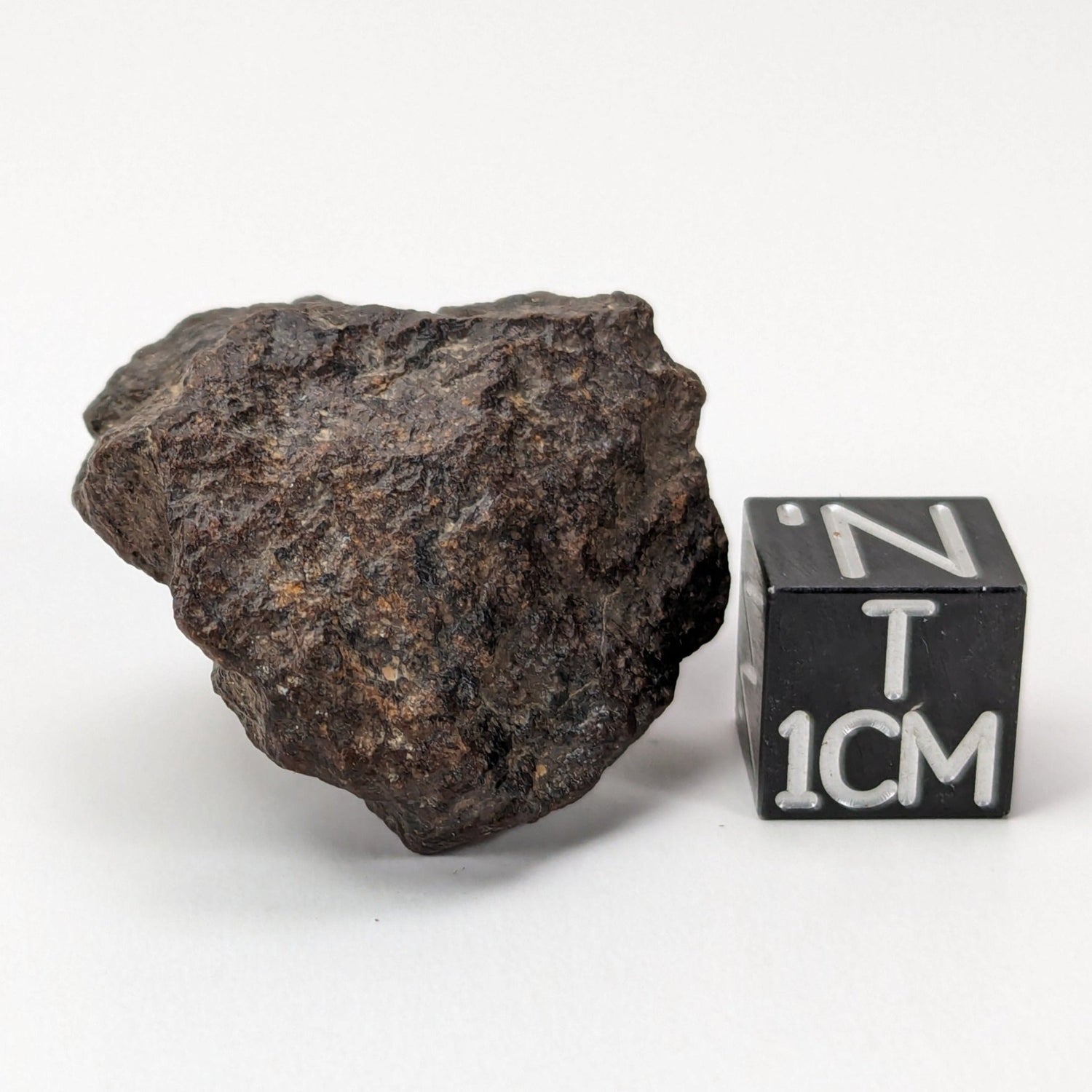

The NWA 267 meteorite fragment offered here is in as found condition. It weighs 16.6 grams, with dimensions of 28x27x22mm. The meteorite will come with two specimen description cards including a signed "The Mark Bostick Collection" card.
This meteorite was once a pile of weathered unclassified meteorite fragments brought to the 2000 Denver show by a Moroccan fossil dealer. These fragments, 73.9 kg. worth, where purchased by Canadian meteorite dealer Dean Bessey, who was told the following on the meteorites: "A nomad found an area with a lot of unusual strange stones near the Morocco/Algeria border. He brought one to a fossil dealer and asked: "I hear that you will pay money for stones like this". After shaking his head in disbelief at a positive response, the nomad gathered up all his camels, wives and children and brought them into the desert to search over his personal strewn field." Or at least that is how the story goes.
Many thousands of stones, 73.9 kilograms, were recovered, most of these fragments under 20 grams. Then 356 grams and a thin section of the meteorite was donated to the Vernadaky Institute of Geochemistry and Analytical Chemistry, part of the Russian Academy of Sciences, Moscow, where it was classified by M. Ivanova. This meteorite, an ordinary stone chondrite, H4 class has a Shock Rating of 2 and a Weathering Grade of 2-3 and the classification information was published in Meteoritical Bulletin 85.
While the stone did not get a heavy weathering grade, very few specimens show any crust. This meteorite is believed to have come from the Hebe class asteroids. I've included an informational photo of a NWA 267 Meteorite thin section which are used in earth geology, and in meteorites to identify the minerals in them. The photo shows a large imperfect elongated chondrule. Chondrules are unique features to meteorites. The chondrule shown is composed of mostly pyroxene and the bright colored minerals scattered throughout the thin section is mostly olivine.
One of the fun facts is that the NWA 267 was also the first meteorite ever minted onto a real legal tender coin. The National Bank of Liberia made 999 of these $10.00 Silver coins in 2004. The meteorite used in the coin, was supplied by Mark Bostick himself and his name and signature came on the certificate with the coin. The provided images of the coin shows a nomad on a camel on the obverse. A meteorite is falling through the star filled sky in the background. Reverse of coin has a seal of the Liberia Government and notes its value. We include 2 specimen cards but unfortunately the thin section and coin used in the ad are NOT included!

This is an aluminum label with all the information regarding the Estherville, Iowa, USA meteorite. This flat model fits nicely in a Riker type box or our own Alder wooden boxes. An excellent way of identifying and displaying your collection of meteorites.


This is a superb part slice of the Northwest Africa 3152 meteorite, weighing 2.7 grams and measuring 25x19x3 mm. This is a very rare type 7 Eucrite meteorites classified as a HED achondrite Eucrite.
This beautiful 2,7 gram crusted part slice of NWA 3152 is a very rare highly metamorphosed (type 7) basaltic Eucrite achondrite found in Northwest Africa 2005. The internal appearance of this meteorite was somewhat of a surprise when we first cut it because of the very striking and unusual breccia. There are only a few examples of type 7 Eucrites in existence making this meteorite found as single stone an admirable find. A Total known Weight (TKW) of 1,496 grams is officially recorded for this scarce meteorite.
This is a very interesting class of achondrite. This meteorite takes a great polish and displays very handsomely. Both sides are polished so there are no signs of saw marks ruining the appearance of an otherwise highly collectable specimen. The last step in preparing each piece was to dry it using pure ethyl alcohol and a heat lamp, creating a very stable piece that resists oxidation and that will stand the test-of-time.
This hard to acquire piece displays very well with its diamond lap finish, it is a high quality specimen that would make an amazing addition to any new or existing collection. Comes in a large gem box with a Canagem and a Hupé Collection specimen card.


This is a superb looking part slice of an NWA 1277 Carbonaceous chondrite type 3.6 meteorite found in Sahara Desert in 2001. This excellent cut specimen has all the qualities you're looking for in a rare Carbonaceous specimen and is 1 of only 8 approved meteorites classified as CO3.6.
This specimen weighs 2.5 grams and measures 15x13x4 mm. It has a Shock stage of 2 and a Weathering grade of 1. The total known weight of this meteorite is a low 1200 grams.
This piece displays extremely well and is a very desirable type. Would be a beautiful addition to any new or existing collection. Comes with a The Hupé Collection and a Canagem Collection specimen card.


Here we have for you a nice looking individual fragment of a Sahara Desert NWA unclassified meteorite weighing 49.4 grams. Its dimensions are 66x28x19mm. This never classified North West Africa stone was found in the Sahara desert around 2000.
It's a good quality individual fragment NWA meteorite specimen. Some weathering shows the meteorite's time spent aging in the desert. Would be a beautiful addition to any new or existing collection. Comes with a Canagem Collection specimen card.


This is a great looking part slice of a Northwest Africa 2841 H3.9 classified meteorite. It weighs 8.0 grams and measures 30x16x6 mm. This meteorite was found in the Sahara Desert in 2004 and has a total recovered weight recorded as a very low 190 grams. It has a Shock stage of 2 and a Weathering grade of 1. Very attractive porous matrix.
The specimen comes with a Canagem Collection specimen card. Would be a beautiful addition to any new or existing collection.

This is a superb looking fragment of a Sahara Desert NWA 515 classified meteorite weighing 1.16 grams. Its dimensions are 16x9x5 mm.
This meteorite was found by Berber nomads in the deserts of Africa. Hundreds of small stones, more then 20 kilograms in total, was purchased November 8th, 2000 in M'Hamid, Morocco, Africa by a group of meteorite dealers and collectors. 247 grams was donated to UCLA were it was classified by A. Rubin as an L6 Chondrite with a shock rating of 2 and a weathering grade of 3 (25% olivine). Cut pieces of this meteorite show a nice light matrix with golden hues.
Thin sections (2nd photo) show nice chondrules ranging in size from less then 1mm to 3mm. Thin sections are used in earth geology, and in meteorites to identify the minerals in them. Stone meteorites are made of mostly of olivine and pyroxene. The pyroxene is typically greyish or yellowish and the bright colored minerals scattered throughout the photo are mostly olivine.
This piece displays extremely well and would be a beautiful addition to any new or existing collection. Comes with a The Mark Bostick Collection and a Canagem Collection specimen card.


This is a great looking Russian Sikhote-Alin classified meteorite weighing 20.2 grams. Its dimensions are 29x26X13mm. This Iron (IIAB) Coarsest Octahedrite classified meteorite was recovered in Russia after the fall of February 12, 1947.
So far approximately 23 tons of this material have been recovered. This piece displays extremely well and is a very desirable size. These specimens are known as shrapnel specimens, ripped and torn edges reminiscent of bomb shrapnel. They broke due to atmospheric pressure and/or mid-air collisions, and possibly explosive fragmentation upon impact. These pieces are a good example of the shrapnel type Sikhote-Alin.
Would be a beautiful addition to any new or existing collection. Comes with a Canagem Collection specimen card.

This is an aluminum label with all the information regarding the Cole Creek, Nebraska, USA meteorite. This flat model fits nicely in a Riker type box or our own Alder wooden boxes. An excellent way of identifying and displaying your collection of meteorites.
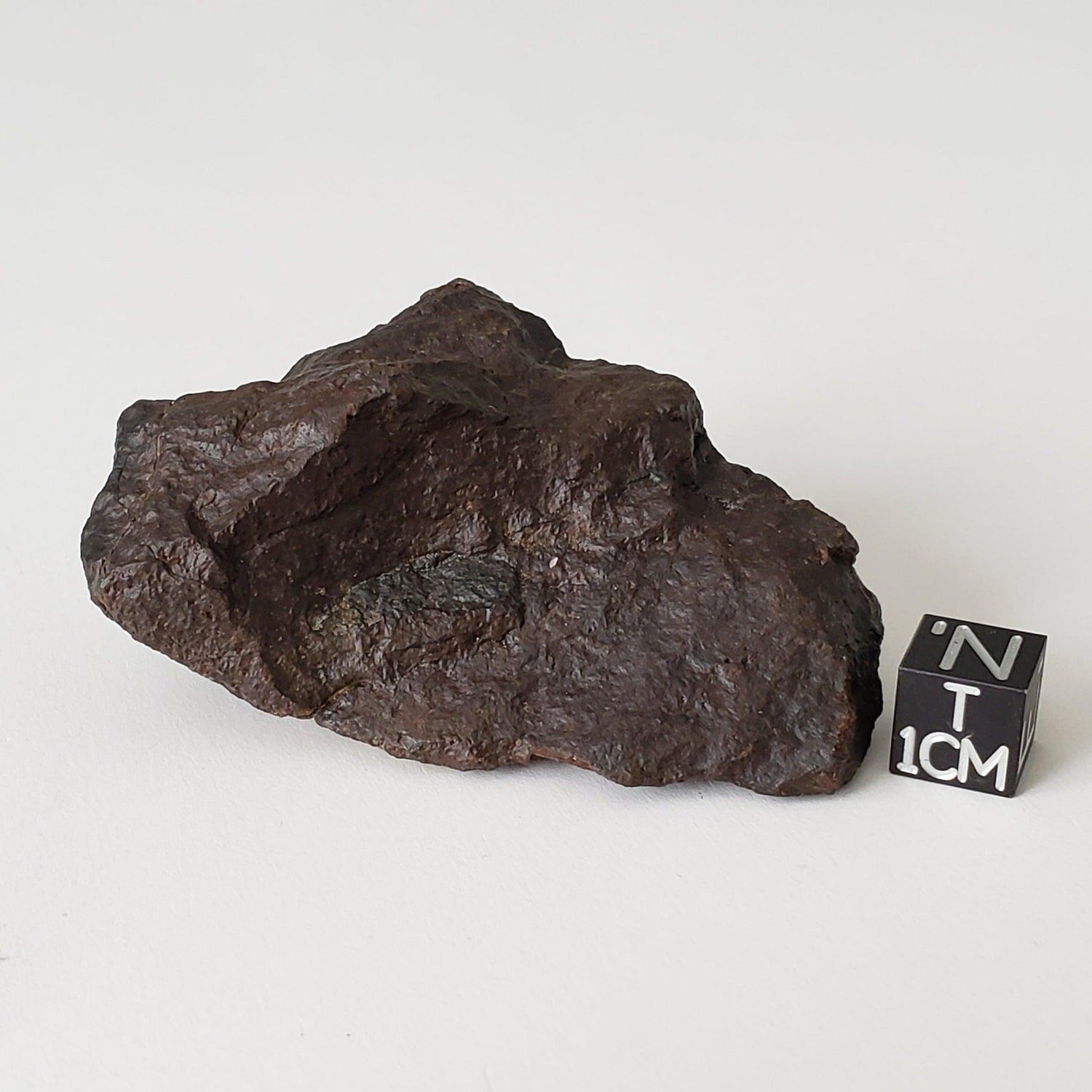
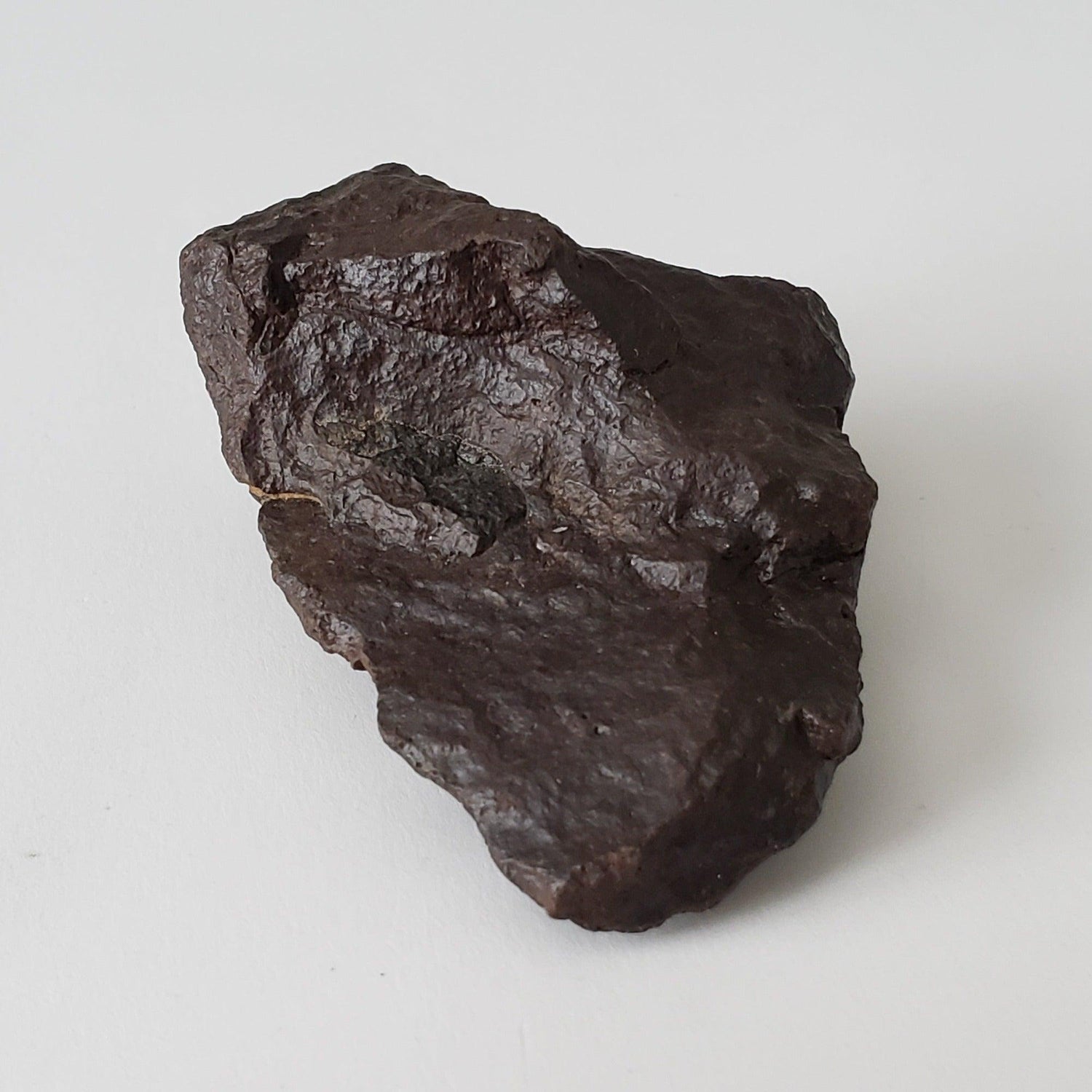
Here we have for you a superb looking Dhofar 020 classified meteorite weighing 103.75 grams. Its dimensions are 67x49x32 mm. Found 10 March 2000 in Dhofar, Oman, in the Arabian Peninsula this H4/5 classified chondrite has a TKW of 256 Kg with a shock stage of S4 and weathering grade of W3 by the Russian Academy of Sciences, USSR.
The following is an excerpt from Mark Bostick's review of this meteorite: "Dhofar 020 is a ordinary stone chondrite meteorite. The meteorite is high in free metal and therefore falls in the H class. S4 tells it is highly shocked. Slices of the meteorite, show veins of the cosmic impact created mineral Ringwoodite, although fractures in the stone tend to hide this some. It almost appears to me to have splinted upon impact. The meteorite falls in 4-5 petrology class, a reference to how metamorphed the meteorite is from its original state. This is judged by studying a thin section of the meteorite, most visually at the chondrules, a feature unique to stone meteorite. In a thin section under polarized light, pyroxene chondrules seem more common then their olivine pair. Still some regions in the meteorite show scattered patches of bright olivine inclusions. These are fairly rare, at least on my thin section, and most of the meteorite's olivine and pyroxene, some of the easier things to see in a thin section, appear to have went through a metamorphism, and have "melted" into the matrix and are at times undistinguishable."
This piece displays extremely well showing a beautiful crust, superb shape and good size. Would be a beautiful addition to any new or existing collection. Comes with a Canagem Collection specimen card.


This is a rare and fantastic 2.4 gram Libyan Desert Glass from Kuffra, Libya, with dimensions of 19x14x11 mm. Although its exact origin is still debated, the leading theory suggests it was formed by a high-energy event, such as a meteoric impact or airburst, that melted the desert sand directly where it lay, without being ejected into the atmosphere and re-entering. This results in different physical characteristics compared to tektites.
Libyan Desert Glass is found specifically in the Great Sand Sea of the Eastern Sahara, within a more localized area spanning parts of western Egypt and eastern Libya. Characterized by its yellow to greenish-yellow color, it lacks the aerodynamic shapes of tektites and often appears as irregularly shaped pieces. It is almost pure silica (around 98%) with very few impurities. Throughout history, it has been regarded as a mystical and powerful material, sometimes used in talismans and amulets.
This piece displays extremely well and is a quality translucent specimen. It has an aesthetic shape with a beautiful wind eroded body from the years spent in the Desert. Would be a beautiful addition to any new or existing collection. Comes with a Canagem Collection specimen card.
Recently viewed products
Featured


Canagem is proud to be professional member of The International Gem Society(IGS) the world's top resource for gem professionals, enthusiasts, and industry content.