

📢 Notice to ALL Customers 📢
288 products
Sort by:
288 products
288 products


This amazing specimen of Vesuvianite was collected in the now closed Jeffery Mine in Asbestos, Québec, Canada. The specimen is made up of a combination of green and mauve vesuvianite crystals also named violet manganoan vesuvianite. It is a large specimen in good condition. A great addition to any collection!
Vesuvianite was first discovered on Mount Vesuvius in Italy in the 18th century, hence its name. It typically occurs as a green, brown, yellow, or blue-green crystal, and is often found in metamorphic and igneous rocks. The alternate name, Idocrase, is from the Greek eidos “form”, and krasis “mixture”, because Vesuvianite often appears to combine the crystal forms of other minerals. It is used as a gemstone.
Name: Vesuvianite Crystal
Specimen Size: Miniature-Sized
Dimensions: 34x20x13 mm / 1.3x0.8x0.5 inches
Weight: 10.74 grams / 0.4 ounces
Origin: Mined in Jeffery Mine, Asbestos, Québec, Canada


Vanadinite crystals are small, hexagonal prismatic crystals that are typically red to brownish-red in color. They have a bright luster and a transparent to translucent appearance. The crystals often form in aggregates, creating intricate and interesting formations. Vanadinite would hardly be as famous if not for the outstanding locality of Mibladen, Morocco. This locality has by far produced the most outstanding crystals of beautiful color and form.
Vanadinite is believed to enhance vitality, motivation, and manifestation, while also promoting clarity, focus, and protection from negativity.
Product Type: Vanadinite Crystal On Barite
Specimen Size: Miniature-Sized
Dimensions: 45x34x23 mm / 1.8x1.3x.09 inches
Weight: 29.56 grams / 1.0 ounces
Origin: Mibladen, Morocco


While it's commonly colorless or white, Calcite can also appear in various hues, including shades of green, blue, yellow, orange, red, brown, and even black. This sphere is a beautiful example of yellow calcite. The coloration is often due to impurities or exposure to different minerals during formation. Calcite is typically transparent to translucent, allowing light to pass through and sometimes exhibit a phenomenon called double refraction. is found throughout the world in sedimentary, metamorphic, and igneous rocks.
Calcite is associated with clarity, amplification of energy, and cleansing. It is believed it can help with emotional healing, motivation, and creativity.
Name: Calcite Sphere
Dimensions: 73 mm / 2.7 inches
Weight: 540 Grams / 1.5 Lbs
Origin: China

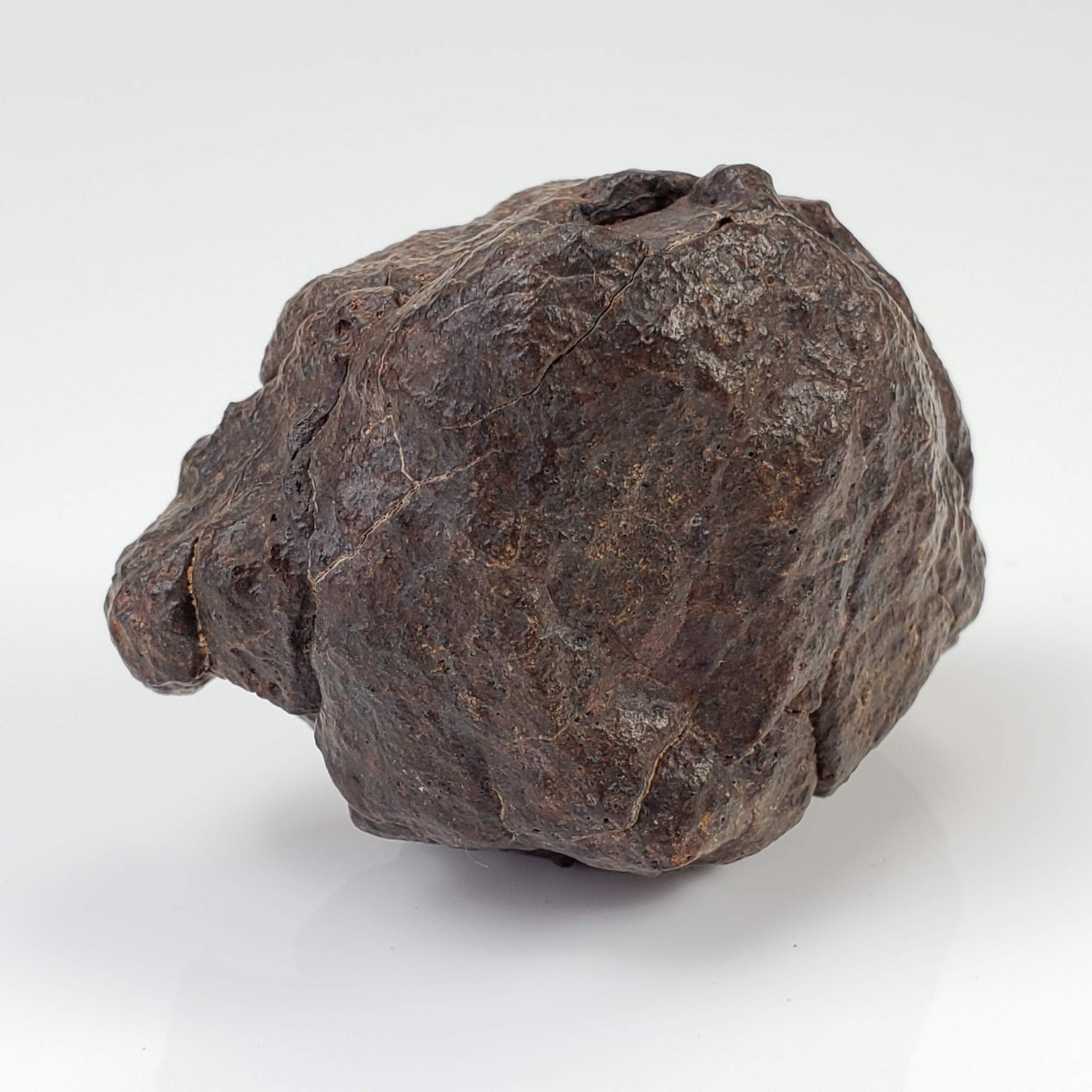
This is a nice looking individual fragment of a Sahara Desert NWA unclassified meteorite. It weighs 81.1 grams and measures 51x37x25 mm. This never classified Northwest Africa stone was found in the Sahara desert around 2000.
It's a good quality NWA meteorite individual fragment. Some weathering shows the meteorite's time spent aging in the desert. Would be a beautiful addition to any new or existing collection. Comes with a Canagem Collection specimen card.


These are perfect rosettes of metallic, lustrous molybdenite, almost completely exposed in a glassy quartz matrix crystals from Moly Hill, Abitibi-Temiscamingue, Québec, Canada. The largest of the crystals is 12x10 mm (0.5x0.4 inches). Molybdenite is commonly found as foliated masses meaning the mineral forms folia or layers, like the mineral mica. It is metallic gray, has a greasy feel, and is very soft at only 1 on Mohs' hardness scale. Its softness, metallic luster and gray color led scientists to mistakenly believe it was a lead mineral. This specimen shows the typical hexagonal layered structure of the crystal.
Some believe molybdenite is linked to intuition, transformation, and problem-solving, helping with mental clarity and adaptability. It is sometimes associated with the third eye chakra, thought to enhance insight and creative thinking.
Name: Molybdenite Crystals
Specimen Size: Miniature-Sized
Dimensions: 41x32x17 mm / 1.6x1.3x0.7 inches
Weight: 21.4 Grams / 0.7 ounces
Origin: Mined in Moly Hill, La Motte, Abitibi-Temiscamingue, Québec, Canada
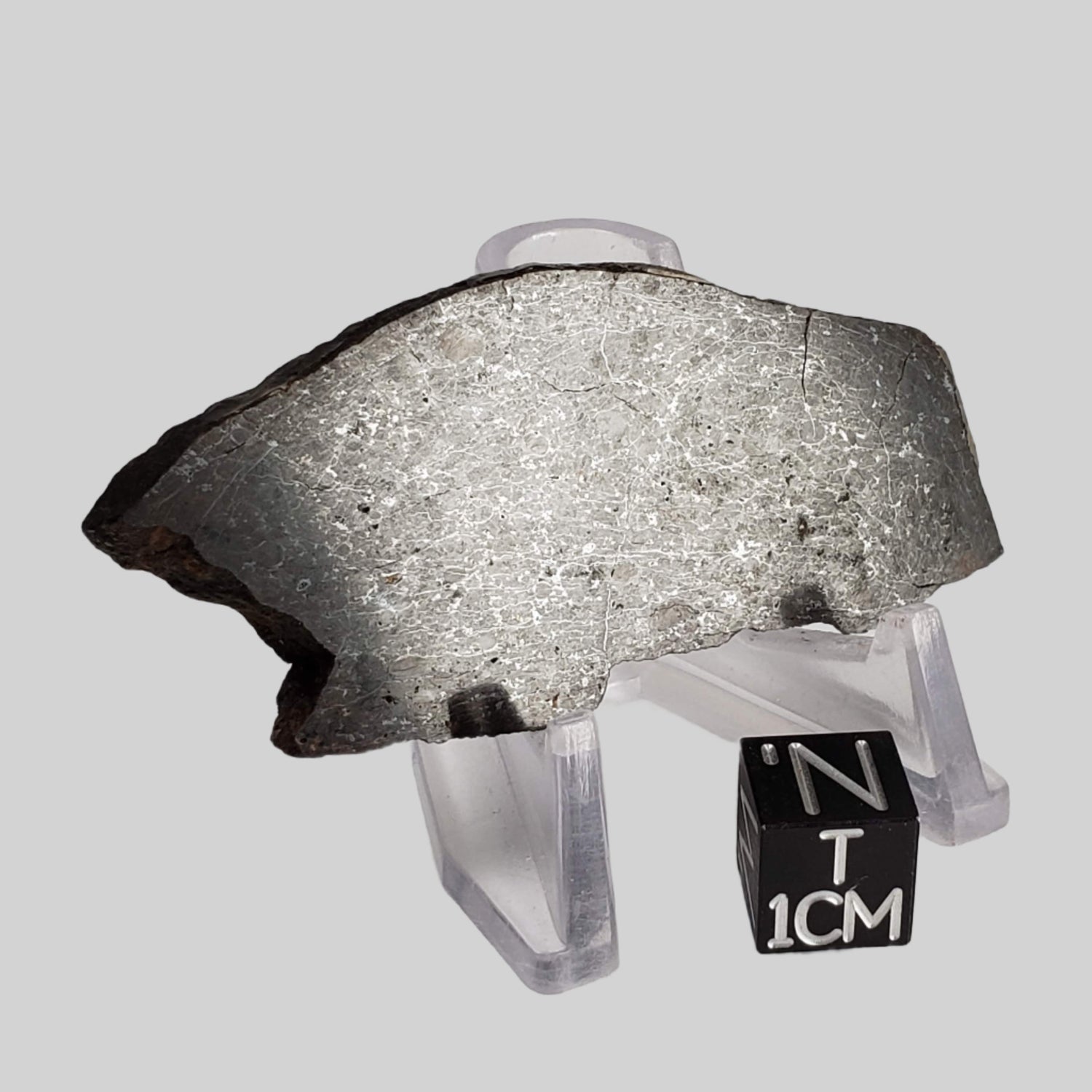
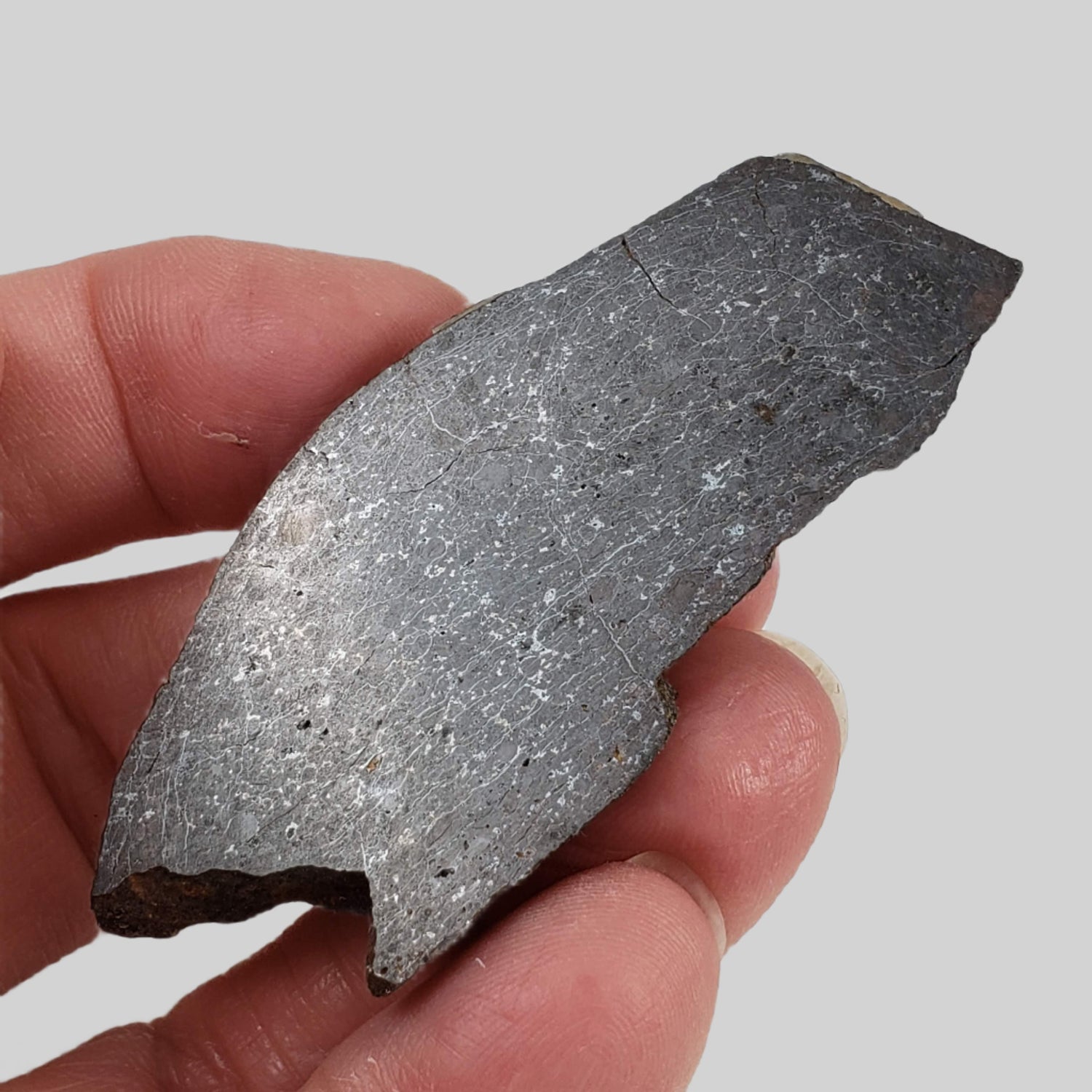
This is a great looking Dhofar 273 classified meteorite weighing 20.4 grams. Its dimensions are 62x28x5 mm. This L5 classified meteorite was found in Zufar, Oman in 2001. The total weight of the single piece recovered is recorded as 2.085 kg and the meteorite has a shock stage of 4 and weathering grade of 3. This piece displays extremely well because of its beautiful shape and is a great size.
Would be a beautiful addition to any new or existing collection. Comes with a Canagem Collection specimen card.


This is a must have 52 gram Impact Breccia also referred to as Suevite coming from the famous Rochechouart impact structure in South Western France, near the village of Chassenon. Although not a meteorite, impactites are directly linked to them and their impacts and are probably going to be one of the rarest collection items you'll ever own. Impactite is a slag-like glassy object found on the surface of the earth, formed from rock melted by the impact of a meteorite.
Named after the town of Rochechouart, the Rochechouart impact structure is located on the western margin of the French Massif Central near the city of Limoges, approximately 350 km (220 mi) south of Paris. Rochechouart (population about 3800) is built with rocks created or modified by the impact (impactites). Chassenon, a third of the size of Rochechouart, is also built of impactites. Impactite was used 2000 years ago for building Chassenon's monumental Roman baths of Cassinomagus.
The very fine materials (impactoclastites) are preserved forming a very fine layered horizontal deposits on top of the melt rich suevite (breccia with a debris matrix and both rock debris and melt fragments as clasts) near Chassenon.
The term impactite encompasses shock-metamorphosed target rocks, melts or suevites and mixtures of the two, as well as sedimentary rocks with significant impact-derived components and shocked mineral grains, tektites, anomalous geochemical signatures, etc. This impactite was formed 186 million years ago. This deformed rock fragments and partly molten are imbedded in a melt matrix showing typical flow structures from former melt.
This gorgeous slice displays very well with a mass of 76x46x16 mm. Would be a beautiful addition to any new or existing collection. Comes with a Canagem Collection specimen card.


This is a fantastic crusted 26.1 grams NWA (Northwest Africa) 869 L3-6 classified meteorite Individual found by Nomads in the Sahara Desert. The dimensions of the specimen are 46x24x16 mm.
NWA 869 classified meteorites can still be interesting and this one is for sure perfectly shaped to catch your attention. It displays a superb crust on most of its surface. Most samples are individual meteorites but some fragments (mostly >1 kg) also occur. In most cases the fusion crust has been polished or ablated by wind erosion. Many samples are more severely affected and show faces with deep wind erosion features. Fracture faces, formed by ground collision, show a typical gray-green color and sometimes visible brecciation (light and/or dark clasts).
Would be a beautiful addition to any new or existing collection. Comes with a Canagem Collection specimen card.


This is a great 34.2 gram Red Suevite Fallback Breccia from the Sääksjärvi crater in Finland. It has dimensions of 76x39x6 mm. Although not a meteorite, impactites are directly linked to them and their impacts and are probably going to be one of the rarest collection item you'll ever own. Impactite is a slag-like glassy object found on the surface of the earth, formed from rock melted by the impact of a meteorite.
The term impactite encompasses shock-metamorphosed target rocks, melts or suevites and mixtures of the two, as well as sedimentary rocks with significant impact-derived components and shocked mineral grains, tektites, anomalous geochemical signatures, etc.
Sääksjärvi is a lake in Kokemäki, Satakunta, western Finland, east of the town of Pori. The lake is notable because it overlies an impact crater. The crater is 5 kilometres (3 mi) in diameter and is completely buried under the lake and is not visible at the surface. The age of the impact structure is estimated to be about 543 ± 12 Ma (million years ago), at the boundary between the Ediacaran and Cambrian periods. The enormous heat and pressure at the impact explosion created an interesting melt, a Suevite, and shattered rocks and dust which fell back into the crater area becoming cemented together over the centuries. These rock formation is known as Fallback Breccia.
These are some of the best looking breccias we've found. Would be a beautiful addition to any new or existing collection. Comes with a Canagem Collection specimen card.


Prehnite is a green to yellowish-green colored mineral that belongs to the phyllosilicate family. It is composed of calcium, aluminum, and silicate, with traces of iron, magnesium, and other elements. Prehnite crystals have a unique pearly luster and can form in a variety of shapes, including tabular, prismatic, and stalactitic formations.
Prehnite is believed to have a calming effect on the mind and emotions, promoting relaxation and inner peace. It is also said to be a stone of unconditional love, compassion, and healing.
These Prehnite clusters originate from Africa. The dimensions of the clusters are listed below:
A: 31x24x20 mm/1.2x0.9x0.8 in | 20 gr/0.7 oz | 100.5 carats
B: 42x28x24 mm/1.6x1.1x0.9 in | 36 gr/1.3 oz | 182.5 carats
C: 43x32x31 mm/1.7x1.3x1.2 in | 59 gr/2.1 oz | 295.8 carats
D: 60x43x28 mm/2.4x1.7x1.1 in | 84 gr/3.0 oz | 420.6 carats


This is a must have 25.3 gram Impact Melt Rock from the Stac Fada Member Impact Structure, NW Scotland. It measures 74x31x6 mm. Although not a meteorite, impactites are directly linked to them and their impacts and are probably going to be one of the rarest collection items you'll ever own. Impactite is a slag-like glassy object found on the surface of the earth, formed from rock melted by the impact of a meteorite.
The term impactite encompasses shock-metamorphosed target rocks, melts or suevites and mixtures of the two, as well as sedimentary rocks with significant impact-derived components and shocked mineral grains, tektites, anomalous geochemical signatures, etc.
This beautiful Impact melt rock comes from the Stac Fada impact structure in Scotland. The structure has an estimated age of about 1.2Ga (1,200 Ma). The Stac Fada Member of the Precambrian Stoer Group in Scotland has previously been described as volcanic in origin. However, shocked quartz and biotite provide evidence for high-pressure shock metamorphism, while chromium isotope values and elevated abundances of platinum group metals and siderophile elements indicate addition of meteoritic material. Thus, the unit is reinterpreted as having an impact origin.
This gorgeous slice displays very well. Would be a beautiful addition to any new or existing collection. Comes with two a Canagem Collection specimen card.


This is a rare Iron ungrouped classified Taza Northwest Africa 859 specimen, in an as found state. It weighs 2.8 grams and measures 14x11x5 mm.
The NWA 859 was found in 2001 in Taza, Morocco. A total weight of 75.3 kg of mostly small pieces was classified by UCLA as an Iron, ungrouped; it is one of 157 meteorites classified as such.
This specimen displays extremely well and would be a beautiful addition to any new or existing collection. Comes in a gem jar with a Canagem Collection specimen card.


This is a must have 28.9 gram Impact Breccia also referred to as Suevite coming from the famous Rochechouart impact structure in South Western France, near the village of Montoume. Although not a meteorite, impactites are directly linked to them and their impacts and are probably going to be one of the rarest collection items you'll ever own. Impactite is a slag-like glassy object found on the surface of the earth, formed from rock melted by the impact of a meteorite.
Named after the town of Rochechouart, the Rochechouart impact structure is located on the western margin of the French Massif Central near the city of Limoges, approximately 350 km (220 mi) south of Paris. Rochechouart (population about 3800) is built with rocks created or modified by the impact (impactites).
The term impactite encompasses shock-metamorphosed target rocks, melts or suevites and mixtures of the two, as well as sedimentary rocks with significant impact-derived components and shocked mineral grains, tektites, anomalous geochemical signatures, etc. This impactite was formed 186 million years ago. This deformed rock fragments and partly molten are imbedded in a melt matrix showing typical flow structures from former melt.
This gorgeous slice displays very well with a mass of 59x40x7 mm. Would be a beautiful addition to any new or existing collection. Comes with a Canagem Collection specimen card.


This is a must have 25.97 gram Impact Breccia also referred to as Suevite coming from the famous Rochechouart impact structure in South Western France, near the village of Montoume. Although not a meteorite, impactites are directly linked to them and their impacts and are probably going to be one of the rarest collection items you'll ever own. Impactite is a slag-like glassy object found on the surface of the earth, formed from rock melted by the impact of a meteorite.
Named after the town of Rochechouart, the Rochechouart impact structure is located on the western margin of the French Massif Central near the city of Limoges, approximately 350 km (220 mi) south of Paris. Rochechouart (population about 3800) is built with rocks created or modified by the impact (impactites).
The term impactite encompasses shock-metamorphosed target rocks, melts or suevites and mixtures of the two, as well as sedimentary rocks with significant impact-derived components and shocked mineral grains, tektites, anomalous geochemical signatures, etc. This impactite was formed 186 million years ago. This deformed rock fragments and partly molten are imbedded in a melt matrix showing typical flow structures from former melt.
This gorgeous slice displays very well with a mass of 58x37x7 mm. Would be a beautiful addition to any new or existing collection. Comes with a Canagem Collection specimen card.


Lapis lazuli or lapis for short, is a deep-blue metamorphic rock used as a semi-precious gemstone that has been prized since antiquity for its intense color. This specimen shows deep blue with sparks of pyrite and is in great condition.
Product Type: Lapis Lazuli Rough
Specimen Size: Cabinet-Sized
Dimensions: 75x68x35 mm / 2.9x2.7x1.4 inches
Weight: 341.6 Grams / 12 ounces
Origin: Afghanistan


This is a rare and fantastic 18 gram Libyan Desert Glass from Kuffra, Libya, with dimensions of 44x25x19 mm.
Although its exact origin is still debated, the leading theory suggests it was formed by a high-energy event, such as a meteoric impact or airburst, that melted the desert sand directly where it lay, without being ejected into the atmosphere and re-entering. This results in different physical characteristics compared to tektites. Libyan Desert Glass is found specifically in the Great Sand Sea of the Eastern Sahara, within a more localized area spanning parts of western Egypt and eastern Libya.
This piece displays extremely well and is a quality translucent specimen. It has an aesthetic shape with a beautiful wind eroded body from the years spent in the Desert. Would be a beautiful addition to any new or existing collection. Comes with a Canagem Collection specimen card.

Canagem is proud to be professional member of The International Gem Society(IGS) the world's top resource for gem professionals, enthusiasts, and industry content.