



1573 products
Sort by:
1573 products


Vanadinite crystals are small, hexagonal prismatic crystals that are typically red to brownish-red in color. They have a bright luster and a transparent to translucent appearance. The crystals often form in aggregates, creating intricate and interesting formations. Vanadinite would hardly be as famous if not for the outstanding locality of Mibladen, Morocco. This locality has by far produced the most outstanding crystals of beautiful color and form.
Vanadinite is believed to enhance vitality, motivation, and manifestation, while also promoting clarity, focus, and protection from negativity.
Product Type: Vanadinite Crystal On Barite
Specimen Size: Miniature-Sized
Dimensions: 45x34x23 mm / 1.8x1.3x.09 inches
Weight: 29.56 grams / 1.0 ounces
Origin: Mibladen, Morocco


While it's commonly colorless or white, Calcite can also appear in various hues, including shades of green, blue, yellow, orange, red, brown, and even black. This sphere is a beautiful example of yellow calcite. The coloration is often due to impurities or exposure to different minerals during formation. Calcite is typically transparent to translucent, allowing light to pass through and sometimes exhibit a phenomenon called double refraction. is found throughout the world in sedimentary, metamorphic, and igneous rocks.
Calcite is associated with clarity, amplification of energy, and cleansing. It is believed it can help with emotional healing, motivation, and creativity.
Name: Calcite Sphere
Dimensions: 73 mm / 2.7 inches
Weight: 540 Grams / 1.5 Lbs
Origin: China

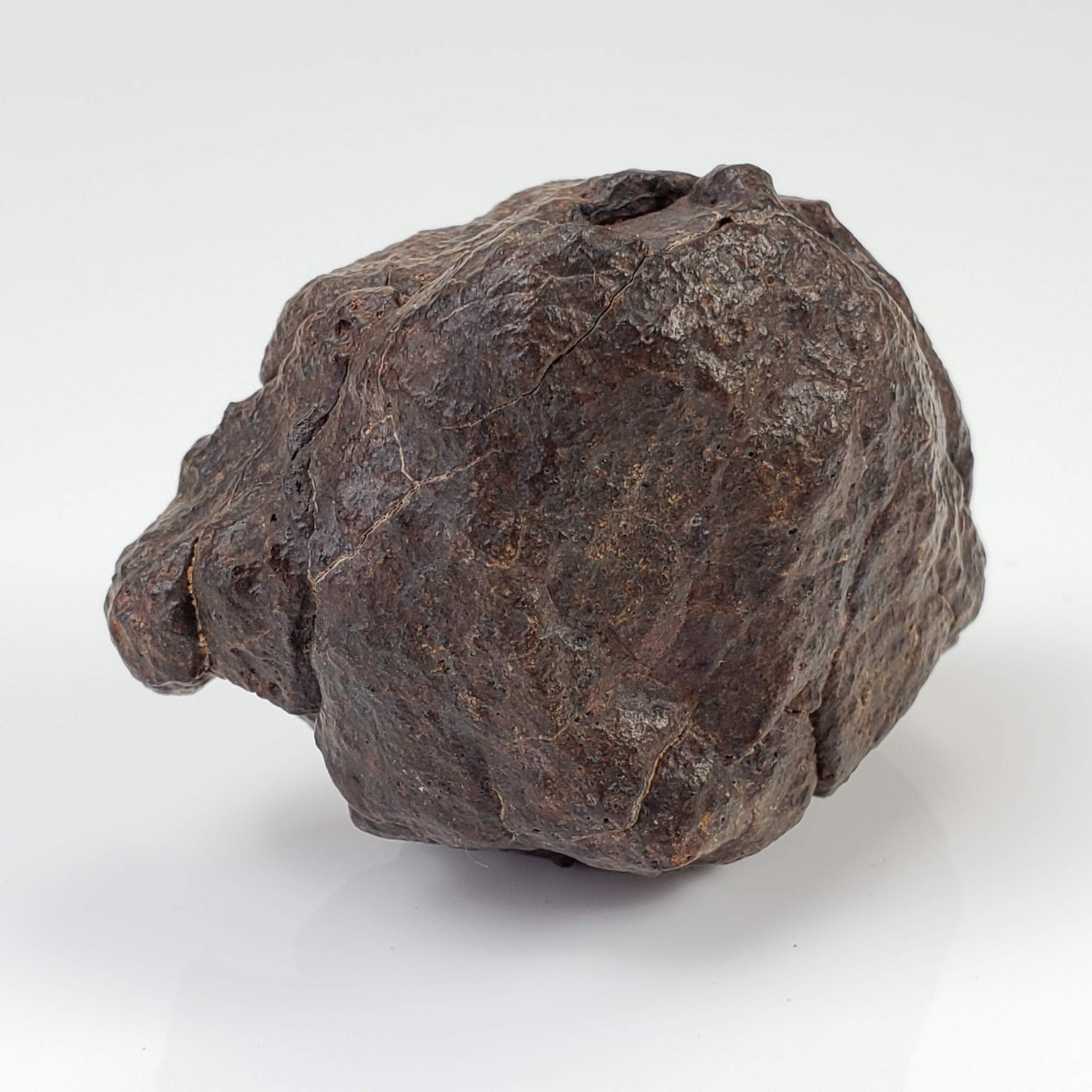
This is a nice looking individual fragment of a Sahara Desert NWA unclassified meteorite. It weighs 81.1 grams and measures 51x37x25 mm. This never classified Northwest Africa stone was found in the Sahara desert around 2000.
It's a good quality NWA meteorite individual fragment. Some weathering shows the meteorite's time spent aging in the desert. Would be a beautiful addition to any new or existing collection. Comes with a Canagem Collection specimen card.


These are perfect rosettes of metallic, lustrous molybdenite, almost completely exposed in a glassy quartz matrix crystals from Moly Hill, Abitibi-Temiscamingue, Québec, Canada. The largest of the crystals is 12x10 mm (0.5x0.4 inches). Molybdenite is commonly found as foliated masses meaning the mineral forms folia or layers, like the mineral mica. It is metallic gray, has a greasy feel, and is very soft at only 1 on Mohs' hardness scale. Its softness, metallic luster and gray color led scientists to mistakenly believe it was a lead mineral. This specimen shows the typical hexagonal layered structure of the crystal.
Some believe molybdenite is linked to intuition, transformation, and problem-solving, helping with mental clarity and adaptability. It is sometimes associated with the third eye chakra, thought to enhance insight and creative thinking.
Name: Molybdenite Crystals
Specimen Size: Miniature-Sized
Dimensions: 41x32x17 mm / 1.6x1.3x0.7 inches
Weight: 21.4 Grams / 0.7 ounces
Origin: Mined in Moly Hill, La Motte, Abitibi-Temiscamingue, Québec, Canada


Creedite is a rare mineral that is best known for its radiating crystal clusters, which can appear in transparent to translucent orange, purple, white, or colorless hues. It was first discovered in Creede, Colorado, USA, which is how it got its name. Today, some of the best specimens come from Mexico (notably in Chihuahua), Kazakhstan, and Bolivia. In Mexico, creedite is often found as vibrant orange clusters, making it a favorite among collectors.
Creedite is thought to support spiritual growth, intuition, and clarity. Some believe it stimulates the third eye and crown chakras, aiding meditation and insight. Its bright, radiating form is often seen as a symbol of light and transformation.
This is a very unusual, sculptural cluster of Creedite. It is secured to a base in order to display and protect the crystal, and is mesmerizing in person. Would be a great addition to any new or existing collection.
Name: Creedite Crystals
Specimen Size: Miniature-Sized
Dimensions: 44x31x34 mm / 1.7x1.2x1.3 inches
Weight: 39.8 Grams / 1.4 Ounces (including base)
Origin: Mined in Mina Navidad, Abasolo, Durango, Mexico
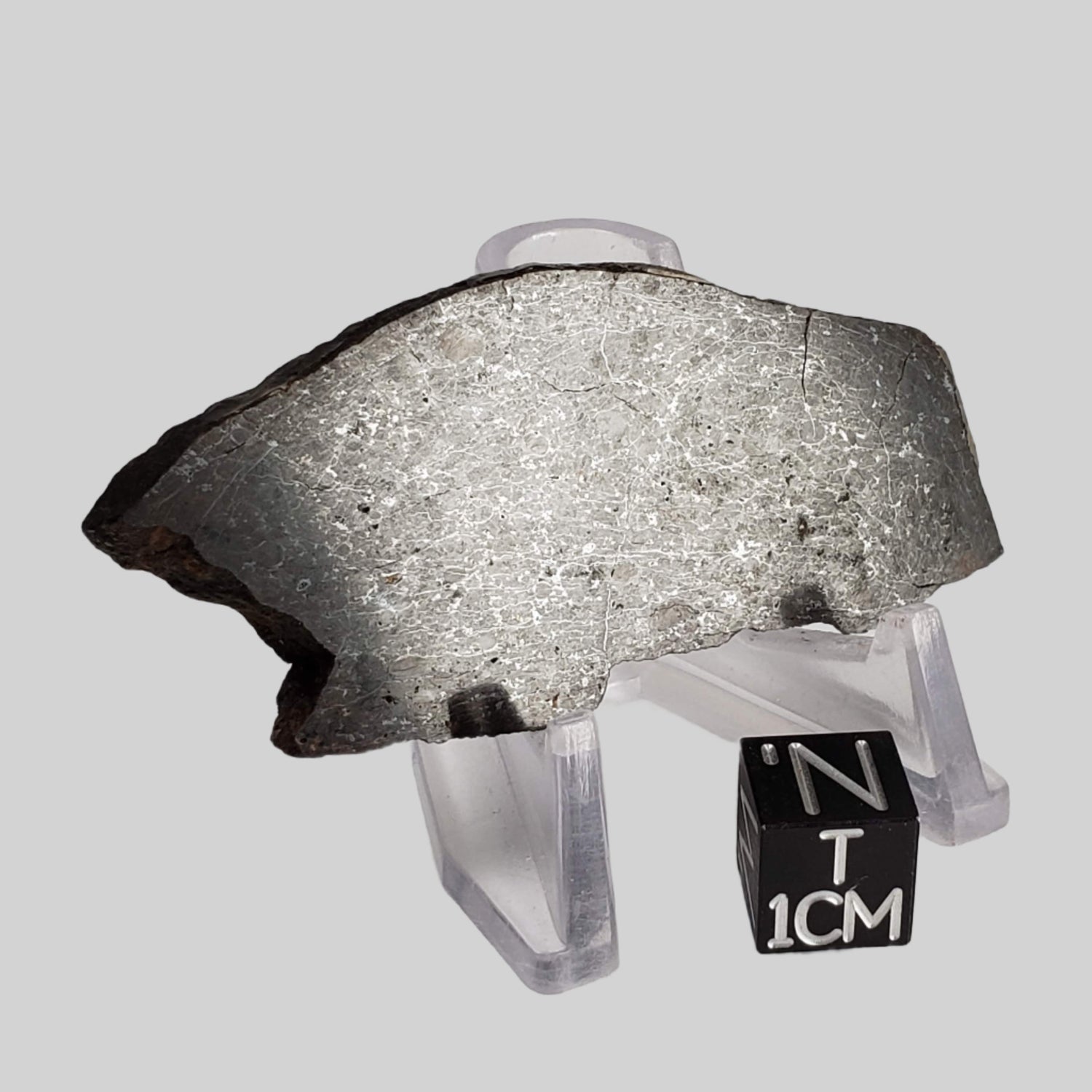
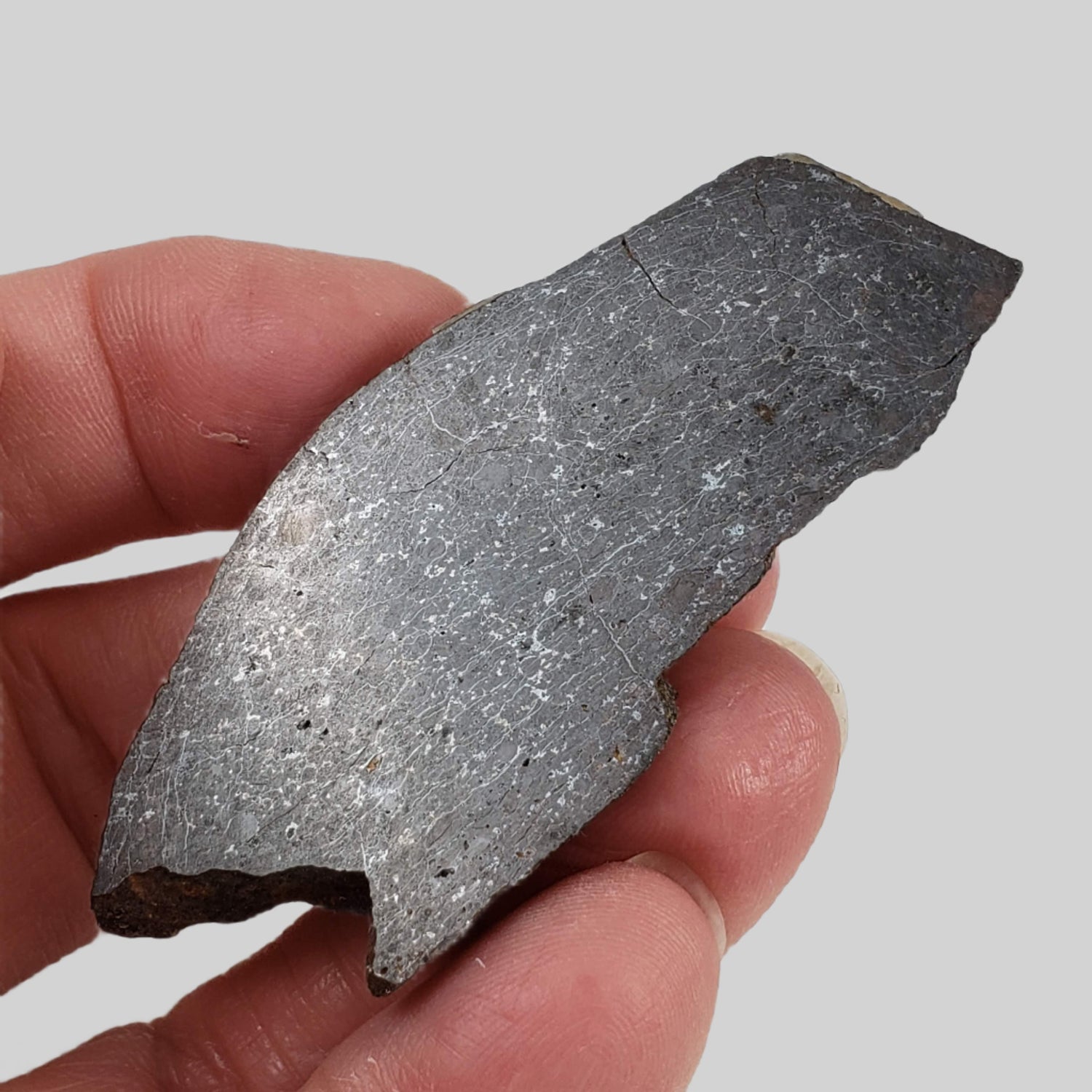
This is a great looking Dhofar 273 classified meteorite weighing 20.4 grams. Its dimensions are 62x28x5 mm. This L5 classified meteorite was found in Zufar, Oman in 2001. The total weight of the single piece recovered is recorded as 2.085 kg and the meteorite has a shock stage of 4 and weathering grade of 3. This piece displays extremely well because of its beautiful shape and is a great size.
Would be a beautiful addition to any new or existing collection. Comes with a Canagem Collection specimen card.


This mineral combination is from a classic locality, the Newfoundland Zinc Mine, which has been closed for many years. This mine was a high grade zinc mine with very little contaminants in the ore which made it easier to mill and produced good concentrate. This site is known for beautiful mineral specimens, particularly sphalerite crystals often associated dolomite.
The sphalerite from this region typically appears as dark brown to black, resinous crystals, sometimes with red or orange undertones due to iron content. These crystals often serve as a striking backdrop for the light-colored dolomite, which forms as rhombohedral or curved aggregates on top. The contrasting colors and textures make specimens from Daniel’s Harbor highly collectible.
Very nice showy material in excellent condition and a collectors dream specimen.
Name: Dolomite on Sphalerite Crystals
Specimen Size: Miniature-Sized
Dimensions: 41x27x19 mm / 1.6x1.1x0.7 inches
Weight: 25 Grams / 0.8 Ounces
Origin: Newfoundland Zinc Mine, Daniel's Harbor, NL, Canada


This is a must have 52 gram Impact Breccia also referred to as Suevite coming from the famous Rochechouart impact structure in South Western France, near the village of Chassenon. Although not a meteorite, impactites are directly linked to them and their impacts and are probably going to be one of the rarest collection items you'll ever own. Impactite is a slag-like glassy object found on the surface of the earth, formed from rock melted by the impact of a meteorite.
Named after the town of Rochechouart, the Rochechouart impact structure is located on the western margin of the French Massif Central near the city of Limoges, approximately 350 km (220 mi) south of Paris. Rochechouart (population about 3800) is built with rocks created or modified by the impact (impactites). Chassenon, a third of the size of Rochechouart, is also built of impactites. Impactite was used 2000 years ago for building Chassenon's monumental Roman baths of Cassinomagus.
The very fine materials (impactoclastites) are preserved forming a very fine layered horizontal deposits on top of the melt rich suevite (breccia with a debris matrix and both rock debris and melt fragments as clasts) near Chassenon.
The term impactite encompasses shock-metamorphosed target rocks, melts or suevites and mixtures of the two, as well as sedimentary rocks with significant impact-derived components and shocked mineral grains, tektites, anomalous geochemical signatures, etc. This impactite was formed 186 million years ago. This deformed rock fragments and partly molten are imbedded in a melt matrix showing typical flow structures from former melt.
This gorgeous slice displays very well with a mass of 76x46x16 mm. Would be a beautiful addition to any new or existing collection. Comes with a Canagem Collection specimen card.


This is a superb individual Tsarev meteorite weighing 142.2 grams. Its dimensions are 71x44x29 mm. Twenty-eight specimens of this L5 classified meteorite were found in fields. The largest mass weighs 284 kg, the smallest 761 gr with a total weight of 1.23 Tons. The greatest distance between the find sites was 6.0 km.
In 1968, amidst a global surge in conflicts, a remarkable discovery was made in a small village in Volgograd Oblast. This region, known as the primary site of the Battle of Stalingrad—one of the largest and bloodiest battles in history—yielded an extraordinary find in the quiet fields near the rural village of Tsarev.
The Tsarev meteorite, named after the Russian word for czar, is a stone meteorite responsible for one of the largest meteorite showers in Russian history. This meteorite shower occurred on December 6, 1922, but the stones were not discovered until 1968 and only recognized in 1979. The Tsarev meteorite's mineral composition matches that of ordinary chondrites, including olivine, orthopyroxene, clinopyroxene, maskelynite, calcium phosphates, nickel-iron, troilite, chromite, ilmenite, and rutile.
Academic analysis of the Tsarev meteorite reveals significant features: large grains of nickel-iron, light grey areas with well-preserved chondritic texture, and dark areas containing a matrix with olivine grains and remnants of chondrules.
This specimen would be a beautiful addition to any new or existing collection. Will come with a Canagem specimen card.


This is a nice Stilbite specimen from Oregon, USA. There are two vugs contain pearly white stilbite crystals that are in excellent condition. The largest vug measures 32x32 mm, with the largest crystal measuring 12 mm.
Stilbite is a zeolite mineral appreciated for its delicate crystal formations and pastel hues, ranging from colorless to white, yellow, pink, and peach. It forms distinctive tabular crystals with a bowtie or butterfly shape and exhibits a vitreous to pearly luster. Commonly found in cavities in volcanic rocks, stilbite is often associated with other zeolite minerals. It is valued for its aesthetic appeal and is believed by some to have calming energy, supporting spiritual growth and emotional healing.
Name: Stilbite Crystals in Matrix
Specimen Size: Cabinet-Sized
Dimensions: 81x78x55 mm / 3.2x3.1x2.2 inches
Weight: 280 gr / 9.9 oz
Details: Mined in Oregon, USA

Canagem is proud to be professional member of The International Gem Society(IGS) the world's top resource for gem professionals, enthusiasts, and industry content.