



194 products
Sort by:
194 products


This is a beautiful specimen of Pyrite from the Island of Elba in Italy. While pyrite is common around the world, this Italian specimens displays the typical pyritohedral form of the species.
Pyrite from Elba Island, Italy, is highly prized by collectors for its sharp, cubic, or pyritohedral crystals with a brilliant metallic luster. The most famous specimens come from the historical iron mines, particularly the Valle Giove mine and mines at Rio Marina. These pieces are often found in clusters, sometimes on a contrasting black hematite matrix, and are valued for their aesthetic quality and natural geometric perfection.
Pyrite is known as a stone of protection, abundance, and confidence. It is believed to shield against negative energy and promote mental clarity and willpower.
This great specimen is in very good condition. Would be a beautiful addition to any new or existing collection.
Name: Pyrite Cluster
Specimen Size: Miniature-Sized
Dimensions: 53x43x22 mm / 2.1x1.7x0.9 inches
Weight: 93 Grams / 3.3 oz
Origin: Island of Elba, Italy


This is a nice 6.48 gram specimen of the Seymchan Iron meteorite, the fragment measures 22x15x13 mm. The meteorite was found in 1967 in a brook-bed flowing into the river of Hekandue, a left tributary of the river of Jasachnaja of the Magadan district, USSR. It is classified as an Iron Pallasite main group and is 1 of only 48 approved meteorites classified as such, with a recovered weight of about 323 Kg.
This piece is very stable and will remain like this for years to come with minimal care. This piece displays extremely well and is a desirable size showing great features. Would be a beautiful addition to any new or existing collection. Comes with a Canagem Collection specimen card.


This is a rare Iron ungrouped classified Taza Northwest Africa 859 specimen, in an as found state. It weighs 0.97 grams and measures 12x6x6 mm.
The NWA 859 was found in 2001 in Taza, Morocco. A total weight of 75.3 kg of mostly small pieces was classified by UCLA as an Iron, ungrouped; it is one of 157 meteorites classified as such.
This specimen displays extremely well and would be a beautiful addition to any new or existing collection. Comes in a gem jar with a Canagem Collection specimen card.


This is a great looking fresh individual Gao-Guenie H5 classified meteorite. It weighs 3.65 grams and measures 17x15x10 mm. Picked up right after the fall, It has a nice black crust on over 90% of its surface.
This H5 classified meteorite was observed falling at about 17:00 March 5, 1960 near the village of Gao in Africa. There is no total known weight recorded for this meteorite.
Would be a beautiful addition to any new or existing collection. Comes with a Meteorpassion and a Canagem® Collection specimen card.


The NWA 267 meteorite fragment offered here is in as found condition. It weighs 2 grams, with dimensions of 18x11x6mm. The meteorite will come with two specimen description cards including a signed "The Mark Bostick Collection" card.
This meteorite was once a pile of weathered unclassified meteorite fragments brought to the 2000 Denver show by a Moroccan fossil dealer. These fragments, 73.9 kg. worth, where purchased by Canadian meteorite dealer Dean Bessey, who was told the following on the meteorites: "A nomad found an area with a lot of unusual strange stones near the Morocco/Algeria border. He brought one to a fossil dealer and asked: "I hear that you will pay money for stones like this". After shaking his head in disbelief at a positive response, the nomad gathered up all his camels, wives and children and brought them into the desert to search over his personal strewn field." Or at least that is how the story goes.
Many thousands of stones, 73.9 kilograms, were recovered, most of these fragments under 20 grams. Then 356 grams and a thin section of the meteorite was donated to the Vernadaky Institute of Geochemistry and Analytical Chemistry, part of the Russian Academy of Sciences, Moscow, where it was classified by M. Ivanova. This meteorite, an ordinary stone chondrite, H4 class has a Shock Rating of 2 and a Weathering Grade of 2-3 and the classification information was published in Meteoritical Bulletin 85.
While the stone did not get a heavy weathering grade, very few specimens show any crust. This meteorite is believed to have come from the Hebe class asteroids. I've included an informational photo of a NWA 267 Meteorite thin section which are used in earth geology, and in meteorites to identify the minerals in them. The photo shows a large imperfect elongated chondrule. Chondrules are unique features to meteorites. The chondrule shown is composed of mostly pyroxene and the bright colored minerals scattered throughout the thin section is mostly olivine.
One of the fun facts is that the NWA 267 was also the first meteorite ever minted onto a real legal tender coin. The National Bank of Liberia made 999 of these $10.00 Silver coins in 2004. The meteorite used in the coin, was supplied by Mark Bostick himself and his name and signature came on the certificate with the coin. The provided images of the coin shows a nomad on a camel on the obverse. A meteorite is falling through the star filled sky in the background. Reverse of coin has a seal of the Liberia Government and notes its value. We include 2 specimen cards but unfortunately the thin section and coin used in the ad are NOT included!


This is a fantastic crusted 3.81 grams NWA (Northwest Africa) 869L3-6 classified meteorite Individual found by Nomads in the Sahara Desert. The dimensions of the specimen are 19x11x14 mm.
NWA 869 classified meteorites can still be interesting and this one is for sure perfectly shaped to catch your attention. It displays a superb crust on most of its surface. Most samples are individual meteorites but some fragments (mostly >1 kg) also occur. In most cases the fusion crust has been polished or ablated by wind erosion. Many samples are more severely affected and show faces with deep wind erosion features. Fracture faces, formed by ground collision, show a typical gray-green color and sometimes visible brecciation (light and/or dark clasts).
Would be a beautiful addition to any new or existing collection. Comes with a Canagem Collection specimen card.


Pseudomorphs are mineral specimens that have the external shape of one mineral but are composed of another. The pseudomorph goethite after marcasite forms when marcasite is exposed to oxidizing conditions and starts to oxidize and break down. As the marcasite breaks down, goethite replaces it in the crystal structure, preserving the shape of the original marcasite crystal. The resulting specimen appears as a marcasite crystal, but is actually composed of goethite.
The Farafra Oasis, in the White Desert, has been known for a number of years to deliver incredible pseudomorph specimens. The pseudomorphs occur within the Cretaceous Khoman Chalk, from which the White Desert derives its name.
This specimen is remarkable for its relatively sharp marcasite crystal form. It is in excellent condition.
Name: Goethite After Marcasite Pseudomorph
Specimen Size: Miniature-Sized Specimen
Dimensions: 41x34x36 mm / 1.6x1.3x1.4 inches
Weight: 76.2 grams / 2.7 ounces
Origin: White Desert, Farafra Oasis, Egypt

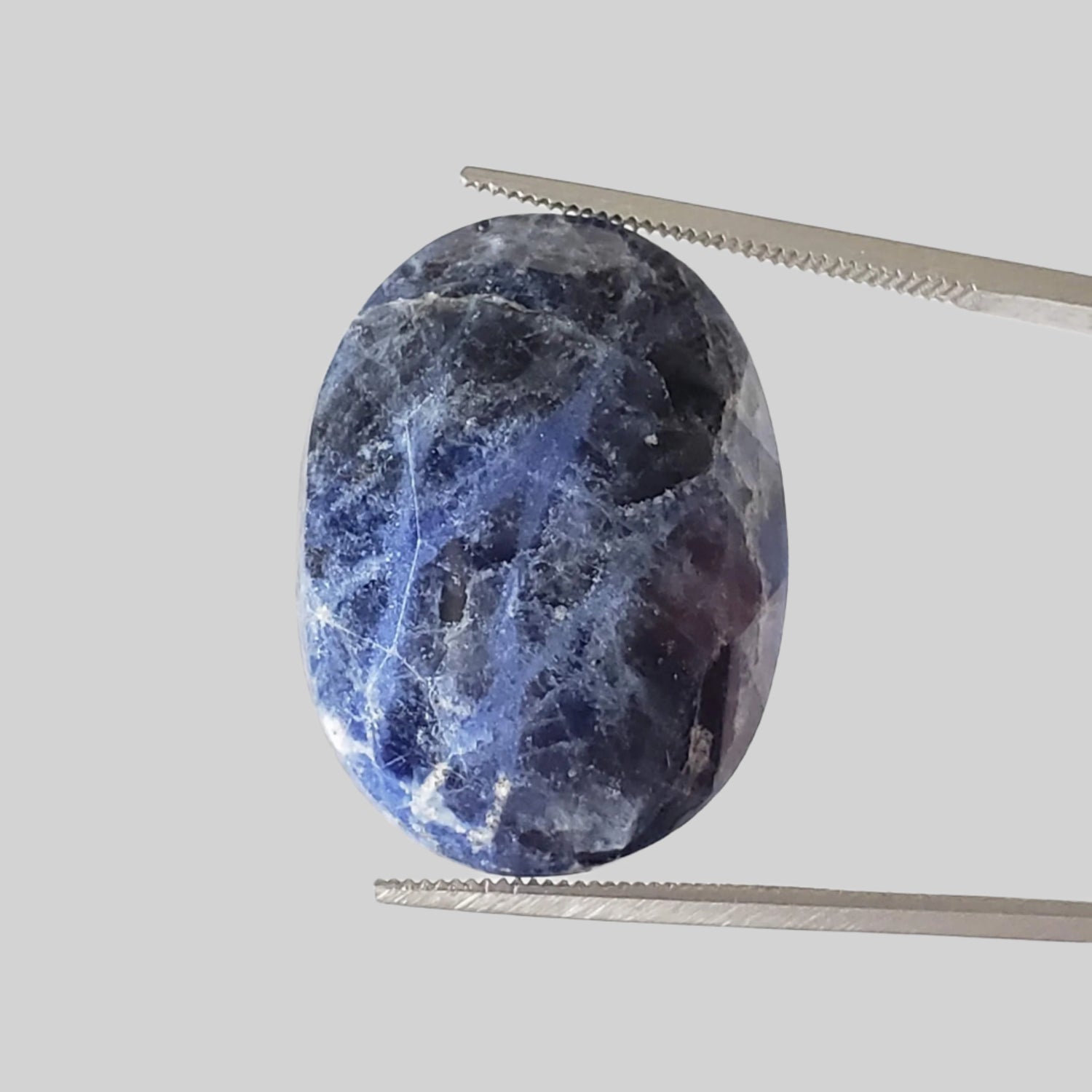
Product Type: Sodalite
Approx Weight (per piece): 16.2ct
Size: 23.3x17.3mm
Shape: Oval Facet Cabochon
Color: Navy Blue with White Patterns
Clarity: Opaque
Origin: Canada


Product Type: Labradorite
Approx Weight (per piece): 4.6ct
Size: 11mm
Shape: Round Cut - Faceted on both sides
Color: Gray with Rainbow Luster
Clarity: Transparent
Origin: Africa
Labradorite is an unusual mineral. It can display a beautiful iridescent play of colors, caused by internal fractures in the mineral that reflect light back and forth, dispersing it into different colors. This effect, known as labradorescence, gives Labradorite its appeal and fame.


Product Type: Natural Quartz Cats Eye
Approx Weight (per piece): 0.8ct
Size: 6mm
Shape: Round Cabochon
Color: Orange
Clarity: Opaque
Origin: Brazil
Treatment: Untreated
Quartz Cats Eye is a type of gemstone that exhibits an optical phenomenon called chatoyancy, which creates a luminous band resembling a cat's eye. It is caused by fibrous inclusions within the quartz that reflect light in a concentrated manner. The gemstone comes in various colors, with golden yellow to brown being the most common.

Canagem is proud to be professional member of The International Gem Society(IGS) the world's top resource for gem professionals, enthusiasts, and industry content.